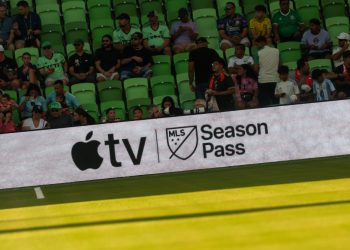
With the MLS regular season on pause for the Leagues Cup, it may be the perfect time to review Apple TV’s coverage of the league at the midway point of season one.
The content
One of the biggest selling points of the Apple contract was that MLS would finally have a legitimate partner with a vested interest in putting the league on the main stage. Halfway through year one, that promise has definitely been kept. There have been podcasts, previews, pre-game shows, post-game shows, highlight shows and more. In our initial review, one of the areas highlighted for improvement was the NFL Redzone-esque MLS 360 whiparound show. Since that review, MLS and Apple have smoothed out some of the rougher edges, such as de-emphasizing the hosts’ roles in the show while also offering the product to non-subscribers — even putting the production on YouTube to watch for free at one point. In addition, having all these products in one place makes it incredibly easy for the fan to stay engaged and move from show to show.
Nowhere has this been better felt since the Lionel Messi signing. There was wall-to-wall coverage, including his arrival ceremony and first training session. Every single Messi game will feature 18 cameras including a Skycam, drone, Steadicam and four slow-motion cameras. Apple promised to make MLS a priority and it followed through on the league’s biggest ever signing.
While the content is great, it does seem to be more of a national, league-led feel, with the more local, nuanced coverage of individual teams a little harder to find — both within the app and in terms of amount of coverage. Apple has let each individual team run their own “channel” within the app and you can definitely tell which teams have taken that seriously and let a good creative team run with it and which teams have left the cupboard a little bare. Especially when there is no RSN coverage, the local fan may be left disappointed with what their club has had to offer in its place.
The broadcasts
While there were some technical hiccups early on, overall the broadcasts have been solid. As mentioned in the initial review, the picture quality is fantastic and makes a real difference in the perception of the league. Especially since Apple and MLS do not geo-fence their highlights (another major advantage of this deal) there are MLS highlights from official league accounts in 1080p all over social media, such as Messi’s first goal for Inter Miami — a stoppage time free kick golazo that has been viewed over 50 million times. There are still some technical glitches in-game and post-game they must fix — the “I get one question” hot mic moment from field reporter Katie Witham stands out in particular from Messi’s debut — but those moments aside, its a broadcast that feels major league, a first for MLS.
Another major talking point to the deal was the consistency with kickoff times, wherein nearly all games start at 7:30 PM local time. This has been great in getting MLS matches a set time on the calendar but has also had an unintended consequence: if there are multiple marquee matchups, or if someone were to attend a game live, it can be tough for the MLS fan to keep up with happenings outside of the team they support.
MLS commissioner Don Garber has already mentioned that the league is looking into alternative kickoff times for Messi’s games to broaden its global audience, but it might also be prudent to look at a more NFL-style, two or three time block setup. Instead of 7:30 PM local time kickoffs across the board, maybe there are 6, 8 and 10 PM ET matches — enough games for MLS 360 to still have value, but also spread out so that fans can see more of the rest of their league. NBC and the Premier League have a similar setup that gives fans a large amount of choices, with a Saturday morning and a Saturday noon showcase game, then several games at 10 AM in between, before the last few showcase games on Sunday.
The talent
Overall, the hires MLS has made for both in-booth commentary and studio shows have been fine. Nothing stands out as egregious, perhaps other than the infamous Mickey Mouse call. Crucially, nothing really stands out at all. Liam McHugh, Bradley Wright-Phillips, Sacha Kljestan, and Kaylyn Kyle have been good additions to the studio but Apple has yet to strike the gold CBS Sports did with its cast of Kate Abdo, Thierry Henry, Jamie Carragher, and Micah Richards.
For the in-booth talent, Apple has yet to produce a true “A tier” commentating talent like NBC has with Peter Drury and Jon Champion. Overall, it makes each game feel the same with no layer of context. Consider the NBA. If Mike Breen or Kevin Harlan is on the call, you know it’s the game of the week. For the biggest game of the week in MLS, who is on the call? Currently it’s probably Taylor Twellman and Jake Zivin — the team on tap for Messi’s first and second game — but will they develop into a true A team pairing? Maybe with LIV Golf’s future uncertain Arlo White could make a comeback? Lastly, it is a bit odd that we never get to see the commentators during the game. It is a common feature of many pregame and halftime moments across several sports where you get to see the commentators in the actual booth. Not having that as part of the broadcast really misses out on grounding the viewer into the moment.
Overall thoughts
So what to make of it all? Given Apple’s inexperience in live sports production realm, and all the technical worries headed into the season, year one has been impressively solid. It has lived up to the content promises and is making improvements little by little each week, as evidenced by the MLS 360 changes. As for all the worries about the amount of subscriptions? According to Jayda Evans of the Seattle Times, MLS is closing in on Apple’s required subscription threshold that allows for the league to start receiving a share of that subscription revenue. Per John Ourand and Alex Silverman of the Sports Business Journal, the total number of subscribers is already approaching 1 million, up from a starting base of 700,000.
MLS is a guinea pig of sorts as well — the German Bundesliga recently held preliminary talks about a possible partnership once their rights expire in early 2026 and its no secret other leagues are watching closely to see what they can learn from this first-of-its-kind deal. Year one hasn’t been perfect, but it’s clear that this path is doing far more to advance MLS’s interests, and by extension has made MLS more interesting, than anything they had prior.