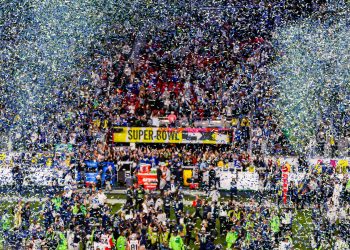
What does it take to outdraw the Super Bowl? Nancy and Tonya, Sam and Diane, Hawkeye and J.R. Ewing.
On an annual basis, there is the Super Bowl and then there is everything else in television. Nothing, not even other NFL games, comes close. (Perhaps a news event here or there might gross a larger audience, but not on a single network.) Yet one does not have to go back too long (relatively) to find the last time the Super Bowl was not the highest rated program of the year.
To find the last program to average a higher rating than the Super Bowl in the same year, one need go back 30 years to Lillehammer, Norway. When American figure skater Nancy Kerrigan was attacked weeks before the Olympics by goons later linked to her U.S. rival Tonya Harding, figure skating acquired a cultural cachet like few sports have experienced before or since. Figure skating was already considerably more popular in the mid-1990s than it is today, and the Nancy-Tonya scandal was perfect tabloid fodder in an era when those publications were perhaps especially shameless.
On the first night of the women’s figure skating competition, tape-delayed primetime coverage on CBS averaged a whopping 48.5 rating, higher than any program since, including every subsequent Super Bowl (the highest rated of which was Patriots-Seahawks in 2015 at a 47.5). It was also higher than the Cowboys-Bills Super Bowl on NBC less than a month earlier (45.5), marking the most recent time that any program has beaten the Super Bowl in the same year. The viewership figure that night — 78.7 million, one of the largest non-NFL television audiences ever – was about 11 million fewer than Cowboys-Bills (90.0M), a disparity that can likely be explained by the greater levels of guest viewing from the traditional Super Bowl parties.
1994 was the second-straight year that the Super Bowl was not the highest rated show on television. Less than a year before Nancy and Tonya, it was Sam and Diane that topped the charts. The series finale of NBC’s Cheers — featuring the return of Shelley Long’s Diane Chambers for the first time in six years — averaged a 45.4 rating in May 1993, slightly higher than the Super Bowl (another Cowboys-Bills matchup on NBC) earlier in the year (45.1). As with 1994, the Super Bowl still finished with a larger audience, its 91.0 million viewers comfortably topping the Cheers audience of 80.4 million.
To find a program that actually averaged more viewers than the Super Bowl, one would have to go back another decade to the series finale of M*A*S*H. With an audience of 106 million viewers, “Goodbye, Farewell and Amen” was the most-watched program in U.S. television history for 27 years, from its first airing in February 1983 through the Saints’ defeat of the Colts in the 2010 Super Bowl. The episode averaged nearly 25 million more viewers than Washington’s defeat of Miami in the Super Bowl less than a month earlier (81.77M). The ratings disparity was also wide, as M*A*S*H averaged a 60.3 and the Super Bowl a 48.6 (still the second-highest in the history of the game).
Three years earlier, the resolution of the “Who Shot J.R.?” Dallas cliffhanger averaged 83.6 million on CBS — comfortably topping the Steelers-Rams Super Bowl on the same network (76.3M). In the ratings, Dallas clocked in at a 53.3 and the Super Bowl at a 46.3. Three years prior to that, the Super Bowl was not even the top program of the month as its 44.4 rating placed just fifth for January 1977 behind four episodes of ABC’s “Roots” miniseries — the most-watched of which was said to have averaged anywhere from 80-100 million viewers, compared to 62.1 million for the Raiders’ win over the Vikings.
An honorable mention should go to the series finale of Seinfeld, which averaged a hefty 41.3 rating on NBC in May 1998 — higher than the subsequent Super Bowl in January 1999 (Broncos-Falcons: 40.2), but no match for the same-year edition months earlier (Broncos-Packers: 44.5). (Its audience of 76.3 million was lower than both games.)
There are more examples, but the further back one goes, ratings in the 30s and 40s were much more common. A 1976 airing of “Gone with the Wind” averaged a 47.5 across two nights on NBC, surpassing not just the Super Bowl months earlier (42.3), but every primetime program to that point. Even an airing of the 1970 film “Airport” managed a 42.3 on ABC in 1973, nearly matching the Super Bowl at a 42.7. While the Super Bowl has been an outsized ratings draw from the beginning, it was not uncommon in its first decade for relatively unremarkable programming to average comparable ratings.
It should be noted that the programs mentioned in this article are in their own way iconic. The series finales of three of the best-loved sitcoms of all-time in M*A*S*H, Cheers and Seinfeld, a once in a lifetime figure skating scandal, a historical epic in “Roots” and a pop cultural sensation in “Who Shot J.R?”
The conditions no longer exist for anything like these programs to ever air again. There are no scripted series that resonate with the great mass of people. There is always the potential for lurid scandal, but it is hard to envision any modern-day story that would pull 80 million viewers to a television set at the same time. Beyond that, the bar is higher now than it was then; 80 million would be an incredible number and still come 30-40 million shy of a Super Bowl. What was once a rare, but not unprecedented event is now something that in all likelihood will never happen again.