Sports Media Watch presents thoughts on recent events in the industry, leading with a noticeable difference between NHL and NBA studio coverage.
NBA commissioner Adam Silver said recently that he is sometimes jealous of the coverage other leagues receive from their broadcast partners. One wonders if he was watching TNT’s NHL pregame on Sunday.
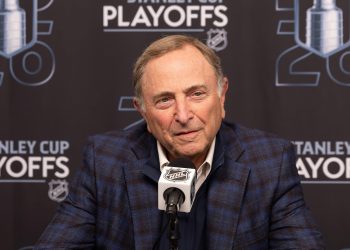
With Alex Ovechkin on the brink of setting the all-time record for goals scored, the then-current record holder Wayne Gretzky appeared on TNT’s NHL studio show — where he is occasionally the network’s highest-profile analyst — to discuss the looming achievement. Gretzky has become a deeply controversial, perhaps even reviled, figure in Canada, so it may be the case that his words carry less weight than would have been the case three months ago. Nevertheless, “The Great One” displayed in about 30 seconds on TNT the sharp difference between the network’s two flagship studio shows, and between the cultures of hockey and basketball more broadly.
In a pregame hit on TNT, Gretzky lavished praise upon Ovechkin, Sidney Crosby, and the new generation of stars coming in behind them. “I can’t say enough good things about our game. … We’re lucky. Our game, we don’t have any animosity towards each other in each era. We’re thankful and we’re happy.”
Gretzky, for whatever faults he may have beyond the realm of hockey or sports, has appeared to avoid the insecurities that are seemingly common among the NBA’s past greats. Perhaps that is because his status as the greatest ever has rarely ever been truly challenged.
Had he been an NBA player, Gretzky’s career journey might provide opportunities for ‘debate.’ Four championships yes, but none after he was traded from an Oilers squad that went on to win an additional ring in his absence. An itinerant final stage of his career that brought him from Los Angeles to St. Louis to New York, with just one finals appearance to show for it. Had there ever been a “GOAT” debate in hockey — had the likes of ‘Stephen A.’ and ‘Skip’ ever paid any attention — these would be surely mentioned as demerits. Instead, Gretzky had his jersey retired leaguewide upon retirement and has the comfort of knowing that nobody seriously questions whether he is the greatest who ever played, which probably makes it easier to be magnanimous.
Contrast that to Jordan, who despite a more immaculate record of achievement, has had his status as the ‘greatest ever’ challenged regularly since his 2003 retirement, which happened to precede by months the debut of one LeBron James. Given the competitive fire that sustains him even past age 60, why would Jordan lavish praise upon James and undermine his once-bulletproof case as the greatest who ever played?
Jordan has been largely distant from the league since retirement, rarely speaking about the modern game or players. It is perhaps characteristic of his private nature that his apparently warm, close friendship with Kobe Bryant was not known publicly until the latter’s death. Jordan may well have an appreciation for the generations who have followed him, but one would never know it.
Consider the manner in which Jordan has remained tethered in the NBA, as compared to Gretzky. Jordan was an owner, at a fair remove. Gretzky was a coach, stuck in the muck and mire of the Arizona Coyotes, where the only headlines ever generated were by an assistant coach (and they were not good ones). Jordan’s television presence has been largely confined to hagiographic documentaries. Gretzky flies out to Atlanta every now and again to sit next to Paul Bissonnette late into the night in the TNT studio. If Jordan was the unreachable star, Gretzky has been fully integrated into the NHL culture in his post-playing career.
Yet Jordan is not the real issue for the NBA. It would certainly help if he would affirmatively put his rubber stamp on the players who have succeeded him, but as long as he is not out there trashing the product, the distance is a small problem to have. He is nonetheless symbolic of the arms-length treatment — and at times outright hostility disguised as tough love — showcased by some of his 1990s contemporaries.
Complaints by players and fans about TNT’s Charles Barkley and Shaquille O’Neal are well known, and maybe well worn, by this point. Even so, their open hostility toward the modern game seems only to grow by the week. In addition to trash talking Nikola Jokic on the TNT set last week (he would turn Jokic into “Slavian chicken” if they played head-to-head, or “wherever he’s from”), O’Neal on his podcast repeatedly referred to the modern game as a four-letter word. There is plenty of constituency for that kind of talk, but one does not usually see it from people paid handsomely to cover the league.
The gulf in the way the NHL and NBA are discussed on the TNT set simply could not have been more noticeable than over the past week. Perhaps it is the case that the generational appreciation is unique to hockey, moreso than generational animosity being unique to the NBA. On TNT Sunday, Anson Carter contrasted the response to Ovechkin breaking Gretzky’s record to Eric Dickerson’s less-enthusiastic response to Saquon Barkley breaking his rushing record last season. It may be that the culture of hockey is more prone to — as TNT’s Rick Bowness said Sunday — “mutual respect.”
The “Four Nations Face-Off” earlier this season was an occasion for many to tout all of the elements of hockey that are lacking in the NBA. (Think all of the usual buzzwords used to imply laziness and lack of dedication on the part of NBA players.) The biggest aspect of hockey culture that is most sorely missing in the NBA is that mutual respect. As the NBA Playoffs begins later this month, the league’s studio stewards are those who seem to have little if any for the game or those who play it.
What to expect of national championship viewership
Monday’s Florida-Houston NCAA men’s national championship is surely not the matchup CBS had in mind going into the weekend. The Cougars’ stunning comeback over Duke Saturday night prevented what would have been the Blue Devils’ first title game appearance in a decade and probably closes off any possibility of a blockbuster audience. Nevertheless, the Gators and Cougars are high-quality teams — #1 seeds — and the game figures to be closely contested. Viewership should comfortably outpace the past two years to rank as the highest for a national title game since 2022.
Viewership was already going to decline substantially for the NCAA women’s basketball title game — last year’s bar of nearly 19 million is unlikely to be reached by any domestic basketball game, men, women, college or pro, in the near future. Even so, UConn’s unexpected demolition of South Carolina means the audience could well be closer to the pre-Caitlin Clark norm than one might have anticipated.
ABC scheduling remains bizarre
Sunday’s UConn-South Carolina women’s national championship was off the air well in time for the 6 PM ET news, which might go without saying given the midday 3 PM ET start time. CBS, which has much more valuable programming at 7 PM on Sundays than does ABC — “60 Minutes” versus “America’s Funniest Home Videos” — scheduled a USL soccer match for a later 4 PM ET start, which ran long and bled into the 6 PM slot. The final of the FOX-created “College Basketball Crown” had a 5:30 PM ET start, finishing in primetime. If those two events combine for even a third of the women’s title game audience, it would be a surprise.
FOX and CBS were willing to inconvenience local affiliate newscasts — and potentially risk primetime preemptions — for events that may well end up in the six figures viewership wise. ABC was unwilling to do so for an event that likely attracted, at worst, in the neighborhood of five million.
A remote possibility
ESPN’s decision to keep its announcers remote for the NCAA women’s gymnastics regionals seems impossible to justify, given the stakes and the growing popularity of the sport. (That goes for any use of remote announcers for any domestic sporting event of consequence.) The competitions were not held in Tokyo, like the MLB season openers, but on the campuses of Penn State, Alabama, Utah and Washington.
It is especially odd given that for the majority of regular season meets, announcers are on-site. How can the biggest meets of the season merit lower-quality coverage than a random Friday night pairing of North Carolina and Arkansas? One could credibly argue that the production is otherwise high-quality, but the use of remote announcers immediately signals to viewers that a network is not fully invested — even if all other aspects of the production are top notch.
The last of the generalists
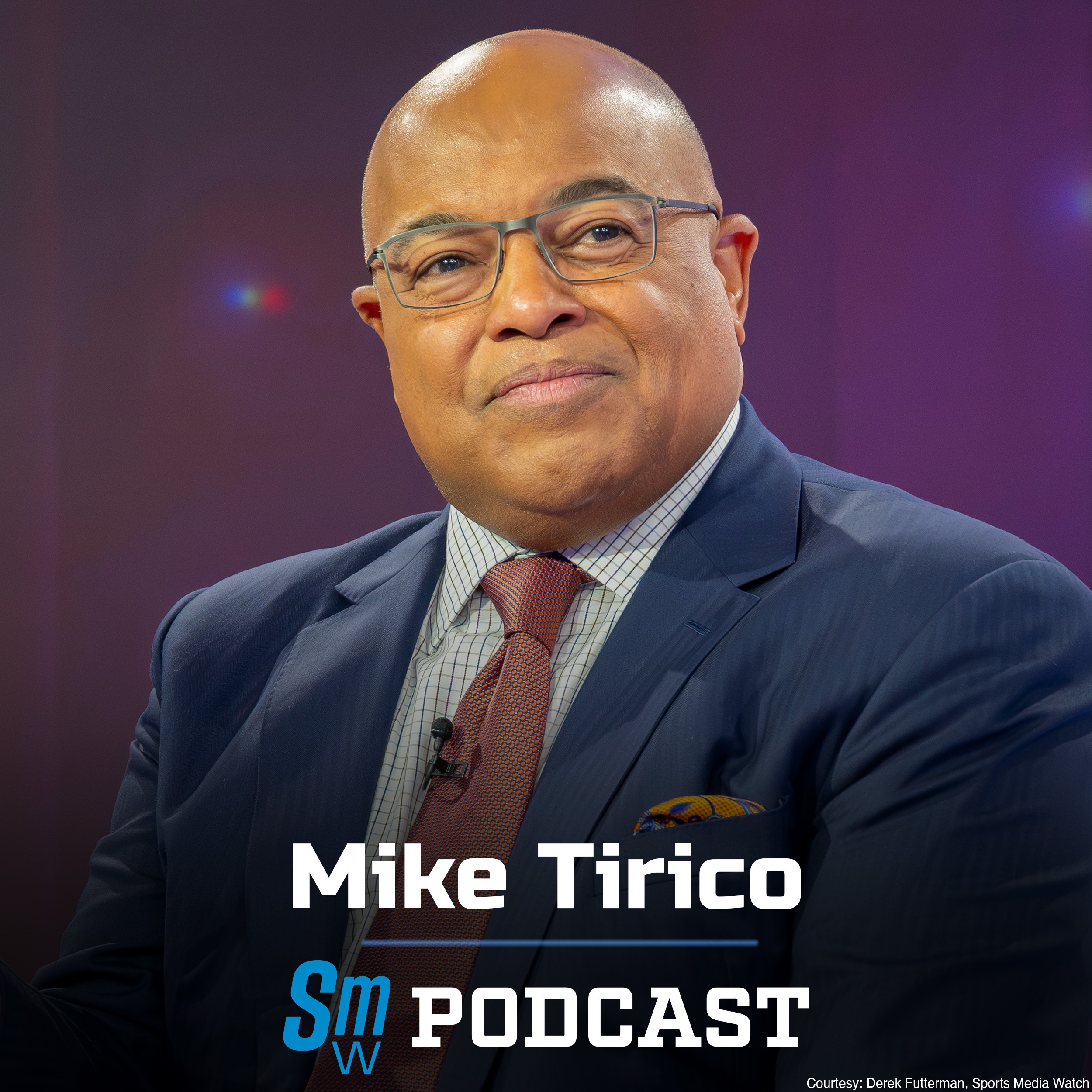
As NBC’s voice of the NFL — and soon NBA — Mike Tirico is one of the biggest names in the sports media industry. All the more reason why it is fairly impressive that he regularly works low-profile events that will not draw particularly large audiences, including this past weekend’s Augusta National Women’s Amateur and last month’s ISU World Figure Skating Championships. It used to be commonplace for a network’s top-tier announcer to lend his presence to just about anything that needed an imprimatur of quality, but that has long gone out the window. The top tier NFL voices have largely stopped working other major leagues, with Joe Buck cutting baseball and Jim Nantz dropping college basketball. (Kevin Burkhardt still does MLB studio work.)