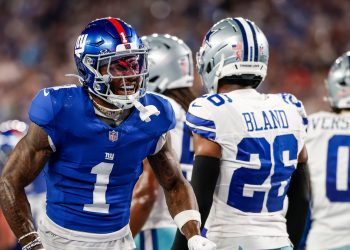
When NBC raises the curtain on next year’s NFL season, it will mark an important anniversary in network history. While September 10, 2026, will feature the league’s Thursday night kickoff game this season, it will also mark 20 years since the first ever “Sunday Night Football” game on NBC — the showdown of the Manning brothers between the Colts and Giants on September 10, 2006.
Since that night in 2006, Sunday nights have transformed from a night on which NBC could not quite find its footing to the single biggest sports night any major network has attempted in broadcast television history.
Starting this Sunday, February 1, NBC will have live sports scheduled for all-but-two of the next 51 Sunday nights — through at least January 17 of next year, which coincides with NFL Wild Card Weekend. (And the two exceptions, as will be discussed later, will almost certainly feature live sports as well.) While broadcast networks have turned Saturday nights over to live sports, and are increasingly scheduling events for weeknight primetime, no over-the-air network — much less one of the “Big Three” like NBC — has ever made such an investment into live sports programming on what is still the most-watched night of the week.
And it all started with that Manning brothers matchup in September 2006.
“‘Sunday Night Football’ was really a foundational key piece that proved out the ability to have big time sports on a Sunday night,” NBC Sports EVP/programming Justin Byczek told Sports Media Watch this week. “What we did with that property when it moved over here, the brand equity, the production that we’ve put into that, certainly set a very good foundation for what sports — and the vision of big sports — could be on Sunday nights, on NBC.”
The network of “Must See TV Thursday” had never been particularly competitive on Sunday nights, which throughout the 1990s featured “Dateline” episodes, feature films and TV movies. In fall 2004, the final television season before NBC acquired the rights to “Sunday Night Football,” the network’s line-up was highlighted by “Law & Order: Criminal Intent” and “Crossing Jordan” — successful series, but far from culturally relevant. NBC did move its acclaimed series “The West Wing” to Sunday nights the following year, but by that point the show was a ‘lame duck.’
Quite frankly, so was NBC Sports. The Dick Ebersol-run division was at that time at the lowest point of its existence, having lost rights to its AFC game package after the 1997 season, Major League Baseball after 2000, and the NBA after 2002. From June 15, 2002, onward, NBC had rights to exactly zero of the four major sports. It got hockey in 2004, but thanks to NHL owners’ 2004-05 lockout of players, it lost the first season of that partnership. While the Olympics was far more than a mere consolation prize, NBC Sports during that era was defined by little else; maybe Wimbledon, maybe Notre Dame football, maybe the XFL if one wanted to be insulting.
NBC had been emboldened to shed its money-losing sports properties because of its success in entertainment. Recall Don Ohlmeyer, then president of NBC’s West Coast division, publicly rooting for the 1997 World Series to end in a sweep so NBC could avoid preempting “Seinfeld” with a Thursday night Game 5. (“We’re looking for four and out. … The faster it’s over with, the better it is.“)
Keep in mind that sports ratings were trending down pretty much across the board in the early 2000s. Why rent highly-expensive and declining sports properties when one could own entertainment fare that attracts just as large an audience for a fraction of the price? That was the logic of the time, and it was sustained across the industry, usually to ruinous results for network sports divisions.
But by 2004, “Friends” and “Frasier” were ending, “The Office” had yet to begin (and was never as popular), and NBC could no longer take for granted that its entertainment programming could carry the day.
With NFL rights up for bid, Ebersol saw an opportunity to get back into primetime sports television. But it would not be with the “Monday Night Football” package that had been losing so much momentum that, as Ebersol has noted, ABC at one point approached NBC about taking the rights off of its hands. While “Sunday Night Football” had been a low-wattage afterthought on ESPN, Ebersol thought Sunday nights offered distinct advantages over Mondays, specifically the possibility of flexible scheduling (it took years before the NFL was willing to flex games from Sunday to Monday) and less disruption to NBC’s existing schedule, which at that point still included late night shows hosted by Jay Leno and Conan O’Brien on weeknights.
“Sunday Night Football” was, as Ebersol described it in his 2022 memoir, “absolutely a huge bet to make.” That may seem hard to believe from a present-day perspective, where the NFL is the most dominant programming in all of television and essential to the survival of the major networks. But 20 years ago, there was considerable skepticism within NBC about picking up primetime NFL, especially at a time when Disney was making no secret of its lukewarm feelings toward its own venerable package. It was ABC’s ambivalence toward “MNF” that opened the door for NBC to acquire “Sunday Night Football.”
“ABC Entertainment executives in Los Angeles looked at football’s sinking ratings and stewed,” Ebersol wrote, “feeling like they could do better with more scripted dramas or reality shows than a series that only lasted through December anyway.” (“ABC was losing $150 million or more a year on ‘Monday Night Football,’ and the clock had just run out on ABC’s interest in continuing to do that,” then-ESPN president George Bodenheimer said in the 2010 book “ESPN: Those Guys Have All the Fun.”)
Perhaps that explains why instead of just swapping Sunday and Monday Night Football between ABC and ESPN, Disney opted to cede one of its two primetime NFL packages altogether. ABC already had a Sunday night hit in “Desperate Housewives” — such a cultural phenomenon that the network had one of the characters show up in a controversial 2004 “Monday Night Football” cold open. In the short-term, picking that show over the NFL was a smart bet. “Desperate Housewives” beat NBC’s “Sunday Night Football” in the first two years they went head-to-head in 2006-07 and 2007-08. But eventually, the tide turned, “Desperate Housewives” ended, and the NFL would go on and on and on.
Indeed, over the 20 years since ABC gave up “Monday Night Football,” network entertainment executives are no longer able to look down their noses at live sports. There are no more “Desperate Housewives” to compete with the NFL. And viewing habits have changed such that whatever hits are remaining in television can be watched at any time. But live sports remains appointment programming, and in an era of ever-changing methodologies, viewership figures are at least nominally growing.
Sunday night fever
20 years later, not only is “Sunday Night Football” television’s top show, it has now expanded into a year-round Sunday night sports line-up on NBC. This Sunday marks the debut of a new, eight-week “Sunday Night Basketball” package of regular season NBA games, followed by NBA playoff games in the spring and “Sunday Night Baseball” in the summer.
The Sunday night games were a key component of NBC’s new 11-year NBA media rights deal, which to this point has consisted of weekly Tuesday night regional windows on NBC and Monday night exclusives on Peacock. “I think ‘Sunday Night Basketball’ will continue the legacy of big-time matchups, great storytelling and really premier production NBC has been known for, throughout this winter” and extending through the NBA playoffs, Byczek said.
Unlike the NFL and MLB, the NBA has never had a consistent Sunday night package. During NBC’s fondly-remembered prior run with the NBA from 1990-2002, the network carried a few 5:30 and 6:30 PM ET games that bled into Sunday primetime — one of the reasons why NBC had a difficult time establishing a consistent entertainment line-up on the night — but outside of the NBA Finals and the occasional conference final Game 7, none of those games ever aired fully in primetime.
Now, the league has the opportunity to establish a consistent presence on the most-watched night of the week. With no Finals games scheduled for Sunday nights this year — a scheduling adjustment around the FIFA World Cup — the most important Sunday night NBA games this season will belong to NBC.
The NBA had long been in NBC’s plans, but the idea of a year-round Sunday night sports lineup was more opportunistic. It just so happened that NBC was expanding its Sunday night line-up at the same time ESPN was opting out of its Major League Baseball contract, freeing up the cable network’s longtime “Sunday Night Baseball” package. Bob Costas, who starting Sunday will return to NBC as a contributor to both its NBA and MLB packages, said on the latest Sports Media Watch Podcast that when he first started talking with NBC about a potential return a couple of years ago, “they had a pretty good sense that they had a shot at the NBA. At that point, they probably thought baseball was a long shot.”
While NBC clearly has much more invested in its NBA deal, worth a reported $2.5 billion over 11 years — more than NBCUniversal pays for “Sunday Night Football” — the short-term MLB contract has the advantage of providing comparable inventory at bargain basement rates ($200 million/year, per reports). And “Sunday Night Baseball” has the distinct advantage of being a fully exclusive window with no other competing games scheduled. By comparison, there are seven other games scheduled opposite NBC’s “Sunday Night Basketball” debut.
“The baseball opportunity came up, and you look at those summer months of June, July and August, I think it was a pretty obvious sweet spot for us to continue what we feel will be a great sports strategy,” Byczek said. “To really lean into Sunday nights and big-time sports across these three major American tentpole properties of the NFL, the NBA and Major League Baseball.”
Between the NFL, NBA, MLB, 48 of the next 51 Sunday nights on NBC are fully accounted for. (Three of those will be shared with the Winter Olympics, which will lead out of the Super Bowl on February 8, the NBA All-Star Game on February 15 and a Celtics-Lakers NBA game on February 22.)
A 49th night belongs to the Wisconsin-Notre Dame college football game from Lambeau Field on the Sunday of Labor Day weekend, part of what Byczek said will become an annual occurrence. “That’ll be a component of our Notre Dame scheduling — working with [former NBC Sports president and current Notre Dame athletic director] Pete Bevacqua and the Notre Dame team moving forward — is that we’re going to look to do a big Notre Dame game on Labor Day Sunday night. We think it’s a nice way to jump out of Labor Day weekend and kind of get into the college football season with a big matchup, and Wisconsin-Notre Dame at Lambeau Field certainly does that for us this year.”
The exceptions are July 12, when there are no Sunday night Major League Baseball games due to the All-Star Break, and August 23 — the night of the MLB Little League Classic, which will continue airing on ESPN. Perhaps not coincidentally, Caitlin Clark and the Indiana Fever are scheduled to play WNBA games both nights against prominent opponents, A’ja Wilson and the defending champion Aces on July 12 and then Clark’s rival Angel Reese and the Sky on August 23. Clark, it should be noted, has joined NBC as a contributor to its Sunday night NBA pregame.
“More to come on that front as we work through it, but we’re going to be strategic to fill any and all those Sunday nights with live sports where we can,” Byczek said. “And we would certainly welcome some big time WNBA matchups as part of that, if the schedules work out that way.”
Then there are the occasional Sunday night events that have long been part of the NBC schedule, from the final round of the U.S. Open to national governing body events like the U.S. gymnastics and figure skating championships. “With our new USGA relationship, both across the men’s and women’s schedules coming up, golf can certainly pop into there as well.”
The variety of sports properties also affords NBC any number of cross-promotional opportunities, from the aforementioned pairing of the Olympics with the NBA and NFL in NBC’s “Legendary February” to a Father’s Day lineup that will see the final round of the U.S. Open lead directly into “Sunday Night Baseball.” Byczek said NBC is “strategically trying to tie together big events,” using as an example the pairing of the network’s coverage of the PGA Tour Hartford tournament in June with a Yankees-Red Sox game later that night.
And those efforts will not be limited to Sunday nights; all signs point to the Kentucky Derby leading into an NBA playoff game this spring. (“Whether that’s a game six or seven, or whether that’s a game one of the next round series — we’ll have to see how schedules play out — we’re going to be very mindful about utilizing those high-water marks to bring people in and to continue a great sports day. And certainly, the first Saturday in May will be one of those for us.”)
Amidst all the sports tonnage, it is fair to question what the programming strategy says about the state of broadcast television. There was a time not too long ago when primetime broadcast TV was limited to the very best games. Is it the case now that sports programming has grown to the point where it merits the greatest possible exposure? Or is it more that broadcast television has fallen to the point where just about any game can justify a primetime slot?
Presented with the suggestion that NBC is now primarily a sports network, Comcast co-CEO Mike Cavanagh pushed back in a recent interview with CNBC reporter Alex Sherman. “Have you watched ‘Stumble’? Have you watched ‘St. Denis [Medical]’? We don’t want to be a sports-only service. That’s not the plan.”
But if NBC is not going to be ‘sports-only,’ it is hard to see it as anything other than ‘sports first’. And that prospect may actually be helpful to its entertainment division. NBC used its Sunday night Rams-Bears Divisional Round game — the first time it has gotten the late Sunday Divisional slot since reacquiring rights to the league — as a lead-in for the debut of the Tracy Morgan football comedy “The Fall and Rise of Reggie Dinkins.”
“We are one big media company, right? And you saw that coming out of our Divisional game of how we partnered and worked with NBC Entertainment to take advantage of a big audience to help those football fans go sample a new show,” Byczek said. “Whether it’s a pure programming strategy and or promotional strategy, these big events have to drive to other parts of our company, whether that’s entertainment, whether it’s theme parks, whether that’s upcoming movies, that’s kind of a hallmark of what we do really well here at NBC,” he added, describing NBC as “one coordinated, symphonic promotional vehicle.”
But even if entertainment programming is still a core component of NBCUniversal, make no mistake that the dynamics have changed considerably from when Ebersol was trying to sell executives on “Sunday Night Football” 20 years ago. Sports is in the driver’s seat and entertainment is just along for the ride. And the next time NBC has something other than live sports scheduled for a Sunday night, it may well be mere cannon fodder — counter-programming opposite next year’s Super Bowl.
In some ways, the new Sunday night effort is a reprise of Ebersol’s risk-taking two decades ago. Sports may dominate television in 2026, but sports programming is not foolproof — and the NBA and MLB are most certainly not the NFL. The new basketball and baseball series will share elements in common with “Sunday Night Football,” including nearly identical logos and various other “hallmarks that are very much in NBC’s DNA,” Byczek said, though they will nonetheless maintain their “own distinct look and feel.”
But even with the ‘big game’ elements that NBC has brought to “Sunday Night Football,” a March NBA game is a March NBA game no matter the network, and the same holds for baseball in August. Can NBC make a weekly ‘event’ out of games that are one of 82 — or 162? And can the NBA in particular justify the high, long-term price tag NBC has committed to pay?
In his memoir, Ebersol described the “ingredients — the flexible scheduling, the promotional muscle, the best talent and production team in the business” that allowed “Sunday Night Football” to achieve the goals that he envisioned in 2004. “With all due respect to our friends at ESPN,” Ebersol wrote, “Sunday night became football night, and has remained so ever since.”
Now the challenge is to make Sunday night basketball night, baseball night, and anything else in between.