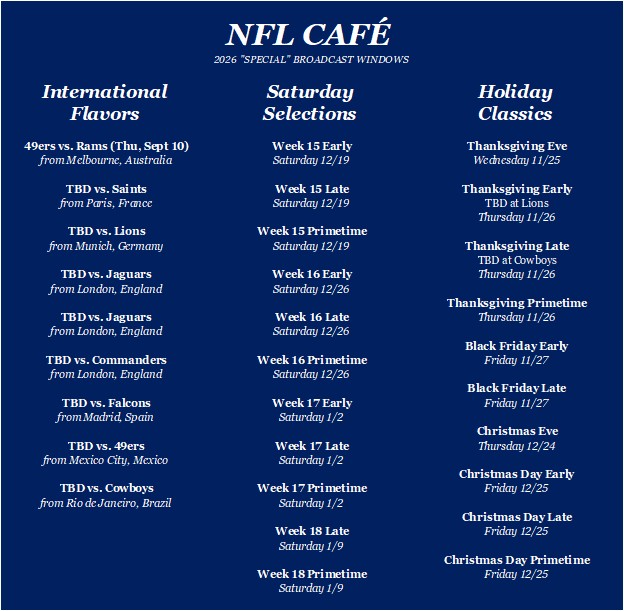
Mike Florio of Pro Football Talk reported recently that the NFL has presented prospective bidders on its new five-game media rights package a “menu” of options from which to choose. If the league is to hit its typical mid-May timeline for the release of this year’s schedule, those orders probably need to be placed in the next few weeks. Sports Media Watch examines this broadcasting “menu,” with a look at who could be at the table and what their appetite might look like.
What’s on the menu?
International Series
The league has announced a record nine-game international slate for the 2026 season. Six of these are set for European markets: three in London, plus one each in Madrid, Munich and Paris. These typically air in a 9:30 AM ET window, but could also be part of the 1:00 regional games.
Two additional games are set for Rio de Janeiro (featuring the Dallas Cowboys) and Mexico City (hosted by the San Francisco 49ers). Both of these games could air in primetime or in the afternoon. There will not be a game — in Rio or elsewhere — on the Friday of Week 1; that was only allowed the last two years thanks to a calendar quirk.
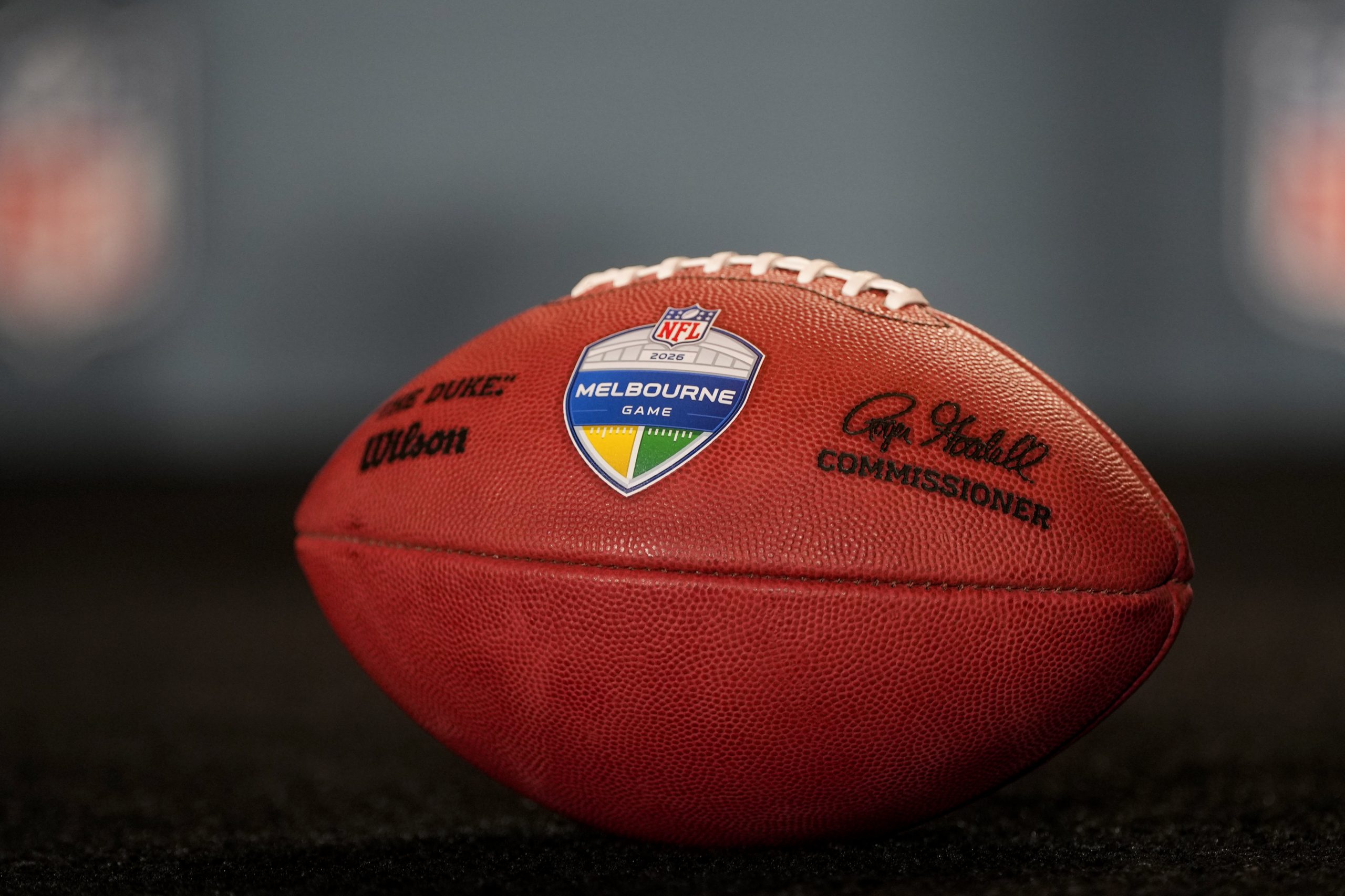
The one international game that does have a date is the 49ers-Rams game in Melbourne on September 10. The game will kickoff in primetime on Thursday night, which corresponds to late Friday morning in Australia. That opening Thursday is typically occupied by the NFL’s season opener, which has been pushed back to Wednesday night this year.
Holiday Games
Since the addition of out-of-home viewing to Nielsen audience measurement in 2020, the NFL has cracked the code on getting big audiences: occasions when Americans are likely to be gathered in homes together with family and friends. Out-of-home viewing gives a boost to viewership on Sundays, but is particularly strong on holidays like Thanksgiving and Christmas, and the days surrounding them. It’s why the Thanksgiving afternoon games are consistently the most-watched games of any season.
With this in mind, the NFL seeks to take advantage of any available moment over the critical holiday stretch. Reports indicate the league is considering selling a new “Thanksgiving Eve” game on Wednesday night — a night that has typically produced strong results for the NBA. That will be followed by the traditional Thanksgiving Day tripleheader, with home games for Detroit and Dallas, and then a Black Friday slate that could expand to multiple games.
Christmas Eve falls on a Thursday night, so could feature a game as part of Amazon’s Thursday Night Football or another partner. Christmas Day will feature a tripleheader, after the commissioner went on the record last year to confirm there will always be three games on Christmas Day, regardless of the day of the week the holiday falls.
Saturday Games
The NFL is forbidden by law from televising Saturday games through the first Saturday of September to the second Saturday of December as part of the 1961 Sports Broadcasting Act’s conditions to grant the league an antitrust exemption. That would leave just four regular-season Saturdays (December 19 and 26 and January 2 and 9) for the NFL, and the league will take full advantage of them. The Week 15 games clash with the first round of the College Football Playoff on ESPN and TNT, but the league has not been shy from scheduling marquee games on broadcast TV opposite the CFP.
The next two Saturdays are wide open, and there’s no reason we couldn’t see a tripleheader on both dates. Week 18 contractually belongs to ESPN/ABC, which will air a season-finale doubleheader to be set after the results of Week 17.
Who’s hungry?
All of these special entrees are a part of the league’s aggressive media strategy. The NFL is seeking to force its current partners — for whom NFL inventory is an existential asset — to pay higher rights fees, while also stripping them of inventory to sell in smaller packages. All of the league’s primary partners (ESPN, NBC, FOX, CBS, Amazon) are theoretically able to consider these smaller packages, but the point is really to sell them to outside parties for a little extra cash.
YouTube was recently reported as the frontrunner to acquire a five-game package that could include any of the options above. YouTube streamed the Rio game last year on a one-year deal, and parent company Google is the exclusive distributor of the Sunday Ticket package. Netflix and FOX were also mentioned as competing for the five-game package.
Some mouths additionally need to be fed thanks to prior contractual agreements. Peacock is owed a streaming-exclusive game, which was scheduled for a December Saturday in 2023 and 2025 and featured the Rio game in 2024. NFL Network has to carry a seven-game slate, which in the past has featured a mix of Sunday-morning international games and December Saturdays. Netflix will return with another Christmas Day doubleheader, with FOX — the only partner contractually linked to Christmas when the current rights deals were announced — airing a third game.
Beyond that, is there any limit to the number of carve-outs the league could make? And is there any limit to the number of partners? Perhaps Apple TV could get a game or two for the right price. What about TikTok, in pursuit of the league’s desire to get in front of young people? There’s evidently no reason to rule out anyone willing to put up the cash for a slice of NFL inventory.
Additionally, as the league renegotiates rights with its existing partners, its possible certain off-menu inventory initially promised to partners could change hands. Depending on how the talks go, could the Thanksgiving games eventually move to a streamer? What about the season opener or the last Sunday night? There are more holidays to take advantage of as well: Veterans Day, Halloween, New Year’s Eve. The league’s unplanned 2020 venture into Wednesday Afternoon Football on NBC showed that there’s almost always an audience for NFL football.
What’s the risk?
While the NFL appears to be on a perpetual upward viewership trend, there are a couple of risks to the current strategy. First, every carved-out “special” window slightly weakens the value of CBS and FOX’s Sunday afternoon windows. A 1:00 regional that includes five games instead of six will still draw a strong audience, but includes two fewer home markets that will slightly diminish the window’s drawing power. Moving marquee games onto streaming specials can also hurt the averages for primetime windows. As enticing as the streaming exclusives can be, Sunday is the NFL’s bread and butter.
Secondly, although the networks don’t seem positioned with much leverage, they are the primary buyers of what the NFL is selling. If the league continues to take advantage of its partners in an already-challenging media landscape, the risk that one could leave the table altogether grows. In a future where big tech platforms are the dominant NFL broadcasters, the rights may not be as valuable. Viewership for NFL games on streaming has been mixed: from a record 31 million for a playoff game on Prime to less than 10 million for a December Saturday night on Peacock.
Finally, each new platform to carry NFL action increases frustration for fans, although all games continue to be broadcast over-the-air in local markets. Viral posts frequently use some questionable math to calculate the cost required to watch every single game in a season, with that figure often placed at $1,000. Prime Video and other streamers often tout that their average audience is a good deal younger than that of games carried on traditional platforms, but part of that is due to losing an older audience that doesn’t feel comfortable with streaming. The more the NFL continues to slice and dice its inventory, the greater the risk that frustrated fans give up entirely.