In a 1992 Time Magazine profile, Hall-of-Fame broadcaster Bob Costas recalled how his love affair with baseball began. He remembered the cross-country journeys with his dad, twisting the radio dial in his father’s car to pick up broadcasts of MLB games through the crackling static.
“There was a romance to the airwaves,” Costas said, “a notion that moving the dial just slightly enabled you to eavesdrop on what people heard in Baltimore — or, a little farther over, Cincinnati, Philadelphia, and, on a really clear night, St. Louis.”
Costas’ lifelong affinity for America’s pastime was shaped not just by the surpassing greatness of players like Ted Williams, Stan Musial and Mickey Mantle, but by the voices who chronicled their outstanding careers. That star-studded list includes icons such as Jack Buck, Vin Scully, and Ernie Harwell. Each man possessed a distinctive style and a sort of avuncular presence within the organizations for which they worked. Day after day and year after year — through commanding victories and crippling defeats — these golden-throated legends guided baseball fans from spring to autumn.
Their day has long passed, but the relationship between radio listeners and baseball announcers remains. Fans learn to hear, feel and see the game through the vivid descriptions of their favorite voices. Those charismatic raconteurs become a source of comfort — an invitation to withdraw from life’s bustling pace and return to the innocence of childhood. When one of those voices is silenced, the pain is visceral and the loss profound.
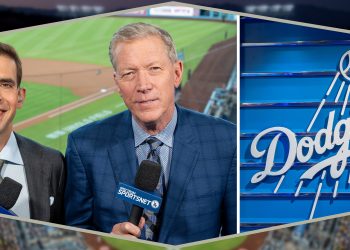
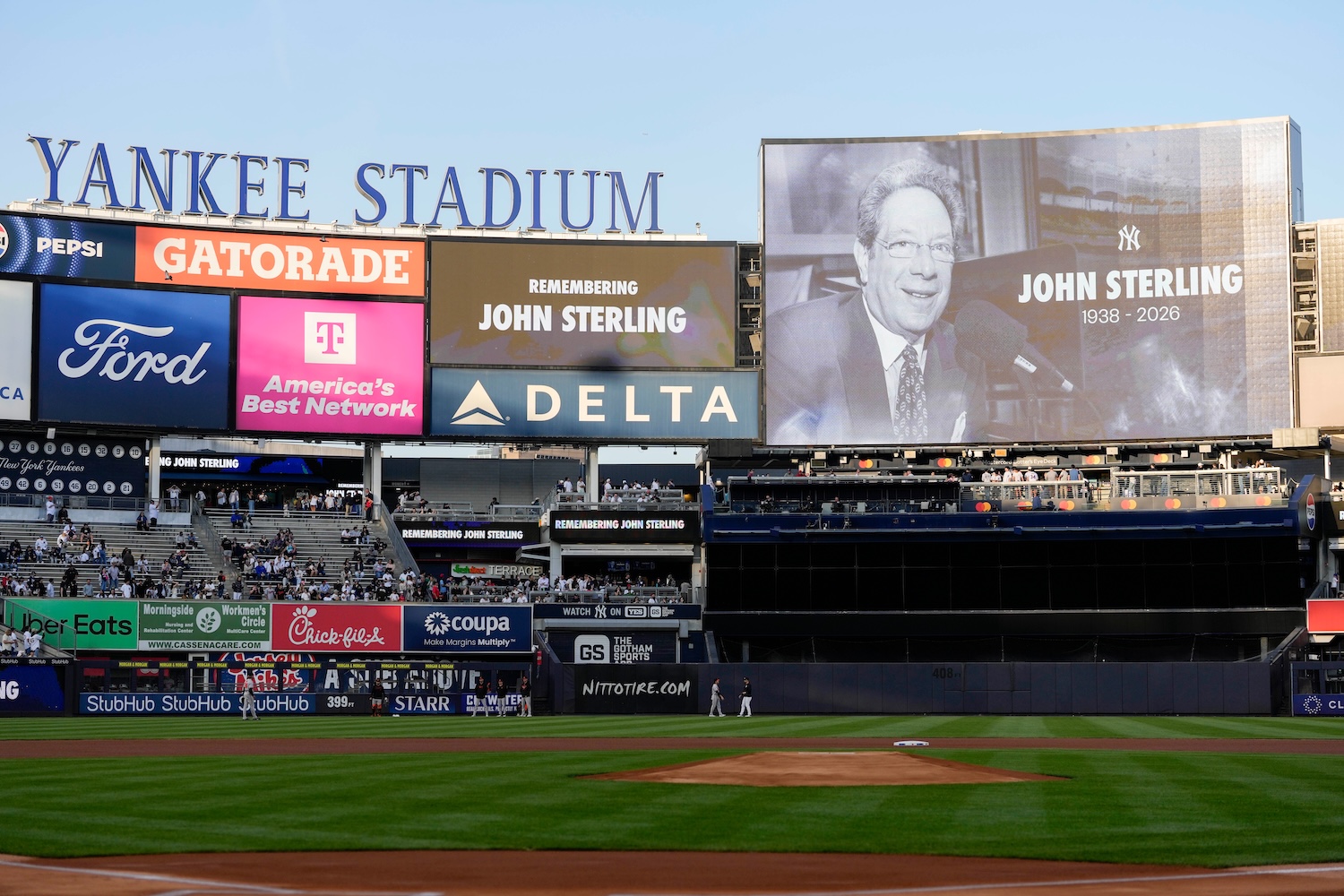
New York fans are feeling that loss. John Sterling, who called more than 5,600 Yankees games on radio over 36 years, passed away Monday at the age of 87. Yankees TV broadcaster Michael Kay, who shared the radio booth with Sterling for much of the 1990s, spoke with Sports Media Watch about his longtime colleague.
“He is as significant and relevant as many Yankee players throughout history,” said Kay. “Broadcasters are here sometimes a lot longer than players, and they become part of the fabric and part of the family of the people that listen. For 36 years, he was everybody’s friend every summer, so I think he leaves an incredible legacy. In this age of digital retention of everything that’s said and done, his calls are going to live forever. He happened to broadcast during a time when the Yankees did a lot of winning and won five championships, so his voice is going to be just as significant as Mel Allen’s.”
In the days following his passing, a litany of current and former players, sports media personalities and Yankee fans have paid tribute to the man nicknamed “Pa Pinstripe.” During a segment on his radio show this week, ESPN host and longtime Yankees fan Rich Eisen called Sterling “a companion.”
Was he polarizing? Yes. Could he be bombastic? Yes. Were his custom home run calls (an A Bomb … from A-Rod!) hammy and over the top? Sure. But Sterling’s style didn’t have to be met with every fan’s approval. If you weren’t an ardent Yankee devotee, John Sterling’s performative presentation was likely not your cup of tea.
Yet it is important to remember where Sterling’s loyalties lay. He didn’t just work for the Yankees; he belonged to the Yankees. And as the Bronx Bombers dominated the back half of the 1990s, Sterling’s enthusiastic “Yankees win! THUUUUUHHHH Yankees WIN!” became a familiar refrain.
Television has always been the glitzier medium for play-by-play, but its gaudiness produces a certain distance between the announcer and the viewer. Radio is the purer, less pretentious medium, breaking down the barriers and creating an atmosphere of intimacy, where the listener leans in on every word picture the announcer paints. Every noun, every adjective, every verb becomes a tool the commentator uses to paint his/her own 9-inning masterpiece.
John Sterling knew he was a different kind of artist, one whose colors were louder and more vibrant than most. But his lengthy career and the undeniable connection he developed with a loving fanbase is a testament to the power of baseball radio play-by-play and its uncanny ability to unite and bind generations of avid followers.
Plus: Taylor does her best work in NBC’s NBA studio
Since 2021, Maria Taylor has served as one of NBC’s most prominent anchors, ably handling college football, NFL, and Olympic hosting duties for the network. Yet over the last 7 months, the role of lead NBA studio host has proven to be the assignment with which she is most comfortable.
It was an obvious choice for NBC Sports. Taylor played basketball for her alma mater the University of Georgia, and, for a few years, she was ESPN’s lead NBA anchor before her controversial departure from the company.
Despite the network’s belief in Taylor’s talents, NBC’s studio show “NBA Showtime” presented real challenges. Hall of Famers Carmelo Anthony, Tracy McGrady, and Vince Carter bring elite playing experience, but are still developing in their roles as full-time television analysts, placing greater responsibility on Taylor to steer and enliven conversations, plus ensure her analysts make certain needful observations.
In this area, Taylor has excelled. Discussions are free-flowing, creating a light, relaxed and friendly atmosphere. Simply put, it feels like Taylor, Anthony, Carter and McGrady genuinely get along. And in television, that’s half the battle.
No one can credibly argue that the Showtime cast is as entertaining as the “Inside the NBA” quartet of EJ, Shaq, Kenny and Chuck but, with Taylor’s lighthearted guidance, they do just enough to keep fans engaged.
Viewers can tell when a host likes the sport they cover. There’s a certain glint in their eyes, a certain ease that translates well on camera. “Football Night in America” is her highest profile role, but on “NBA Showtime,” viewers get Maria Taylor at her best.