Mickey Mantle was a 20-time MLB All-Star, seven-time champion, three-time American League MVP, New York Yankees icon and, for many, an almost mythological figure.
But Mantle was not a perfect man — in fact, far from it. In an April 1994 Sports Illustrated profile, he detailed his decades-long battle with alcoholism. Months before the article was published, Mantle had entered the Betty Ford Center to seek treatment.
Years of hard living had taken an immense toll. More than a year after his tell-all SI piece, Mantle died of cancer at age 63. During the memorial, Bob Costas delivered a eulogy that masterfully balanced the image of Mantle as both American sports icon and deeply flawed human.
“In the last year, Mickey Mantle, always so hard on himself, finally came to accept and appreciate that distinction between a role model and a hero,” Costas said. “The first he often was not, the second he always will be.”
In recent years, it seems many in sports media have lost the ability to accept and appreciate that distinction. Whether it’s sports talk radio, YouTube or television, an unfortunate number of sports pundits are using game results and tired storylines to villainize some of the most decorated stars in sports.
This strategy helped elevate the career of former ESPN and Fox commentator Skip Bayless, who built his national TV following on demonizing and insulting NBA megastar LeBron James. After James’ Cavaliers lost a conference semifinal series to the Detroit Pistons in 2006, Bayless went hard after the then-21-year-old star, writing in an ESPN.com column that James was “choking” and that he “came up small” and “shrank under the pressure” in losing in seven to the two-time defending conference champions in his first postseason.
As the years went on, Bayless found new ways to diminish one of the most gifted players basketball has ever seen. Juvenile pejoratives such as “LeBrick,” “LeChoke” and “The Frozen One” became staples of his commentary. Though it was evident to any objective observer that LeBron James was destined for greatness, Bayless found his punching bag early, making it his personal mission to deride the face of the NBA from his platform on the league’s “A” broadcast partner.
His longtime “First Take” counterpart, Stephen A. Smith, has followed that blueprint and, in many ways, taken it even further. In a 2025 profile by Rolling Stone, Smith said of James, “I don’t like him and he don’t like me.” Their long-running tension appeared to reach a boiling point last March, when James and Smith engaged in a verbal confrontation during a game in which James was playing. While Smith has publicly feuded with numerous athletes, the hostility surrounding his relationship with James has reached a particularly intense level.
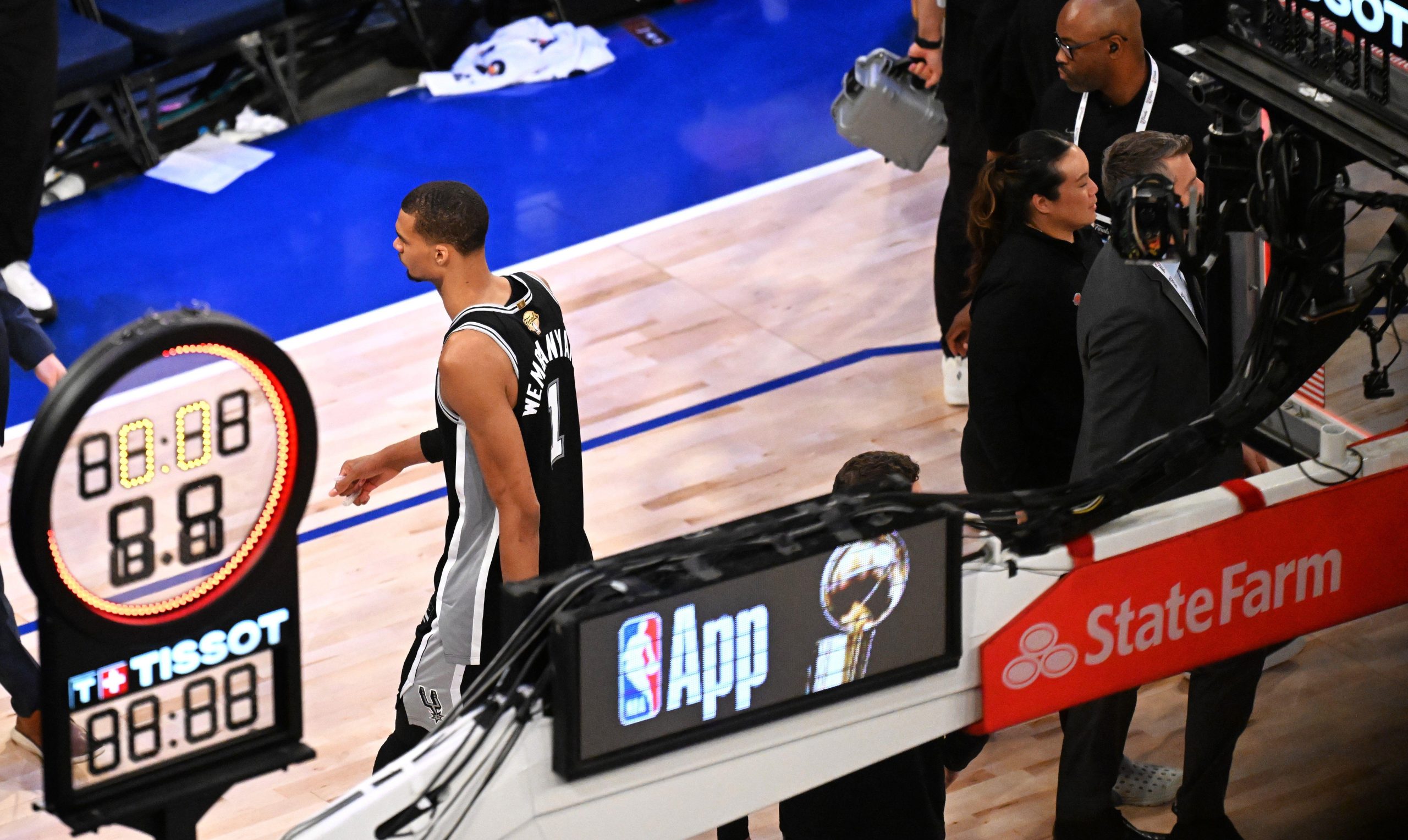
It seems sports media’s newest target is 22-year-old San Antonio Spurs center Victor Wembanyama, who has been described as one who lacks the ‘clutch gene’ and as a classless choke artist.
These labels contrast starkly to the way analysts characterized him ahead of the 2023 NBA Draft. During a June 2023 appearance on “The Dan Patrick Show,” ESPN commentator Jay Bilas was asked if Wembanyama was a better prospect than LeBron James.
“In today’s game, I might lean towards Victor because of the way he impacts both ends,” Bilas responded.
Patrick was not alone. Nearly every national sports talk show spent considerable time during the spring and summer of 2023 drawing comparisons between Wembanyama and James. Just three short years later, many of those same shows are now questioning Wembanyama’s character — or rushing to define it with sweeping declarations.
The young superstar has not always helped his cause. In Game 3 of this year’s NBA Finals, Wembanyama shoved Knicks G Jalen Brunson in the back of the head. No foul was called. In the next game, Wembanyama was assessed a Flagrant 1 foul for elbowing Knicks F Karl-Anthony Towns in the face.
During Game 3 of the West Semifinals series vs. the Timberwolves, Wembanyama was ejected for throwing an elbow that knocked Wolves F Naz Reid to the floor.
If the Spurs big man isn’t being rebuked for his on-court antics, he’s being called out for his speech. His press conference responses have drawn criticism. Some say he’s too blunt, too unfiltered, brash and arrogant.
After the Knicks clinched their NBA Finals victory, one popular debate show asked the question, “Did the NBA Finals help or hurt Wemby’s image?”
Questions like these demonstrate an ongoing trend in sports television, and with a glut of video and audio podcasts, the heat has been turned up. Conversations on these shows might start with some analysis of game performance, but they often end up becoming personal — even visceral.
This approach makes certain commentators wealthy and famous, but it damages our ability to constructively discuss the triumphs and setbacks of the athletes whose abilities we claim to admire.
Social media has also blurred the lines, providing more grist for the mill for those looking for any reason to vilify a star player. At any time, an athlete’s perceived alignment with a political figure or ideology can instantly transform a hero into a heel. In this unstable media environment, liking a politician’s social media post — regardless of party — can be overanalyzed during a TV segment and taken as a blanket endorsement of everything a politician represents.
Athletes are no longer judged solely by their performance on the field or court. Increasingly, they are evaluated through the lens of perceived morality, with those judgments often shaped less by objective standards than by whether the athlete shares the beliefs of the person passing judgment.
Consider the distinct difference in asking, “Where does Victor Wembanyama need to improve” vs. the question, “Is Victor Wembanymama a bad guy?” The former requires more thought, more nuance and perspective. The latter presents a cheap and easy path to a layered topic.
No player is a finished product at 22. It is fair to scrutinize Wembanyama’s in-game behavior but attempts to use select moments to frame him as an unscrupulous villain reflect a larger issue within sports media. Personal attacks on players and coaches have become so commonplace in sports television that some viewers now accept them as legitimate byproducts of journalism.
While professional athletes push their bodies to unimaginable limits and regularly accomplish feats of which the average viewer can only dream, they are still mere mortals. No amount of success on the playing surface will change that. But in the name of content, sports talk shows often forget or minimize the humanity of these athletes, treating them instead like one-dimensional characters in a work of fiction. The game plan is often: build them up, then mercilessly tear them down.
The answer to this dilemma is a return to storytelling. Like Costas’ Mantle eulogy, sports media members must allow themselves room to admire the heroes who astound them while simultaneously acknowledging, accepting, and contextualizing their imperfections. But doing so requires a bit more effort than lobbing pejoratives in their direction.
Plus: How CBS can replace Jason McCourty
Last season, Andrew Catalon worked NFL on CBS broadcasts with analysts Charles Davis and Jason McCourty. This season, Charles Davis will serve as CBS lead college football analyst, and last week Jason McCourty signed an exclusive deal with ESPN, where he’ll feature prominently on its studio programming.
During his tenure on “Good Morning Football,” McCourty established himself as a thoughtful and incisive studio analyst. His game commentary at CBS was just as strong.
McCourty’s departure means more change for one of CBS’ rising stars. Catalon will enter his fourth consecutive season with a different broadcast partner. In 2023, he was joined by Matt Ryan and Tiki Barber. McCourty replaced Ryan in 2024, when the latter left the booth to join “The NFL Today.” After Barber’s departure from the network in 2025, Davis was moved from the “B” crew to partner with Catalon and McCourty.
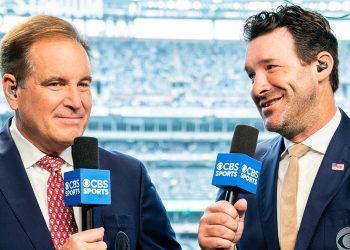
McCourty’s exit also hurts CBS’ depth. Currently, the network has just four full-time NFL analysts on its roster: Tony Romo, J.J. Watt, Trent Green, and Adam Archuleta.
The vacancy should mean more airtime for Ross Tucker. In addition to his Westwood One Radio work, Tucker called select college and NFL games for CBS last season, including a late season Commanders-Eagles broadcast with Kevin Harlan.
Tucker brings experience and enthusiasm, and a unique perspective as a former offensive lineman.