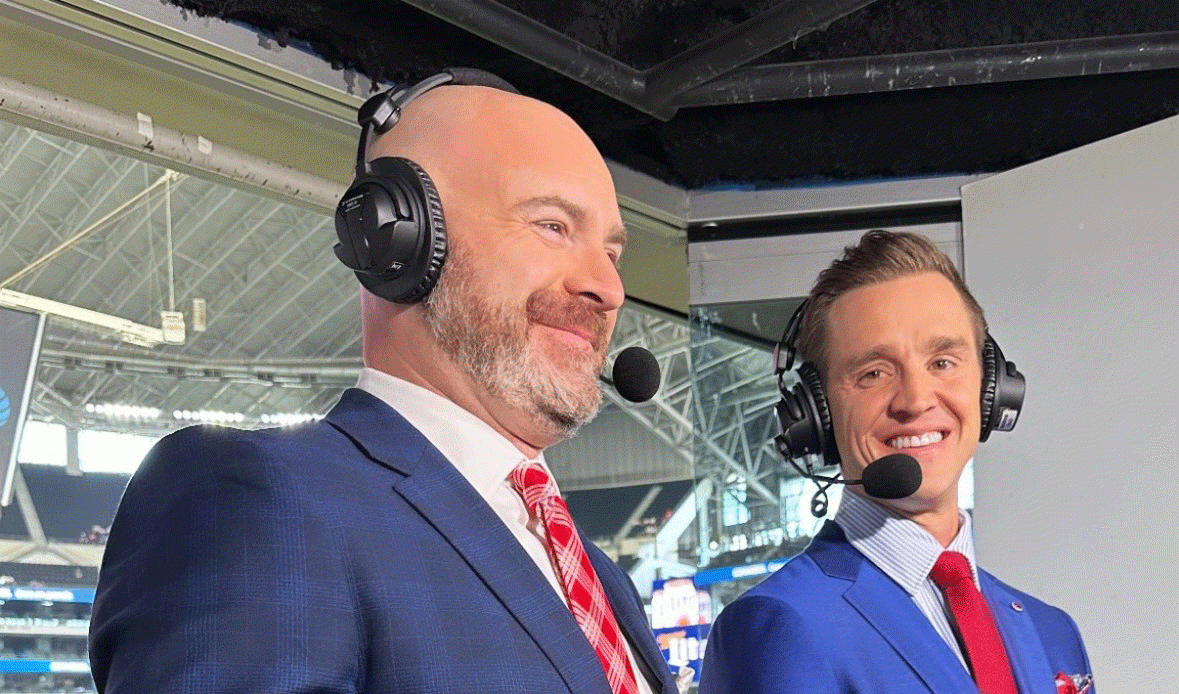
As Belgium completed its convincing 4-1 dismantling of the USMNT in the World Cup Round of 16 Monday night, Fox Sports’ lead announce team used the closing moments of the broadcast to make a heartfelt appeal to viewers.
“If you’ve enjoyed what you’re seeing, well, support your local team. This doesn’t have to be the last soccer you watch for the next four years. It’s a beautiful sport,” said play-by-play voice John Strong.
“The future of American soccer is very bright,” added analyst Stu Holden.
It was sincere. It was well-intentioned. But it wasn’t necessary.
Soccer coverage in America has come a long way from its 2006 nadir. While Dave O’Brien is a grade-A baseball broadcaster, most objective observers have agreed that he did not belong in ESPN/ABC’s lead World Cup booth 20 years ago. That decision, as well as Fox’s head-scratching move to make Gus Johnson its lead soccer voice more than a decade ago, illustrated how little regard network executives (and the broader public, to some degree) had for the sport.
The implication was that soccer couldn’t hold the attention of the mainstream American fan on its own, that it didn’t deserve the same resources or energy as the major sports. To meet the average fan halfway, the sport’s coverage was diluted and treated as an inferior product. It makes no sense to expect a fan to care about a sport if the network producing the coverage is hardly (or at least not fully) invested.
Looking back, that abysmal time set the stage for soccer’s shining hour in America. ESPN’s 2010 and 2014 World Cup coverage remains some of the highest-quality programming the company has ever produced. With top-tier soccer play-by-play voices like Ian Darke, Derek Rae, Jon Champion, and Martin Tyler, as well as some of the company’s strongest hosts — Mike Tirico, Chris Fowler, and Bob Ley — ESPN handled the World Cup with a seriousness this country had not seen. ESPN received widespread praise not merely for its coverage of the USMNT, but for the tournament as a whole.
To its credit, Fox has also stepped its game up. Strong has his detractors, and studio analyst Alexi Lalas will always be polarizing, but the network’s presentation has improved leaps and bounds since the ill-fated Gus Johnson-Warren Barton pairing. Its studio coverage has been one of the network’s biggest successes this year, thanks in large part to host Rebecca Lowe (on loan from NBC), CBS’ Thierry Henry, and soccer great Zlatan Ibrahimović.
This reality, as well as the phenomenal viewership numbers for this year’s World Cup, made Strong and Holden’s plea that much more confusing.
Soccer is not an afterthought in the American sports landscape, and its national appeal does not solely rely on the accomplishments of the United States national team. With the proper promotion, personalities, and production, fans have come to respect the performance and star power of both American and non-American players.
Verne Lundquist once said, “As a play-by-play announcer, my job is to give you a reason to care.”
When a network and its announcers make the investment to treat a sport and its fans with respect, the response is typically overwhelmingly positive from hardcore and casual fans.
The World Cup has enjoyed healthy viewership numbers. Major League Soccer has attracted international stars and built soccer-specific stadiums across the country. The sport is no longer begging for a seat at the table.
When broadcasters plead with American viewers to keep watching soccer, they unintentionally send the message that the sport still needs validation. It suggests soccer remains on some sort of probation with the American sports fan — that the viewer is watching with one eye on the pitch and another on baseball or basketball.
But confidence is persuasive. Insecurity rarely is.
Strong is one of America’s most well-known soccer announcers because he clearly follows the sport and his passion is genuine. That’s what grows the game — people in the office, the production trucks, and the booth who have a love for the game and who cover it through the lens of that passion.
None of this is a criticism of Strong or Holden’s motives. Their remarks reflected a desire to see the sport flourish in America. Those are admirable instincts. The announcers are also aware of the fact that this is the last World Cup Fox has under contract.
But soccer has reached the point where it doesn’t need its lead broadcaster asking viewers for another chance. It needs what it’s always needed—for its announcers to call great matches with confidence, professionalism, and enthusiasm.
The game is beautiful.
It doesn’t need a sales pitch to prove it.
Plus: Robin Roberts returns to ESPN
Earlier this week, “Good Morning America” co-host Robin Roberts and UConn women’s basketball coach Geno Auriemma joined play-by-play announcer Beth Mowins for ESPN’s special WNBA broadcast of the Dallas Wings vs. the New York Liberty.
Roberts and Auriemma called ESPN’s first WNBA game, a contest between the Los Angeles Sparks and Utah Starzz, in June 1997.
Roberts has been an ABC News anchor for so long that some might not remember how vital she was to ESPN’s success during the early to mid-1990s.
In 1990, Roberts became the network’s first female African American journalist. She was the lead host for the Women’s Final Four, as well as a play-by-play announcer, co-host of “NFL Primetime,” and anchor of “SportsCenter,” where she popularized her catchphrase, “Go on with your bad self!”
It would not be a stretch to claim that at the height of “SportsCenter” in its mid-90s prime, there were two anchor teams largely responsible for carrying the franchise’s identity: the 11 p.m. duo of Dan Patrick and Keith Olbermann and the 6 p.m. trio of Roberts, Bob Ley, and Charley Steiner. Roberts’ approachable personality, effortless professionalism, and polished delivery made her one of the program’s most recognizable faces. When ABC News came calling, the transition was seamless.
ESPN wisely called on Mowins to do the heavy lifting while Roberts and Auriemma reminisced. It was a fitting way to commemorate 30 years of the WNBA.
For one night, Roberts was back at the place where she first became a national star. Sports television has long been in her rearview mirror, but in her day, she was among ESPN’s finest on-air personalities.