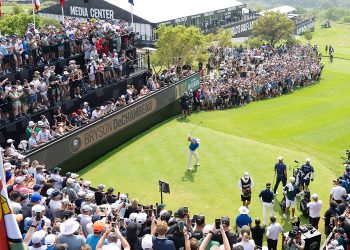
Sports Media Watch contributor Drew Lerner reviews the opening weekend of LIV Golf on The CW.
As most normal people would, I spent some of my weekend afternoon watching The CW. Of course, this was not your standard CW daytime fare of Maury — though if this is how you like spending your afternoons, who am I to judge? — but the network’s maiden voyage into the world of live sports programming with the Saudi-funded LIV Golf Tour.
At first glance, the CW Sports Live watermark gives this season’s broadcast a more legitimate feel as compared to last season’s internet livestreams. The second season of LIV Golf is still being produced in-house, so the CW isn’t involved in any of the broadcasting decisions — those are all made by LIV — but in its second year, it is reasonable to expect a jump in quality from year one.
Structural Challenges
With its desire to differentiate themselves from the PGA Tour in any way possible, LIV has some inherent challenges that a normal golf broadcast does not. Let’s call these “structural challenges” since, while ultimately they were choices LIV made, they’re also a vital part of the league’s branding and thus, unlikely to change.
The first such structural challenge is the shotgun start. A shotgun start has each group of players begin their round on different holes, and all groups tee off at the same time. A group that starts their round on hole 16 would play 16, 17, and 18 before playing hole 1, and finishing on 15.
The benefit to this is that LIV can a) squeeze its product into a shorter broadcast window than the PGA Tour, fitting an entire round into five hours of coverage on a single network, rather than 10+ hours between several networks like the PGA Tour and b) showcase their entire roster of golfers at the same time.
LIV will say that these benefits are worth it, but they come with a significant deterioration of the storytelling, narrative, and buildup that fans are accustomed to from a traditional broadcast. For one, golf courses are often designed to intentionally crescendo with a set of finishing holes that test a player’s nerve, appetite for risk, and ability to handle pressure late in a round. This is lost when players are finishing their rounds on hole 7 rather than hole 18.
More detrimental to the product is simply how difficult the shotgun start makes it for a viewer to follow the natural progression of a tournament. Let’s take last year’s PGA Championship as an example to demonstrate the importance of the traditional staggered start. Eventual winner Justin Thomas began the final round seven strokes back of leader Mito Pereira, putting him about four holes ahead of Pereira on the course.
The gap in play has a twofold benefit for the viewer. First, it serves as a “sneak peak” of sorts. Having seen Thomas play the exact sequence of holes, viewers know what challenges the leaders will face down the stretch. This builds anticipation and allows the broadcast to set the stage for what is to come. Second, when Thomas finishes his round you get a “leader in the clubhouse” effect. Having posted a score of -5, viewers know exactly what score golfers still on the course must exceed to win.
Fast-forward to Pereira sitting at a score of -6 on the 18th tee. Viewers had seen Thomas finish about 45 minutes prior, and had just seen Will Zalatoris match his score of -5 in the group preceding Pereira. By that point, the challenging tee shot on the 18th had been well documented, and the nerves of a young Pereira with a slim lead were palpable. Pereira’s tee shot would find the water and he’d double bogey to complete his final round collapse, sending Thomas and Zalatoris to a playoff.
That shot was a single pivotal moment built up through hours of narrative building that can only happen with a time staggered format. Without knowing exactly what Pereira needed to win, much of the punch is taken out of that moment.
With LIV’s shotgun starts, the pacing of the broadcast is ruined. Players are scattered around the course and all finishing their rounds simultaneously. That leaves the announcers with an impossible task, trying to convey all sorts of permutations to the viewer from different parts of the golf course. It’s confusing and there is no chance to build anticipation as you would with a traditional staggered start. This all results in a jumbled disjointed and unsatisfying narrative.
The second structural challenge the LIV broadcast faces is the lack of a cut. The drama of early round golf broadcasts are often centered around whether or not someone will make the cut. Take The Genesis Invitational this season on the PGA Tour. Thursday and Friday broadcasts of that tournament smashed their previous ratings records because of the drama surrounding whether Tiger Woods would make the cut. The Tiger Effect is real, so this type of viewership jump is atypical, but there is intrigue around the cut line every week on Tour that can drive much of the broadcast narrative in early rounds.
LIV does not have the intrigue of a cut line to fall back on. If you took the LIV Mayakoba leaderboard after round 1, and introduced a hypothetical cut line through half of the field, we’d see the likes of Phil Mickelson and Bryson DeChambeau fighting to play the weekend. It’s understandable that LIV wants to avoid having their biggest draws miss a cut, but the lack of a cut line dilutes the early round broadcasts and can make seeing shots from anyone on the bottom half of the leaderboard feel meaningless.
LIV Culture
Beyond the structural challenges, I would consider the “LIV Culture” aspects of the broadcasts the most difficult to watch. These would be the stylistic decisions LIV makes to further differentiate themselves from the PGA Tour.
The most grating of these is the inclusion of loud music around certain areas of the course. It’s obnoxious, distracting, and a stark juxtaposition to their PGA Tour counterparts who pipe in mellow bird sounds and ambient noise; a tactic that serves as a subtle backdrop interrupted only by the piercing roar of a crowd that signals something actually exciting happened.
I can’t imagine more than a few LIV players enjoy this amateurish nonsense. It ruins the gravity of the moment for the viewer. Golf thrives off of the intensity that builds up in the 99% of time golfers spend not actively swinging a club. The anticipation culminates in the short active burst of a golf swing that has do or die results. This can’t happen when DJ Khaled is playing in the background.
Aside from the broadcast sounding more like a nightclub than a golf tournament, LIV’s announcers love to remind you just how different and great LIV really is. LIV’s broadcast team includes former Premier League voice Arlo White, and former Golf Channel veterans David Feherty and Jerry Foltz. The constant fawning over how groundbreaking and unique LIV is for the sport of golf comes off entirely as if the announcers themselves are coping with the reality of jumping from leagues with true history and meaning to one completely devoid of such things.
So while I’ll give LIV credit for some of its novel ideas, particularly the team format — which while poorly implemented actually has potential to generate interest in the league — it can’t seem to get out of its own way to create a compelling television product. The LIV Tour is so hellbent on being different that it has sacrificed much of what actually makes golf enjoyable to watch. LIV has failed to capitalize on what makes golf golf and by extension created a product that lacks any identity, other than not being the PGA Tour.
There was a true opportunity for the PGA Tour to be challenged by a competitor as it has many deficiencies itself. But LIV’s ham-handed approach and lack of competent leadership has squandered any chance they might have had to be a real competitor.
For now, LIV will continue to be LIV. The ongoing lawsuit between LIV and their PGA Tour counterparts seems likely to fizzle out per recent developments. What we’ll be left with is two competing tours, one with decades of history, corporate backing, and the best young talent in the world. The other, a fledgling television product on the CW, emotionless and empty. I know which one I’d bet on.