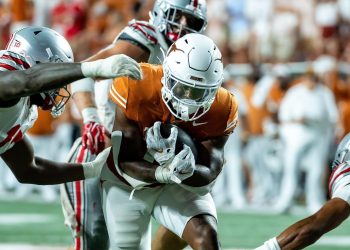
If there’s one thing college football fans, players, coaches, and administrators can agree on, it’s that the schedule is wrong. Before the days of big-money television, the schools largely controlled when they would play their games. Today, in an ever-changing world of transfer portals, conference realignment, NIL deals, and changing TV contracts, fans will always find something to complain about. Here is an overview of the college football TV selection process and some key frustrations.
Who sets the schedule?
That depends on what is meant by “schedule.” The season schedule (i.e., a team’s opponents and the order in which they’re played) is set by the conference, although network partners may request a handful of games for specific dates. The conferences attempt to balance things like schedule difficulty, bye weeks, home and away contests, rivalries, and homecoming games, but no schedule is ever perfect.
The week-to-week assignment of start times is set by the television networks, which are seeking to maximize their revenue while operating within the preferences and contractual restrictions of their rights partners, the conferences.
The first three weeks of kickoff times are mostly set in late May, with the remaining assignments announced on the Monday twelve days preceding each game. In select cases, the networks can exercise a “six-day hold,” in which all or part of a certain week’s schedule are announced on the Sunday before a Saturday game. This is used in cases where the results of “this week’s” games significantly impact the stakes of “next week’s” games, and the networks want to wait to select a game until those results are decided. The six-day hold option is limited to a handful of times per season for each conference.
Why can’t we get the schedule all at once?
Unlike the NFL, which presents most of its games in regionalized windows on Sunday afternoons, every FBS college football game is nationally televised on a broadcast, cable, or streaming network. Televising games from 134 teams requires more than a dozen networks, some with more reach than others. A game on ABC is more widely available to viewers than a game on ESPN2, which is more widely available than a game streaming on ESPN+. Because of the millions of dollars in advertising revenue on the line, it is imperative for the networks that they feature the games that will maximize viewership on their most widely-available platforms.
It can be hard to know in advance which games will draw the biggest audience. While traditional brand names will usually draw well, teams can underperform or overperform in a given season. For example, moribund Florida State (13-0 last season and 1-9 this season) or unbeaten Indiana. It is for this reason that the networks and conferences developed the week-to-week TV window selection process, in which a conference’s TV partners take turns selecting games for their platforms based on the real-time attractiveness of each game.
It should be noted that the SEC, with its rights now consolidated to just one partner, has created a new system in which more schedule details are released well before the season begins. In June, the SEC and ESPN announced a general window for every game of the season, including identifying every game that would kick off in the early afternoon window. This move was well received by fans, and still provided ESPN with the flexibility to put the best games in its best timeslots.
Who picks a game first?
That is spelled out in the contracts with each conference and determined in the spring before each season. In April, after the conference schedule is announced, the networks proceed through a predetermined draft order to select not specific games, but the weeks in which they will have the first pick of that week’s schedule. Let’s first break down the process for the Big Ten Conference, which is by far the most complicated.
In the Big Ten, Fox has the first three picks every year, and used this year those picks to select Week 14 and Week 2, while trading its #3 pick to NBC (which used it on Week 7) in exchange for other picks. Fox announced before the season began that it would use its Week 14 pick to select Michigan at Ohio State, and for good reason: the annual rivalry game is traditionally the most-watched game of the regular-season. It also announced it would use the Week 2 pick on Texas-Michigan, featuring a matchup of two of last years CFP semifinalists. NBC used the #3 pick in the 12-day process to select Ohio State-Oregon, and CBS used the #4 pick on Week 4, which it used on USC-Michigan. The draft continues until all the networks know which weeks they’ll pick first, and then second, and then third, and all the way down.
FOX, CBS, and NBC typically make the first three selections in a given week, typically placing their games at noon, 3:30 PM, and 7:30 PM, respectively. The remaining picks are then split up: Fox can sometimes use another pick for FS1 or a late-night game, NBC can use another pick for Peacock, and the rest end up with Big Ten Network. The Friday games are selected through a separate process.
The Big 12 follows a similar draft process with its partners, Fox and ESPN. Fox had the first selection this year, and used it to pick first in Week 1, and subsequently used it to select Penn State at West Virginia.
The SEC and ACC have a much simpler process. The SEC’s rights are wholly concentrated with ESPN, which means it can place every game in a window that maximizes viewership. The 3:30 window is contractually locked in to an SEC game (a carryover from CBS’s long-running 3:30 SEC game), but ABC has carried an SEC game in almost every window this season at noon and in primetime as well. The ACC’s rights are similarly concentrated, although somewhere in the selection order The CW picks its weekly game. After the SEC, ACC, and Big 12 schedule is set, ESPN fills in the rest of its windows with games from the American, CUSA, and Sun Belt conferences, with the remainder of those games going to ESPN+. In general, games not selected for linear TV (i.e., streaming exclusives) can have their start times set by the host school.
Why is my team playing at Noon so much?
The short answer: because your school’s president authorized conference leadership to negotiate television contracts, through which the school receives a rights fee and brand exposure in exchange for control over the schedule of the largest events of the year. One network in particular (Fox) has developed a strategy around presenting its best available games at noon ET as part of a brand called “Big Noon Saturday.” The strategy began in 2019, after years of struggling to compete against the “SEC on CBS” at 3:30 and ABC’s long-running “Saturday Night Football” franchise in primetime. “Big Noon Saturday” has been the most-watched college football window for two straight years, although that streak is not likely to continue thanks to Fox’s watered-down Big Ten selection order and the strength of the SEC on ABC this season. Fox Sports is a business with shareholders to report to, and in the face of a quickly-collapsing cable-bundle business model, must do what it can to maximize viewership for its college football games.
Why not just schedule the games when its most convenient for the fans?
The college football schedule is an incredibly complicated process of balancing dozens of competing interests. Here’s just a handful of the complicating factors that make the college football schedule a mess:
- ESPN2 doesn’t air any games in Week 1 because it has to cover the US Open tennis tournament.
- NBC can’t air a Big Ten game in primetime when there’s a primetime Notre Dame game.
- Arizona and Arizona state will only play night games at home in September due to the heat. Also, because there’s no Daylight Savings Time observance in Arizona, the schools are on Pacific Time half the season and Mountain time the other half.
- When it’s a toss-up between games, LSU is a contractual favorite for night home games because of the reputational atmosphere at Tiger Stadium.
- Kansas is playing its Big 12 home games in Kansas City this year due to construction, so if there’s a Chiefs game on Sunday, the game has to be scheduled as early as possible.
- The CW has to fit its ACC and Pac-12 games around its coverage of the NASCAR Xfinity series and LIV Golf.
- 11:00 AM local time is the earliest a game can kickoff in most contracts, meaning schools in the Mountain and Pacific time zones can’t play at home at Noon ET, with exceptions sometimes granted upon request. Colorado will host Utah on Fox at 10:00 AM MT this Saturday.
- Even they’re part of the AAC, Army and Navy have a separate deal with CBS for their rivalry game, that also puts their other home games on CBSSN and CBS, except for one a year, which goes back to ESPN.
- Big Ten schools in the Eastern and Central Time zones will mostly refuse to play night games after the end of Daylight Savings Time, citing the brutal weather in the North. Big Ten schools also prefer their homecoming games be played in the afternoon.
- Fox executives were transparent about selecting the Penn State game on November 2 because of the high potential for political advertising revenue in Pennsylvania, a swing state in the days before the 2024 election.
In summary, fans may be justified in feeling frustration over kickoff times, but the control that the TV partners have over the schedule is a direct consequence of the schools’ desires for ever-increasing revenue distributions from their conferences, and is unlikely to change any time soon. As with every issue facing college sports in this critical period of change: money will be the driving factor.