Sports Media Watch presents thoughts on recent events in the industry, starting with two very different — but nonetheless related — media critiques from the MLB commissioner and the face of the NBA.
It is the position of this writer that the responsibility for Major League Baseball splitting with ESPN falls primarily on MLB for devaluing its media rights by way of cut rate deals with Apple and Roku. Yet MLB commissioner Rob Manfred, in a bit of populist misdirection, has suggested the responsibility really falls on ESPN for providing subpar coverage.
Manfred’s complaint has real merit, as with all due respect to Tim Kurkjian and others, it has been clear for some time that ESPN has little remaining investment in MLB. Yet the litmus test is whether MLB would have opted out over those aesthetic complaints had ESPN not opted out over money. The answer to that hypothetical seems fairly clear.
Still, the aesthetic complaint has had considerable currency on social media, where bashing ESPN is an easy way to generate engagement — and rare consensus. For the average fan who is not particularly attuned to the business aspects of the sports they watch, it is easy to imagine Manfred finally being so fed up with ESPN’s baseball coverage that he tore up the deal. So, whatever its merits, it may be worth digging into this claim further.
When does a network fail a league?
ESPN is on two expiring contracts right now, one with MLB and the other with the NBA. ESPN paid the NBA $2.6 billion/year to renew and reportedly offered MLB $200 million/year — at most — to renew. While ESPN gets higher-quality content from the NBA than from MLB (specifically the NBA Finals), the gap in popularity between the NBA and MLB is not anywhere close to $2.4 billion/year wide. Yet one would get that impression watching ESPN’s daily programming, specifically its “embrace debate” talk shows, which talk about the NBA obsessively and baseball not at all.
The lack of coverage on said shows, particularly given the amount of coverage of the NBA, is likely galling for Manfred, the owners and baseball fans — but there are mitigating factors worth considering. For one, FOX is no different, as its FS1 cable networks discuss the NBA far more than MLB despite having zero rights to the former. The second, and more important to this discussion, is the fact that these shows’ laser focus on the NBA is not exactly a good thing for the league or its players.
Manfred’s complaint about ESPN occurs around the same time that NBA players are expressing greater discontent with how the league is covered. After Timberwolves star Anthony Edwards indicated he had no desire to become the “face of the league,” the player who has held that status the past two decades — LeBron James — said in a postgame media availability last week that he understood: “Why do you want to be the face of the league when all the people that cover our game and talk about our game on a daily basis [denigrate] everybody? … I understand [Edwards]. I completely understand. There’s just weird energy.”
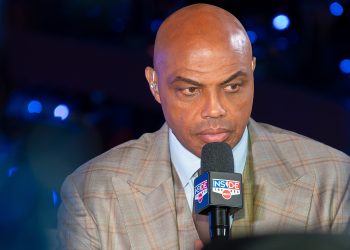
James was adding his voice to a growing conversation among NBA players and fans about the league’s media coverage, which is represented primarily by Stephen A. Smith on ESPN and Charles Barkley on TNT. Barkley has spent the majority of this season complaining vocally about the NBA product — at least when not complaining about his $200 million contract — and Smith, as part of the “embrace debate” era of sports television, has spent his entire ESPN career ripping players for their various failures in contrived TV debates.
Smith proved James’ point by spending much of the following day grousing about the comments, time that could have been spent discussing the resurgent Pistons’ winning streak or Stephen Curry’s 56-point performance the night before.
There is no league with a more intensely negative ‘aura’ than the NBA, and much of that originates from its own television partners. While some may eagerly argue that the NBA is just that bad, a more likely answer is that “embrace debate” simply cannot exist without compulsory negativity. Like its cable news counterpart, “embrace debate” must have raised voices and angry opinions in order to properly function. Why MLB would want any part of that is anybody’s guess.
Do leagues have leverage?
If baseball is unhappy with a lack of regular studio coverage on ESPN, it might make sense to make such programming a contractual requirement. ESPN’s “NBA Today” (formerly “The Jump”) exists as part of the network’s contract with the league. One might suggest MLB does not have much leverage, but ESPN reportedly still has interest in a deal.
While the $200 million/year price point reported by the Wall Street Journal is unacceptable, previous reporting by John Ourand of Puck indicated that ESPN is willing to maintain its current $550 million/year fee for additional rights. Per Ourand, that would include local rights, which ESPN has long coveted, or some midweek games for both linear and streaming. MLB controls the local media rights of five teams — the Twins, Guardians, Diamondbacks, Padres and Rockies — inventory that could presumably help satisfy both needs if MLB is sufficiently creative.
Given ESPN’s desire for an expansive package of local rights in 2028, getting a foot in the door may be a sufficient enough motivation to play ball with Manfred. Perhaps that includes a “Baseball Tonight,” maybe it includes licensing an MLB Network show, as it did for several years with “Intentional Talk.”
If MLB was willing to essentially give away exclusive Friday night and Sunday morning games to streaming services, why not give ESPN a little bit of what it is looking for in order to maintain its rights fees and potentially improve a key relationship?
Plus: Rutledge, racing, Conan
— ESPN’s contract extension with Laura Rutledge last week made sense for both sides, but it does not seem like the status quo can continue for much longer. Rutledge has made it clear through the quality of her work that she is ready for a marquee role, and “NFL Live” and “SEC Nation” do not seem to adequately fit the bill.
ESPN should have given her the “Sunday NFL Countdown” role last year instead of Mike Greenberg. When the network passed on Chris Berman’s obvious heirs Trey Wingo and Suzy Kolber for that role in 2016 — instead going with Samantha Ponder in a move that still does not make a ton of sense — it essentially set the countdown for their eventual departures.
— With IndyCar on broadcast television every week of its season, and NASCAR dropping down to cable starting this weekend, it will be interesting to see how the two racing leagues are perceived this season. To be clear, NASCAR got a far better deal financially, and will almost certainly continue to outrate IndyCar on a weekly basis. Nevertheless, with IndyCar maxing out its broadcast TV exposure at a time when NASCAR is scaling back on the same, there are going to be weeks when the former feels ‘bigger’ than the latter, especially with Fox breaking out all the bells and whistles for its new property.
— If one allows a digression from sports talk, it seems clear now that Conan O’Brien won his war with Jay Leno over “The Tonight Show.” Yes, O’Brien’s tenure was comically short, but all Leno got from the conflict was four additional (fairly forgettable) years as host. O’Brien, by contrast, branched away from the shrinking late night box and on Sunday night played in front of what will likely be the biggest crowd of his career at the Oscars. (If one absolutely needs a sports connection, it was NBC’s Dick Ebersol who in 2010 excoriated O’Brien for his “astounding failure” on “Tonight.”)