Sports Media Watch presents thoughts on recent events in the industry, starting with the end of the NBA Finals and the general vibes surrounding the league after another major injury.
It was perhaps appropriate — cruel, but nonetheless appropriate — that this NBA season would end with yet another Achilles injury to one of the league’s key stars. What has the story been in the NBA the past several years? Injuries to star players, and not mere tweaks, but severe, season-long injuries.
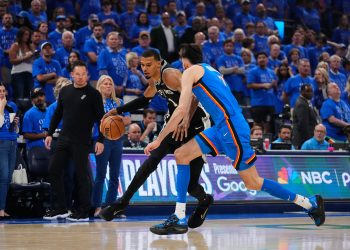
Tyrese Haliburton, arguably the face of this year’s playoffs, was the third star player to suffer an Achilles injury just this postseason — which not only marred Sunday’s Game 7 of the NBA Finals, but almost certainly prevents the league from building upon his star turn next season. While the Pacers have shown time and time again that they can compete without Haliburton (they did lead at halftime Sunday), there is simply no way that the league and its network partners will frequently showcase a team next season that is playing without its highest-profile player.
Consider that next season, the past two Eastern Conference champions will enter shorthanded and not seriously expected to contend. (The Celtics, as many will recall, are just weeks removed from losing Jayson Tatum to the same Achilles injury.)
The Haliburton injury was a nasty way to end the first seven-game NBA Finals in nine years. The league finally put on a compelling show in the month of June — the highly-competitive Bucks-Suns Finals of 2021 took place in July — and this is how it ends?
It was also sadly fitting for an NBA that has seemed for some time to have a dark cloud hanging over it. Perhaps it started with the previous Achilles tear during the NBA Finals, which was suffered by Kevin Durant in Game 5 of the 2019 series — and was followed immediately by Klay Thompson tearing his ACL in Game 6.
Within months, it was China creating an international incident out of a half-hearted tweet by Daryl Morey. Then it was the deaths — within weeks of each other — of David Stern, and unimaginably, Kobe Bryant. Then, it was the NBA that was first affected by COVID (because of course it was), as Rudy Gobert tested positive. And while pretty much all sports suffered ratings declines in the COVID bubble, it was the NBA whose numbers were — and still are — primarily in the crosshairs. All of that happened in the span of two years.
The league in the years following that tumult has settled into a sort of malaise. Most of the discussion is about everything that is wrong. The regular season was defined by complaints about the quality of play, sniping by the league’s biggest television personalities, and agita about the ratings.
The vibes were last like this about 20 years ago, during the mid-2000s — when the scores were low, the ratings were lower, and the league’s image was at its lowest. This was the time of gratuitous dogwhistles like ‘thug,’ ‘punk’ and ‘posse.’ The best teams, mainly San Antonio, did not resonate with the great majority of viewers. Bryant was the face of the league and he was at the very bottom of his public perception, coming off of Colorado and the decline of the post-Shaq Lakers.
How did the NBA get out of that mess? How did it get to the point where, throughout nearly all of the 2010s, viewership was regularly hitting post-Jordan highs in at least one of the regular season, playoffs or Finals — or all three? Where the common perception was that the league had reached a ‘golden age’?
The 2007 Kevin Garnett trade to the Celtics probably kickstarted the recovery. Suddenly, the league was relevant in Boston for the first time in years. Then, the Lakers’ resurgence took things into high gear. James reached his MVP prime. Kevin Durant emerged as a new star.
Is that all it takes? Big markets and big stars? The politically correct answer is to say no, but one need only look at present-day Major League Baseball to see the impact of those factors on the general perception of a league. Two years ago, when the Lakers, Warriors, Celtics and Knicks all made the second round, the NBA had its most-watched playoffs since 2011.
But it is worth noting that the defending NBA champions entering this season were the Celtics. They defeated another big market team last year, Dallas, in a Finals that was not short on stars — but the ratings were subpar and the quality of play dreadful. Big markets and big stars are not everything.
What else could it have been? Marketing? The league debuted its “Where Amazing Happens” campaign in 2007 — arguably its most successful since “I Love This Game” — but when have marketing campaigns ever been more than just window dressing?
Was it better television coverage? Were the games better?
Sometimes, momentum just shifts organically and there is no one clear reason. Certain stars connect with an audience, certain teams become compelling. It happened in the NFL, which had its own bad vibes for much of the 2010s until a class of young quarterbacks — Mahomes, Allen, Burrow and Jackson — revitalized the league.
Perhaps a similar shift is on the way for the NBA. Maybe Victor Wembanyama takes the leap, or Cooper Flagg captures the national imagination in a way he never quite did at Duke. Then again, that presumes they stay healthy.
The only play in the Stephen A. playbook
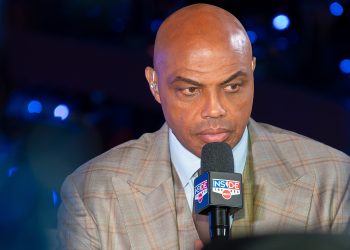
With the TNT-produced “Inside the NBA” replacing “NBA Countdown” as ESPN’s primary studio show next season, Sunday’s Game 7 marked the final studio segment for the network’s in-house crew — for now, anyway — and it went out in characteristic fashion.
With Indiana somehow up one at the half despite Haliburton’s injury, Stephen A. Smith ran the only play in the “First Take” playbook and angrily ranted about Oklahoma City’s poor play. Much has already been said on this site (and elsewhere) about Smith, but an underrated aspect of the Stephen A. era is the constant negativity. “Embrace debate” requires anger in order to function, and in order to sustain that anger, it requires failure. There must be someone to blame, to lambaste. Any praise or appreciation must be in comparison to someone who can be diminished.
When Haliburton struggled earlier in this postseason, there was Smith to mock and insult him. When Haliburton played until the very last his body would allow, there was Smith to castigate his opponent. Whatever game, whatever player, whatever moment, there Stephen A. Smith will be to trumpet any and all shortcomings, as loudly as possible.
In discussing the negativity surrounding the NBA, the prominent position of Smith has to be considered a factor.
What ESPN did right on the NBA Finals
ESPN’s NBA coverage has become a national piñata, but the network did at least one thing right during its NBA Finals coverage.
The decision to have Scott Van Pelt on-site for postgame coverage was such a good move one wonders why it was not done before. Few things connote ‘big game status’ like SportsCenter taking place from the game-site, and there are few anchors better equipped to anchor postgame coverage than Van Pelt, who has handled that role in-studio for a full decade.
Being on-site allowed him to have an eclectic mix of guests, from players to even ESPN play-by-play voice Mike Breen. Dating back to his radio show, which he once co-hosted with Mike Tirico, Van Pelt has been skilled at making the game and his guests the star — the kind of approach that is sorely needed on ESPN’s NBA shoulder programming.
It is hard to imagine how Van Pelt will be able to reprise his role next year, with “Inside the NBA” taking precedence. Will he host postgame shows after “Inside,” which would put him on the air potentially an hour after games conclude? Will he host concurrent postgame shows on ESPN2 while “Inside” airs on ESPN?
The “Inside” deal is essentially ESPN kicking the can down the road on its studio problem. Whatever the eventual solution to that problem — if there even is one — Van Pelt should be part of it, assuming he is interested. He will be in his 60s by the time the “Inside” deal ends, assuming it lasts at least two seasons. Those are still prime years in sports TV, but they are also years in which broadcasters of a certain standing can be more selective in picking assignments. “Monday Night Countdown” is one thing, “NBA Countdown” might be another.
Plus: Eyes on Breen, NBA Finals schedule, new media rights deal
Following Game 6 of the NBA Finals, social media users were talking about Mike Breen as if he was Neil Breen. Breen’s call of Pascal Siakam’s poster dunk — off of a no-look pass by Haliburton — was perhaps a bit on the ho-hum side, but it was far from subpar.
It is likely that Breen viewed it as merely a nice play, not an iconic one worthy of an equally iconic call, and he may be proven right in that respect. Especially with the Pacers’ loss, it seems unlikely that the play will be one of those all-time Finals moments where the call lives on in history.
Breen, who just completed his 20th NBA Finals as ABC’s lead voice, was not at his highest level this season. That simply comes with the territory of the upheaval at ESPN in recent years. Breen has worked with three different analyst configurations in two seasons, with he and Doris Burke joined by Doc Rivers, J.J. Redick and now Richard Jefferson — each for less than a full season. He was not put in a position to do his best work, as he had to help facilitate chemistry with three very different kinds of announcers: the gladhanding Rivers, self-serious Redick and jocular Jefferson.
But make no mistake, Breen is still in his broadcasting prime.
The 18-day length of the NBA Finals made it one of the longest series in NBA playoff history — tying it with the 2016 Cavaliers-Warriors finals (which also went seven games) — and that still was not enough to prevent Haliburton’s injury. The reality is that an elongated NBA Finals will do little to preserve player health coming off of an 82-game regular season and three rounds of playoffs. All that the 18-day format seems to do is sap the Finals of momentum from game to game and force games onto low-rated nights like Friday.
An easy solution to the scheduling issue is a return to the old 2-3-2 format, which would allow for two days off between game sites while maintaining a more typical 14-day schedule. (It would also reduce travel, which would seemingly help mitigate injury risk.)
The Finals could open with Games 1 and 2 on Tuesday and Thursday, take two days before shifting to 3, 4 and 5 the following Sunday, Tuesday and Thursday, and then take two days off again before Games 6 and 7 the following Sunday and Tuesday — essentially the schedule it had during the CBS days.
Even if the league wants to stay with 2-2-1-1-1, a reduction of the Finals schedule should be on the list of changes in the new media rights deal. Even just starting on a night other than Thursday to avoid the totally unnecessary two-day break between Games 1 and 2. (How about Tuesday-Thursday-Sunday-Tuesday-Friday-Monday-Thursday?)
Game 7 of the NBA Finals marked the end of the league’s 2014 media rights deal, which went into effect with the 2016-17 season. The nine seasons of this rights deal were, as mentioned previously, not exactly a golden era for the league.
With the NBA moving forward with two new partners in NBC and Amazon, and with ESPN importing “Inside the NBA,” next season will mark the most significant change to how the NBA is presented on television since ESPN/ABC replaced NBC in the 2002-03 season.
Media coverage can only go so far, but perhaps the new deal by itself will go a long way to changing the vibe surrounding the league.