Welcome back to “On the Air,” in which Sports Media Watch Podcast co-host Armand Broady will offer in-depth breakdowns of broadcasters’ on-air performance and career journeys, plus chronicle broader trends in the industry.
Sports media historians know the name Ray Scott. In the 1960s and ’70s, Scott was a prominent voice of NFL coverage on CBS. He called four Super Bowls, including the first two, and the famous Ice Bowl of 1967.
In those days, CBS assigned its NFL announcers to single teams. Scott drew the Packers. Under legendary coach Vince Lombardi, Green Bay won five championships in the ’60s, and Scott’s voice became inextricably linked with the franchise.
He was the master of brevity; no flowery prose, no highfalutin jargon — just conciseness and accuracy. Scott announced games like a stern professor at the front of a classroom, his rich baritone voice providing measured captions. “Starr … Dowler … touchdown.” His position was unequivocal: The audience can see what’s happening. Let the TV cameras do the heavy lifting.
It’s an approach Scott’s pupil and former broadcast partner Pat Summerall adopted. For more than 20 years and across two networks, Summerall worked with analyst John Madden, forming one of the most acclaimed broadcast teams in sports television history. With his animated delivery and constant use of onomatopoeia, Madden gave the broadcasts an uncommon verve, while Summerall anchored the telecasts with his short, deliberate morsels of commentary.
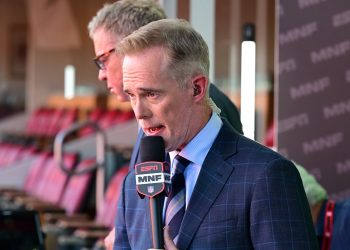
A TV play-by-play announcer exercising such extraordinary self-restraint seems unfathomable in 2025. Host Dan Patrick addressed this topic recently with ESPN “Monday Night Football” voice Joe Buck on the “The Dan Patrick Show.”
Patrick asked, “When did we get to the point where we had to fill all of the time with voices?”
“It should be the reverse,” Buck responded. “Don’t be afraid to not talk. Insecurity breeds overtalking. I can make the case that with the advancements that have been made in audio, there is no more dead air. If I don’t talk, you’re going to hear Aaron Rodgers calling out signals at the line of scrimmage or just good natural sound.”
Buck’s point is valid. Part of the charm of an NFL telecast is hearing the quarterback go through his cadence at the line of scrimmage. Think of Tom Brady’s “GREEN 18,” Dak Prescott’s “HERE WE GOOOOOOO” or Peyton Manning’s “OMAHAAAAA!” To allow the audience to fully appreciate what unfolds pre-snap, the announcers have to be silent, at least sometimes. The viewers can see a receiver going in motion, a linebacker approaching the line to show blitz, or a tailback lined up behind the fullback in the I-formation.
Buck practices what he preaches. Many of his most memorable calls offer few words. When the Giants took a late 4th quarter lead over the Patriots in Super Bowl 42, Buck declared, “Manning … lobs it … Burress … alone … touchdown, New York!” His voice-cracking call of “Diggs … sideline … touchdown!” during the Saints-Vikings 2017 divisional playoff game became an instant classic, not just for his enthusiasm, but for his economy of words.
It should be noted that the word “enthusiasm” has not always been associated with the veteran announcer. For close to a decade, Buck was scorned by viewers and columnists for his dispassionate calls, including his infamous description of David Tyree’s helmet catch in Super Bowl 42. By his own admission, Buck was following the Scott-Summerall template too closely.
“I tried to sound like Pat,” Buck admitted to The Ringer in 2016. “People took that as indifference.”
Summerall is regarded as an all-time great by most observers, but his calls fit within a different era of football and of sports television. Today, Summerall’s play-by-play would be deemed joyless and unemotional. Times change.
While insecurity is a plausible reason for overtalking, there are other possibilities. Many TV play-by-play announcers come from radio, where everything must be explained. Shifting from radio’s descriptive style to television’s caption style can be a daunting task. It is also plausible that TV executives and audiences expect announcers to talk more. Many feel there’s a clear correlation between energy and commentary. Some hold that if the announcer is glad to be working the game, he or she should talk more so as to not appear bored or jaded.
Broadcasting is a subjective field. On television, the rule of “less is more” still applies. Sure, Ray Scott’s laconic style is anachronistic in today’s “information overload” environment, but he captured the spirit of what TV play-by-play is. The industry’s best announcers understand the importance of using the right words, not the most words.
Plus: Unpacking Drew Brees’ second chance at broadcasting
Drew Brees will be a game analyst for Christmas Day NFL coverage on Netflix, according to Andrew Marchand of The Athletic.
Once considered an heir apparent to NBC’s Cris Collinsworth, Brees parted ways with the Peacock network after being panned for an underwhelming on-air performance during the Raiders-Bengals Wild Card game of 2022.
It shouldn’t be surprising that a player of Brees’ stature is getting another chance at broadcasting. He is a future first ballot Hall-of-Famer and some of his NBC work was fine.
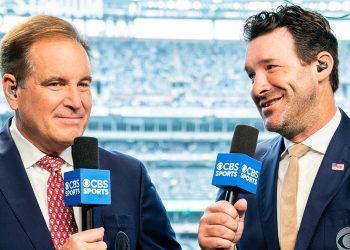
What makes Brees’ comeback tour unique is the circumstances surrounding it. For last year’s Christmas doubleheader, Netflix used prominent game announcers from CBS and Fox. But networks like ESPN and Fox are reportedly reluctant to share talent with Netflix this time around, creating room for analysts like Brees. Consider this: If Netflix could get Kevin Burkhardt and Tom Brady (as they reportedly wanted last year) or Jim Nantz and Tony Romo to lead its broadcasts, would Brees get the nod? It seems unlikely.
Whichever game he calls — Cowboys-Commanders or Lions-Vikings — millions will tune in, providing Brees an opportunity to redeem his once promising broadcast career. On a larger scale, assuming the NFL doesn’t wield its immense power, Brees’ performance could motivate a streamer like Netflix to look past established announcers at other networks and elevate (if only for a couple games) its own voices.