Sports Media Watch presents thoughts on recent events in the industry, starting with a look at the frenzied backlash to news that NFL RedZone will include ads, and whether there is a legitimate reason why ESPN unfairly took the blame.
Much has been said — too much in fact — about NFL RedZone beginning to run ads. The outrage was so over the top that the story became fodder for politicians, including one who made a campaign ad about it. The NFL largely made its own bed; after all, nobody forced the league to run with the “Seven Hours of Commercial Free Football!” tagline for 16 years. But it was ESPN that had to lie in it.
Social media was insistent last week that ESPN’s deal to acquire NFL Media assets was the reason for the change. While it is expecting far too much for the general public to be aware of the minutiae of complicated media mergers, the announcement last month stated explicitly that the NFL will continue to own and operate NFL RedZone — and the deal of course still has months to go before gaining government approval. And yet this fairly definitive debunking was of little impact.
“Nobody cares,” a resigned “SportsCenter” anchor Scott Van Pelt wrote in response to this writer’s effort at clarification. “Just yelling about us.”
Did people really think the National Football League — of all things — needed to be forced by Disney to monetize a product? Surely, the NFL, with its 17-game schedule, expanded playoffs and multi-million dollar rights deals for one and two-game packages, might not need any encouragement to find additional revenue between the couch cushions.
But from the angry rants on social media to the politicians trying to pander to them, there was no shortage of confidently incorrect suggestions that ESPN was behind the whole thing.
Yet as obnoxiously as those claims were often communicated, maybe there are some legitimate concerns underlying the conspiracy theories. No, ESPN had nothing to do with the ads. But ESPN has gotten so big that it is not hard to understand why people might get the wrong impression.
Just over the past five weeks or so, ESPN has been on a self-promotional roll that may exceed anything in its history. The NFL Media deal was enormous, both in terms of what the transaction will entail (if approved) and its meaning. ESPN owning the NFL’s own network? The NFL owning a piece of ESPN? This deal would have been unimaginable a decade ago.
The deal was announced almost simultaneously with the launch of ESPN’s newly revised app and direct-to-subscriber platform, and an accompanying marketing and PR campaign so all-encompassing that it extended even into Stephen A. Smith voice overs on New York’s “E” train.
Combined, the deal and the app give a distinct impression of an ESPN-dominated future where the network is unavoidable. Thought you could hone in on the NFL 24/7? Now ESPN owns NFL Network. Thought you could watch your favorite team all summer? You may soon need the ESPN app to watch MLB.tv. Stand clear of the closing doors.
Companies become unavoidably massive all the time. Try to think of the last time you avoided a Google product in a 24-hour period. ESPN could never get so big, right? Surely, there will always be sports fans whose interests are niche enough to avoid need for the Worldwide Leader. But consider how ingrained ESPN already is into the average sports fan diet, without the company absorbing whole networks and local rights.
It is pretty clear at this point that ESPN has designs on becoming a bundle. It of course is not going to completely replicate the current cable bundle, which would be a cumbersome and expensive endeavor. But there is no way that an ESPN app that just consists of the existing ESPN networks will be enough to achieve the success the company is clearly seeking. All of the hype the past few weeks was not so ESPN could settle for a supplemental cable alternative to get cord-cutting sports fans ‘off the sidelines,’ as Jimmy Pitaro once said. There are obviously bigger plans.
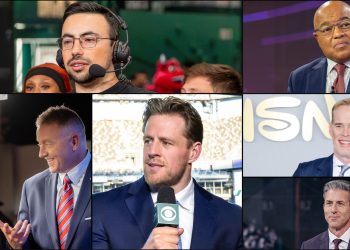
If there is any major theme of the Pitaro era, it is the absorption of competition. Sometimes through traditional means, like signing Joe Buck and Troy Aikman away from FOX. Sometimes through licensing deals, as for “The Pat McAfee Show” or “Inside the NBA.” Sometimes as part of traditional rights deals, like the looming deal for MLB.tv. And sometimes — and maybe just the once — through a full-on media merger, as with NFL Network.
Add NFL Network, MLB Network and MLB.tv to the existing NHL Power Play and now you have something that is indispensable to fans of three of the four major leagues. Imagine an ESPN app that has hoovered up not just the widest portfolio of national rights, but also the various sport-specific options that in the past two decades have emerged as alternatives to ESPN, places of refuge for the ardent fan who just wants highlights and analysis.
A previous column wrote of the “indispensable, unavoidable” ESPN, but perhaps the better terminology would have been “inescapable.” ESPN as the Google of sports, a company that you might not want to do business with, but have no choice to, with its influence visible everywhere.
Maybe it was that sentiment fueling the social media mobs last week. Then again, social media mobs rarely need a reason to assemble, and it certainly seems charitable to assume any rational motivation on their part. And it is worth noting that ire toward ESPN is not a recent development. People online were referring to ESPN as “BSPN” as far back as the Stuart Scott era, which is now romanticized — but generated no shortage of criticism in the moment.
A lot of folks online talk a big game about spurning ESPN. ‘Oh, I don’t watch ESPN except for the games.’ That is a lot like saying ‘I don’t use Google unless I need to search for something.’ It is already pretty hard to believe the ‘I stopped watching ESPN’ crowd, because it’s pretty hard to watch sports in any real depth without it. And as time goes on, ESPN is going to set about making it impossible.
Charles Barkley once joked that he would never work there, because they were not going to work him like a dog and not pay him. And yes, his paychecks will still say “TNT Sports.” But he’s going to be there October 22.
The “Inside” deal is unique, but indicative. ESPN is absorbing all the alternatives. And while the social media mob was wrong about RedZone, it would be fair to have real concern about the competition being assimilated into the proverbial Borg.
So if there was genuine anxiety at the root of all the rage last week, it makes sense. ESPN seems as powerful and ubiquitous as ever, and it is certainly not shy about letting everyone know. That did not, and will not, play into any production decisions the NFL makes for NFL RedZone. But that may prove more exception than rule.
Freshly-extended PTI last line of defense for the old ESPN
News broke Monday night that ESPN has reached contract extensions with “Pardon the Interruption” hosts Tony Kornheiser and Michael Wilbon through 2028. John Ourand of Puck was first to report. After ESPN canceled “Around the Horn” this year, it would have been fair to wonder how much longer “PTI” would last — but it never seemed like the show was on the chopping block. ESPN aired a full hour edition just last Thursday.
“PTI” is truly the last of its kind on ESPN, as none of the other afternoon sports talk shows remain. It may be hard to believe now, but there was once an ESPN sensibility — a bit sarcastic, not overly serious. While “PTI” helped usher in the screaming debate era that now defines ESPN and all of sports television, it was formed in the final years of that 1990s ESPN vibe. With some exceptions, the anger on the show has rarely seemed real, and not in the disingenuous way of “First Take,” but in the exaggeratedly comic fashion of a show that does not take itself too seriously.
It is perhaps the only show in sports television with any patience for history — the end-of-show “Happy Time” segment usually has at least one history lesson — and while it can sometimes veer too much into curmudgeon territory, it is also one of the only shows in the industry where the arguments seem to be made honestly rather than for engagement.
It is hard to imagine that the show will continue much longer beyond this extension, which will take Kornheiser up to age 80, but for however long it lasts, it may be the last thing holding the line for an ESPN long since gone.