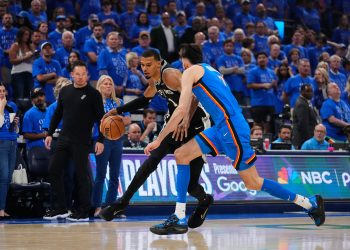
In its return to broadcast television on NBC, the revamped NBA All-Star Game bounced back both on the court and off.
Sunday’s NBA All-Star Game averaged a Nielsen-estimated 3.3 rating and 6.73 million viewers on NBC, with the latter figure rising to 8.8 million including a Spanish-language audience on Telemundo and an Adobe Analytics-measured streaming audience on Peacock — marking the largest audience for the annual exhibition since 2011 (9.1M).
The USA vs. the World round-robin, which peaked with 9.8 million in the 7 PM ET quarter-hour, nearly doubled last year’s Nielsen-only audience of 4.7 million on TNT Sports. (NBC’s position is that because Nielsen does not track its streaming viewership, its combined Nielsen + Adobe audience figures are comparable to the Nielsen-only figures of other networks.)
The combined audience was the highest for any traditional All-Star Game since the Major League Baseball edition drew 9.3 million in 2017. (If one counts last year’s NHL “Four Nations Face-Off” as an All-Star event, the final of that tournament drew 9.3 million.)
Keep in mind that Nielsen did not track out-of-home viewing in its estimates until 2020 and did not do so in 100 percent of markets until last year. In addition, Nielsen in September shifted to a new metric that combines “Big Data” from smart TVs and set-top boxes to its traditional panel. Those changes would not explain a year-over-year increase of such size, but will generally skew comparisons to prior years.
This year’s All-Star Game was the first to air on broadcast television since 2002, also on NBC. And just as in 2002, this year’s game was sandwiched between Winter Olympics telecasts in a 5 PM ET Sunday window. (The 2002 game also saw a pronounced viewership bump, benefiting not just from the Winter Olympics but also the presence of Wizards G Michael Jordan.)
The preceding “Milan Prime” Winter Olympics window (2-5 PM ET) averaged a combined 12.8 million across Nielsen and Adobe Analytics, and the “Primetime in Milan” Olympics lead-out averaged 15.0 million. Those figures include all NBC platforms, including ones that did not air the NBA game. On a Nielsen-only, NBC-only basis, the All-Star Game actually grew out of its Olympics lead-in, but that is because the official Nielsen-measured Olympics window ran 600 minutes from 7 AM-5 PM ET.
While there were no shortage of complaints on social media about the earlier start time — and it likely affected in-person attendance in Los Angeles, where the festivities began at 2 PM local time — 5 PM is generally a better start time on Sundays than primetime. (One need only look at the NFL, whose largest audiences in a given week are during the 4:25 PM ET “national window” rather than “Sunday Night Football.”)
Between the return to broadcast television, the Winter Olympics lead-ins and lead-outs, and the improved timeslot, it is likely the case that literally any version of the NBA All-Star Game — even a reprise of East 211, West 186 in 2024 — would have hit a multi-year high.
But this year’s game likely benefited further from the new “USA vs. the World” format and the apparent increase in intensity that ensued. The first three quarters — each of which was a ‘mini-game’ with a winner and loser — were tightly contested. That was a far cry from the laid back efforts of recent years, which have been the subject of increasingly overwrought criticism.