As the first half of the Major League Baseball season continues, baseball fans are getting used to a new local media ecosystem. The years-long collapse of Main Street Sports Group, combined with broader changes in the industry, has created prolonged instability and confusion.
This year, that applies to the MLB.TV out-of-market viewing product in particular, which enables subscribers to view games beyond their geographic territory. Although the league itself developed and launched the multiplatform product in 2002, it recently granted the out-of-market streaming rights to ESPN as part of a larger three-year media rights deal reportedly worth $550 million annually.
ESPN is now selling MLB.TV through its streaming platform at a price of $30/month or $150/season, and it is also providing new customers with a one-month free trial to ESPN Unlimited that can be canceled at any time. Existing ESPN Unlimited subscribers, whether they are standalone users or subscribe via a pay television provider, receive a $15 discount on the seasonal plan.
New MLB.TV users who sign up with an ESPN account connected to a pay television subscription also receive the discount on the full-season plan. Those who decide to sign up a monthly basis can connect their subscription to a corresponding MLB account, though consumers may have difficulty determining where to link the two accounts, but an ESPN Fan Support post can point you in the right direction.
After signing in to the MLB.TV account, you may assume the process is complete and that you can use the league’s smart television app to begin watching the full slate of action. Yet it may take some additional time for the league’s application to recognize the active MLB.TV monthly subscription. In fact, you may need to exit your MLB account entirely and log back in to view the out-of-market games.
It should be noted that returning MLB.TV users had their subscriptions automatically renewed as usual before the season without any action required from ESPN platforms. Subscribers can access the service through both the ESPN platform and the league-owned outlet, but there are differences in terms of discoverability, user interface and the overall consumption experience.
Both platforms offer the basics, such as the option to watch games in real time or on demand, along with the ability to choose the home or away team feed. Watching games on MLB.TV through ESPN, however, also adds interactivity and integrations with statistics, fantasy and betting, plus streamlined access to other sports content.
When navigating through the ESPN interface specifically though, the discoverability of MLB.TV content is not as straightforward. In order to find MLB game broadcasts, users generally need to navigate through categories or the master schedule.
Once browsing to the MLB category, upcoming and previous game broadcasts are displayed at the forefront. To find replays for games more than two days old though, users need to toggle through the schedule. (Replays for games from previous seasons are only available through the league’s MLB.TV platform.)
When users try to view a replay of a game from earlier in the month through MLB.TV on the ESPN App, it may begin with an unskippable, 15-second advertisement. Afterwards, you should be able to scrub through the game broadcast freely and see where commercial breaks take place. There is no advertisement at the start of replays on the league-owned platform, but finding specific points in the game is actually more difficult without these markers.
A benefit for the MLB platform is in being able to toggle between game broadcast feeds without losing the specific timestamp. In trying to do this on the ESPN App, the presentation starts from the beginning with another 15-second advertisement. Switching between audio occurs instantly on both platforms.
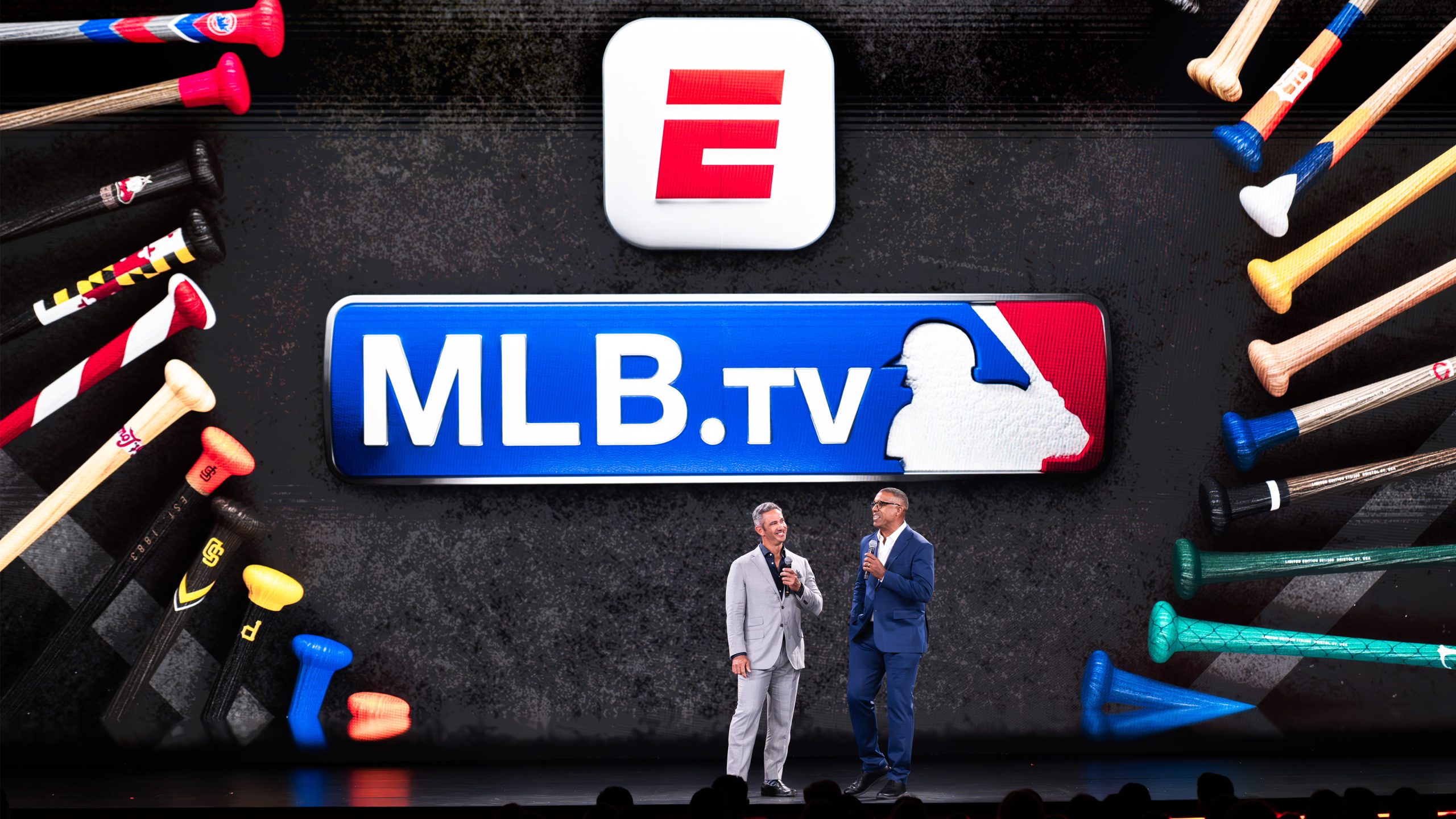
(Disney/Pawel Kaminski)
JORGE POSADA, EDUARDO PEREZ
The cable television landscape of old has been transformed into a fragmented digital labyrinth, but the impediments are starting to vanish. Several vMVPDs have pushed to ingest streaming services into their platforms as part of carriage negotiations. YouTube TV in particular recently inked deals to ingest sports content from ESPN Unlimited and Peacock onto its platform. ESPN Unlimited content is also available directly within Fubo, although Disney-owned Hulu + Live TV combined business operations with FuboTV as part of a merger transaction that closed earlier this year.
MLB.TV has been available on vMVPDs for the last several baseball seasons, and that is still the case. For example, the DirecTV streaming service offers MLB.TV as an add-on subscription for users and offered a free preview featuring out-of-market games during the first week of the regular season. Every team has its own assigned channel on the service that televises the live game feed, a setup that makes navigating games relatively facile.
The vMVPD option, however, does come with some sacrifices. Enhanced features associated with the ESPN App and live statistics and insights through the MLB platform are not available, although users can garner this information through channels outside of the viewing experience.
Streamlining the operations for the user probably makes this form of live viewership the best way to watch out-of-market games. The league allows users to link MLB.TV subscriptions purchased on other streaming platforms directly to its own interface, something that reduces confusion and enables consumers to access live game replays, advanced statistics and more.
Offering the MLB.TV channels directly within the vMVPD reduces the need to shift from one application to another. As sports media has become more fragmented, there are instances where viewers may find this inconvenient — especially when games are exclusive to a streaming service. For instance, MLB Opening Night on Netflix aired concurrently with basketball and hockey games broadcast on RSNs, which are not accessible through the Netflix application.
The issue has been somewhat alleviated on Friday nights since DirecTV is now ingesting live sports content from Apple TV into its electronic programming guide, permitting subscribed users to view games without exiting the application.
Later this week, for example, DirecTV users would feasibly be able to watch out-of-market MLB games, “Friday Night Baseball” on Apple TV and most playoff games in the NBA and NHL from this centralized hub. DirecTV licenses MLB.TV through a deal with the league, and when a user subscribes to MLB.TV through their DirecTV account, ESPN receives the majority of the subscription revenue.
There are plenty of bundling options for users to gain access to MLB.TV, including for teams whose in-market games are produced by the league itself. Many of these clubs have subscriptions for $40/month or $200/season that grants consumers the ability to stream in-market games for their local franchise and out-of-market contests on MLB.TV.
ESPN holds these in-market streaming rights to those teams but did not exercise them for this season. Once it does – and that is expected to occur next season – there may be some more confusion about the content accessible using different types of subscriptions. For now, the system seems to be running smoothly.
Some pay television providers offer a free MLB.TV subscription with the MLB Extra Innings package redeemable through the league’s website. T-Mobile members continue to receive free access to MLB.TV as a perk for using the mobile provider. No matter how you access MLB.TV though, the primary points of entry are through the ESPN App, the league-owned platform or integrations through select providers.
There is no standardized best solution to view out-of-market games through MLB.TV, but as someone looking to watch a blend of major sporting events and other programming, you may find the vMVPD method most optimal.
ESPN Unlimited is expected to soon add NFL Network to its portfolio of offerings, and The Walt Disney Company also offers a bundle with NFL+ Premium that provides access to NFL RedZone. Combined with access to most out-of-market NHL games and some exclusive national broadcasts, this option may also function well for viewers with an eclectic palette of sports interests.
Baseball fans with no interest in other sports content may be better served by a one-time purchase to access MLB.TV and regional contests for their local team.
As baseball seeks to continue appealing to younger demographics and growing the game, it has spread its national inventory across seven different media partners under deals reportedly worth more than $2 billion annually. All of these contracts expire following the 2028 season, at which time the league will presumably seek to bundle national and regional rights to garner more lucrative packages for years to come.
MLB has yet to nationalize local rights across the board, and the outcome of the media rights negotiations could be affected by the next collective bargaining agreement between the league and MLBPA. Whether the two sides can avoid missing games remains to be seen, but in the meantime, fans are tasked with voyaging ahead in what seems to be a temporary plug before the dam bursts. The question is just how much fans are willing to experiment before they decide it is time to find a new source of entertainment without the headaches.