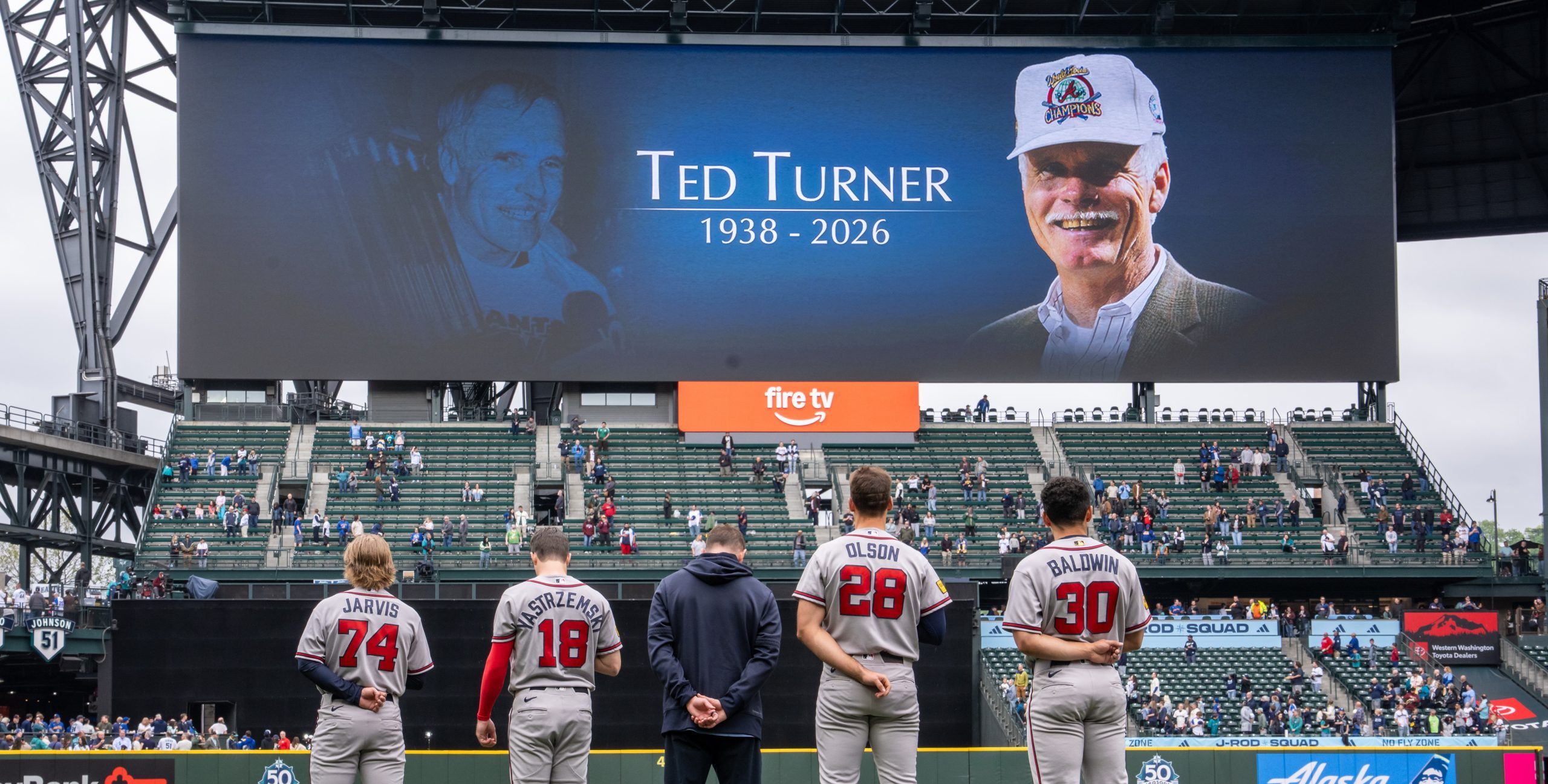
Ted Turner, the media mogul and team owner whose TBS “SuperStation” helped pave the way the era of cable TV sports, died Wednesday at 87.
In a few short years a half-century ago, Turner rapidly went from running his late father’s regional billboard business to the owner of a handful of regional radio stations, to the owner of a little-regarded UHF station WJRJ in Atlanta, known as Channel 17. It was that station, soon to be renamed WTCG, that would transform sports TV.
WTCG had a modest programming lineup consisting of an “inexpensive” programming slate, as described in Ken Auletta 2005 biography “Media Man: Ted Turner’s Improbable Empire”: “The Mickey Mouse Club, Three Stooges movies, and every sports event he could find.” Among those sporting events were Atlanta Braves games, which Turner acquired from the more established WSB (Atlanta’s NBC affiliate then, now affiliated with ABC) in 1973.
To Turner, “the Braves were just a summer replacement show to I Love Lucy reruns. It was either the Braves or a gospel hour,” famed sportswriter Jim Murray wrote in 1977. “Still,” he added, “television will do anything to improve ratings. So, Ted Turner bought the Braves.”
For his part, Turner offered a more generous explanation for his 1976 purchase: “Call it a civic venture. The present owners wanted to sell the Braves and they wanted to sell it to Atlanta interests. I did it for the city and for the South,” he said upon the sale.
Whatever the motivation, Turner’s ownership of the Braves — and soon after the Hawks — was well-timed, coming as he capitalized on the rise of satellite technology to turn his local UHF station into a national cable network that would eventually be named WTBS.
The Braves provided the content that would form the backbone of the “SuperStation.” (MLB had sought assurances that Turner would not distribute Braves games beyond his territory, and he agreed. “He would later argue that he ‘had no idea of the potential extent of cable carriage of the WTBS signal,'” then-commissioner Bowie Kuhn wrote in his 1997 book “Hardball.” “That is like arguing that Harry Truman had no idea of the damage an atom bomb might do to a Japanese city.”)
His WTBS SuperStation would feature reruns and some original programming — or “all that drivel Ted Turner keeps alive to fill time between Braves baseball games and commercials for the amazing ‘Pocket Fisherman,'” humorist Lewis Grizzard wrote in 1983 — but to this very day no single entity was ever more associated with TBS than the Braves, save perhaps for Turner himself.
Turner’s launch of CNN was with little question the single most significant act of his tenure, whatever one thinks of CNN and its programming (surely even its detractors can admit that their preferred cable news networks would not exist if not for Cable News Network). His sports endeavors are of comparably less importance, and are overshadowed by the launch soon after of ESPN. His SuperStation was not unique. (“The country was being indiscriminately flooded with baseball” between WTBS, WGN and other superstations, Kuhn wrote.)
Nevertheless, first with the Braves and then later with fully national major league rights deals, Turner became inextricably associated with sports, and sports television. His cable empire aggressively pursued all manner of sports rights and made a push to acquire ESPN in its early days. As owner of the Braves, he once donned a uniform and managed the team for a day, and at one point received a Steinbrennian year-long suspension. He created his own answer to the Olympics, the Goodwill Games.
To put it simply (and it is not a unique observation), he swung for the fences in ways that modern day executives do not even begin to approach.
One of the most consequential media executives in history, Turner in his 20th century heyday was a colorful and well-known public figure — “the Col. Sanders of cable television,” Tom Shales wrote in 1983. He is unsurprisingly also one of the most chronicled, the subject of any number of biographies and a 2008 autobiography.
Long after he relinquished his creation to Time Warner, which over three misspent decades frittered it all away, Ted Turner remained synonymous with one of the influential sports divisions in the industry: “Turner Sports,” often just “Turner.”
His death comes as the business he built splinters. His cable networks are on the verge of being absorbed by Paramount, and even if they continue to exist in name only, they will surely take a backseat in any combined venture. One of the tributes to him that aired Thursday aired on the TNT-produced NBA studio show that now airs on ESPN, as TNT lost its long-held NBA package.
Other tributes included statements from the NBA and Major League Baseball, plus segments on the channels he created, from CNN to the NHL on TNT.