The name Wimbledon connotes a certain insular sensibility. The grass courts, the strict all-white dress code, the cathedral-like silence between points — it all demands a presentation style that feels informed, polished, and steeped in tennis tradition.
For decades, that style has been expressed by some of the most prominent names in tennis broadcasting. Established voices like Dick Enberg, Cliff Drysdale, Ted Robinson, and Mary Carillo — broadcasters who became synonymous not just with the action, but with the pomp and grandeur of the tournament.
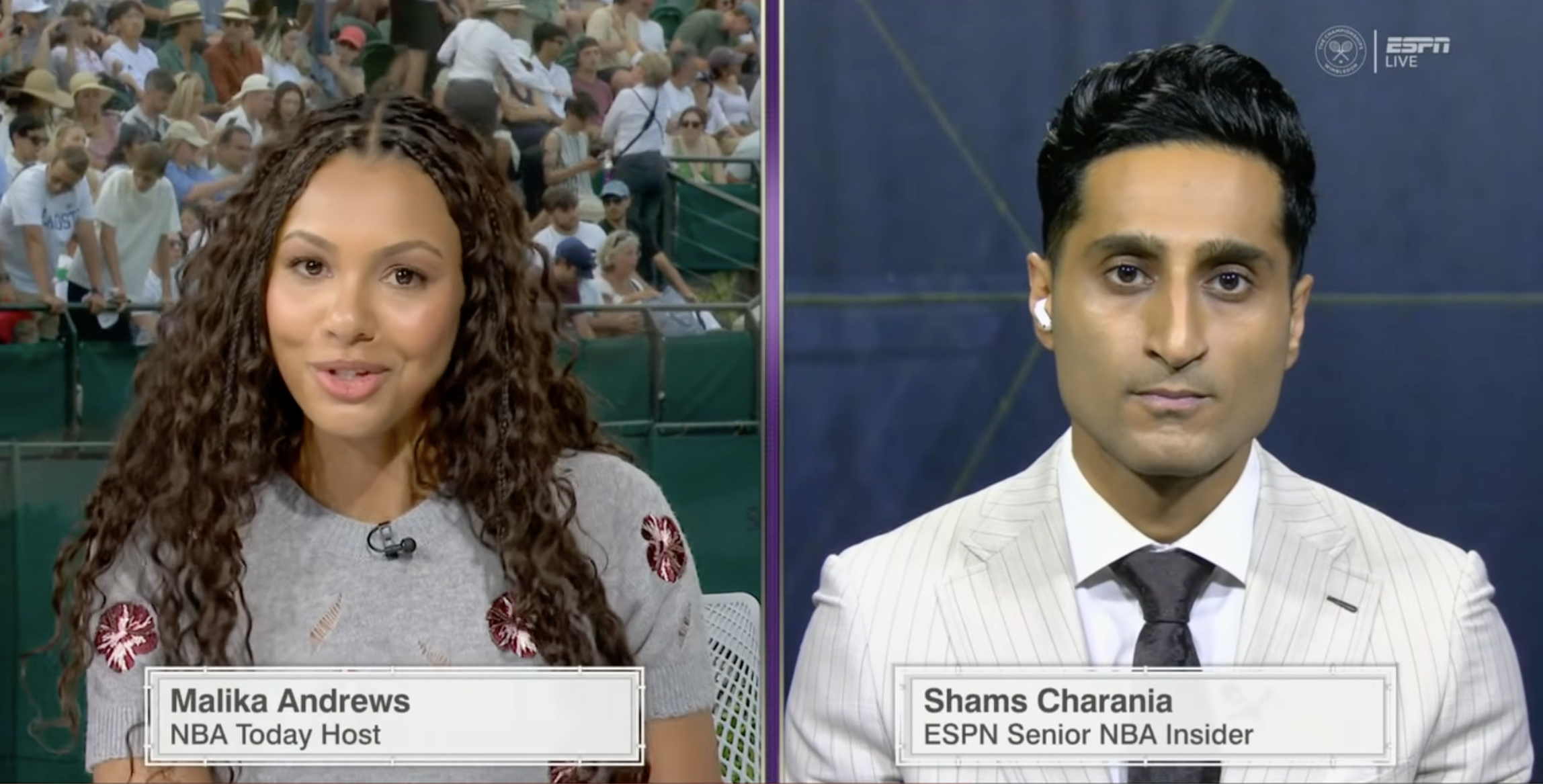
Wimbledon’s carefully preserved tradition was met with an interesting twist when ESPN announced it would feature Rece Davis and Malika Andrews as studio hosts for this year’s coverage.
The changes follow longtime host Chris McKendry’s transition from the studio desk to the booth, succeeding Drysdale, who retired in September after a 46-year career with the company.
Neither Davis nor Andrews has ever worked Wimbledon; in fact, neither could accurately be described as a conventional tennis host. Since 2015, Davis has been the trusted face of iconic college football pregame show “College GameDay.” Andrews, meanwhile, has built her reputation over the last few years as one of the premier voices of ESPN’s NBA coverage through her work as lead anchor of “NBA Today” and her strong reporting during the network’s coverage of the NBA Finals. Both are highly accomplished broadcasters — intelligent, poised, and more than capable of guiding a broadcast.
But the Wimbledon audience is not a raucous “GameDay” crowd nor a forum for takes on NBA trades and social media posts. Tennis fans tend to be particularly protective of their sport’s presentation. Grand Slam coverage has traditionally been anchored by broadcasters with deep institutional knowledge — people who understand player storylines as well as the sport’s subtle nuances, etiquette, and rhythms.
That is not to suggest outsiders cannot succeed. Great broadcasters are, after all, excellent communicators. In past years, ex-ESPNers Mike Tirico and Tom Rinaldi called action at Wimbledon. At one time, Chris Fowler — Davis’ “GameDay” predecessor and current lead tennis voice — was considered something of a misfit in the Wimbledon booth.
Away from ESPN, Ernie Johnson and Marv Albert, two of the NBA’s most accomplished television personalities, provided commentary for TNT Sports’ coverage of Wimbledon in the early 2000s. Today, the network turns to host Adam Lefkoe — best known for his NBA and college basketball work — and lead MLB play-by-play voice Brian Anderson as the primary on-air talent for its French Open coverage.
Davis and Andrews are respected hosts who ask intelligent questions and lead compelling discussions. Sometimes, a fresh voice can broaden a sport’s appeal, making the broadcast more attractive to casual viewers.
Still, ESPN risks alienating its core tennis audience if the network draws too heavily from its familiar football and basketball playbook. On Tuesday, Andrews shared the news of LeBron James’ plans to enter NBA free agency while sitting at the Wimbledon desk alongside analyst Andy Roddick.
“We are here at Wimbledon, but like Serena Williams, there are certain stars that transcend sports,” Andrews said during the on-camera announcement.
While the James news is undoubtedly significant, ESPN’s decision to break into its Wimbledon coverage to announce it is a bit off-putting. “SportsCenter,” which was airing on ESPN2 at the time, was a more appropriate platform for the James news, reaction and analysis. Instead, Andrews broke the news and interviewed NBA insider Shams Charania from her position at the Wimbledon desk.
Hardcore tennis fans have little to no desire to have coverage of the sport’s most revered tournament interrupted by news of an NBA player leaving his team. A fair argument can be made that coverage of other prestigious championship events — surely The Masters — would not have been interrupted in the same manner.
In recent years, ESPN has increasingly emphasized personality-driven studio programming. Debate segments, crossover references, and narrative framing dominate much of the network’s flagship content. That formula can work for sports like football and basketball, which are built around nonstop conversation and spectacle. Tennis, however, exists in a different realm. It rewards patience, context, and analysis over noise. And its ardent fans deserve coverage that is tailored specifically for them.
Earlier this year, ESPN let go of analysts Pam Shriver and Brad Gilbert, who spent more than 60 years combined at the network covering tennis. Choosing marquee network personalities over tennis specialists can send the unintended message that star power matters more than subject-matter expertise.
Perhaps ESPN sees Davis and Andrews as bridges to newer audiences. That strategy is understandable in a competitive media landscape. But in appealing to the casual, mainstream sports fan, it can be easy to forget that an event like Wimbledon can stand on its own — without need for associations to college football Saturdays or the NBA. Its prestige lies largely in its distinctiveness.
ESPN’s challenge is not simply attracting viewers, but making sure to understand that part of the appeal of Wimbledon is that it is not like the other events — and like the Masters, that is part of its appeal. Although tennis fans may tolerate the occasional experiment, they likely won’t stand for feeling patronized.
There are few sporting events that rival the history and unique aura of Wimbledon. As ESPN tweaks its tennis roster, it is important that the network remembers not every sport follows the same broadcast playbook.
Plus: How writing became SportsCenter’s DNA
Longtime “SportsCenter” anchor Linda Cohn signed off from ESPN this past Friday, ending a remarkable 34-year run that began in 1992.
Cohn’s ascent coincided with the peak years of “SportsCenter,” a period widely regarded as the program’s “golden era.” That label may sound corny and nostalgic to some, but for viewers who lived through it, the description is apt. In its heyday, “SportsCenter” blended witty personalities, wall-to-wall highlights, and reporting and commentary that stood alongside the best in television.
At the center of that success was one often-overlooked ingredient: writing. “SportsCenter” icons like Dan Patrick and Rich Eisen, alongside Cohn, have repeatedly emphasized how essential quality writing was to the show’s identity.
“(Former ESPN executive) John Walsh, to his credit, would always say ‘I just want good writers,'” Patrick told Eisen on the “This Was SportsCenter” podcast. “He wasn’t concerned how you looked; he wanted to know how you sounded.”
Writing was the pulse of the show. Anchors wrote their own scripts, allowing each broadcast to carry a distinct voice and flair.
Though fans tuned in for the highlights, the anchors took particular pride in their lead-ins — the concise 15 to 30-second setups that framed each segment. Those brief moments, which could feature anything from Shakespeare quotes to Greek mythology to obscure pop culture references, often represented “SportsCenter” at its finest.
The industry has changed dramatically since the show’s 1990s zenith, yet there is no shortage of industry professionals who will agree strong writing remains the impetus for compelling storytelling.
Cohn’s retirement gave longtime viewers a chance to reflect not only on who made “SportsCenter” memorable, but also on what made it so special. At the core of one of sports broadcasting’s most beloved eras was writing that was sharp, intentional, and deeply impactful.