One of the interesting aspects of the “Inside the NBA” reminiscenses over the past few weeks is that most of the clips shared on social media have been recent. Nearly all have featured Shaquille O’Neal, meaning nearly all have taken place in the past 13 years. By the time O’Neal joined the show, the trio of Ernie Johnson, Kenny Smith and Charles Barkley had been working together for more than a decade, and had already shared no shortage of memorable moments.
Perhaps it is because so many of those moments are from before the HD era, a truly different time not just in television. Perhaps it is because in the young-skewing NBA fanbase, many of the present-day viewers were too young to stay up until 1 AM ET watching a postgame show in those years. Regardless of the reason, the situation is not unlike Barkley’s playing career. So many of his highlights are from his time with the Suns and Rockets, but those came toward the end of his run. His prime was with the 76ers, when the footage was a bit grainier.
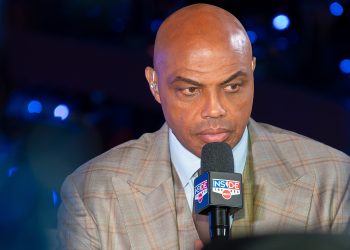
Barkley, who said Friday that he will retire from television at the end of next season, is still in his broadcasting prime. At 61, he is still the single most influential analyst in sports television. Nobody is hiring Tony Romo to co-host a cable news show. Troy Aikman is not doing five radio hits a week. In the long history of sports television, only John Madden was ever as culturally relevant, bursting through walls in beer commercials and eventually becoming the personification of NFL video gaming.
What gets lost in the analysis of Barkley’s career is just how transformative it has been. In those early, pre-HD days, Barkley revolutionized the studio show. He was not alone in doing so, as Johnson, Smith and Tim Kiely had already laid the foundation for what “Inside” would become. Yet it was Barkley who took the show to the next level when his broadcasting career began in 2000. Suddenly, it was ‘everything goes,’ from the silliness of a shirtless Barkley doing a weigh-in to the seriousness of the discussion after he was pictured on the cover of Sports Illustrated in slave garb — possibly the “Inside” segment with the most friction, if one that everyone forgets (or is too young to remember).
Even just the conversational interplay of Johnson, Smith and Barkley was a marked change from the norm. Here were television analysts looking at each other (not the camera), having conversations that never seemed to stop. They kept talking over the outro music playing them into commercial, and they were still talking when the show returned from break. (You never quite knew what you were missing.) The games, gags and pranks were fresh, and without precedent. The Shaq era from which most “Inside” clips originate has been comparably formulaic. All of that was Tim Kiely’s singular vision, but it was Barkley that brought it to fruition.
Barkley was able to do so because he already occupied an unusual position as a social commentator, comedian and pitchman during his playing days. He was not afraid to court controversy in advertising (“I am not a role model“), in press gaggles or on the court, and yet he rarely paid a reputational price. Consider how Roberto Alomar’s image tanked for spitting on an umpire. Barkley, quite infamously, once spit at a heckler and accidentally hit a young girl instead. That would be a reputation killer for anyone regardless of contrition, but not him. Even the more-recent DUI that got him suspended from TNT for months in 2009 would have altered most careers. For Barkley, it was a blip.
The manner in which Barkley was — and is — Teflon is unusual. He is not simply getting away with saying controversial things, as so many public figures do, by retreating into a niche fanbase. He is broadly beloved despite saying controversial things, perhaps even because he does so. He is regarded as an honest broker who says what he thinks with no artifice or ulterior motive, even when the ulterior motives are obvious (as with his flirtation with LIV Golf and the massive contract extension with TNT that came afterward). In those scenarios, the bluntness of his motives is more proof of his honesty. He was not, after all, hiding his desire for more money.
His gregariousness has helped him throughout his public life. The little, disarming chuckle he often gives after a particularly cutting jibe takes out much of its sting. Contrast that with Draymond Green, who in guest appearances on TNT this season could not hide the malice in his commentary. When Barkley says something that would otherwise be regarded as inappropriate or mean-spirited, it seems so obviously to be a joke that only the most humorless could take issue.
Perhaps that is because Barkley has shown that he himself can take a joke. Consider O’Neal’s sensitivity regarding his career. It has become a bit of a running gag — “four rings, Chuck!” — but at the core is the same genuine offense underlying all of his various feuds. Barkley, by contrast, has rarely appeared to take personally the numerous cracks about his lack of championships, his weight, his golf swing, or any of his other perceived failings. Essentially, he can dish it out because he can take it.
None of these qualities are easy to replicate. It is hard to be perceived as honest. It is hard not to take oneself too seriously. It is especially hard to be liked, and to have viewers, reporters and executives view your statements in the best possible light. Green, as natural a broadcasting talent as basketball has seen in recent years, comes off as a cheap shot artist. Football’s Romo overdid the schtick and now the viewers who once found him charming deem him grating. To be seen as contrived, to be seen as having an agenda — these are judgments of authenticity.
There is little more powerful in media, politics or public life in general as appearing genuine. That alone can paper over any number of other flaws, as shown by non-sports examples so obvious as to not merit mention. It may not even be possible to build that kind of trust with the audience in the social media era, where artifice is the language of the day and every single utterance is parsed endlessly for engagement.
Even if it is, there are simply not a lot of Charles Barkley prototypes on the assembly line. He is, to use a cliché, ‘one of one.’ His combination of plain-spokenness, good humor, and relative lack of ego is simply not coming back around any time soon.
The irony of the preceding paragraphs is that Barkley’s retirement announcement on Friday could well be a leverage play. It sounded genuine and markedly different from his other flirtations with retirement, but in the wake of his LIV Golf pursuit and the massive contract that followed, it is worth remembering that Barkley did not just stumble accidentally into millions and lasting fame. He is more keenly aware of what he is doing than he lets on. Yet rest assured that if Barkley ultimately continues his media career, most observers will trust that he simply changed his mind.