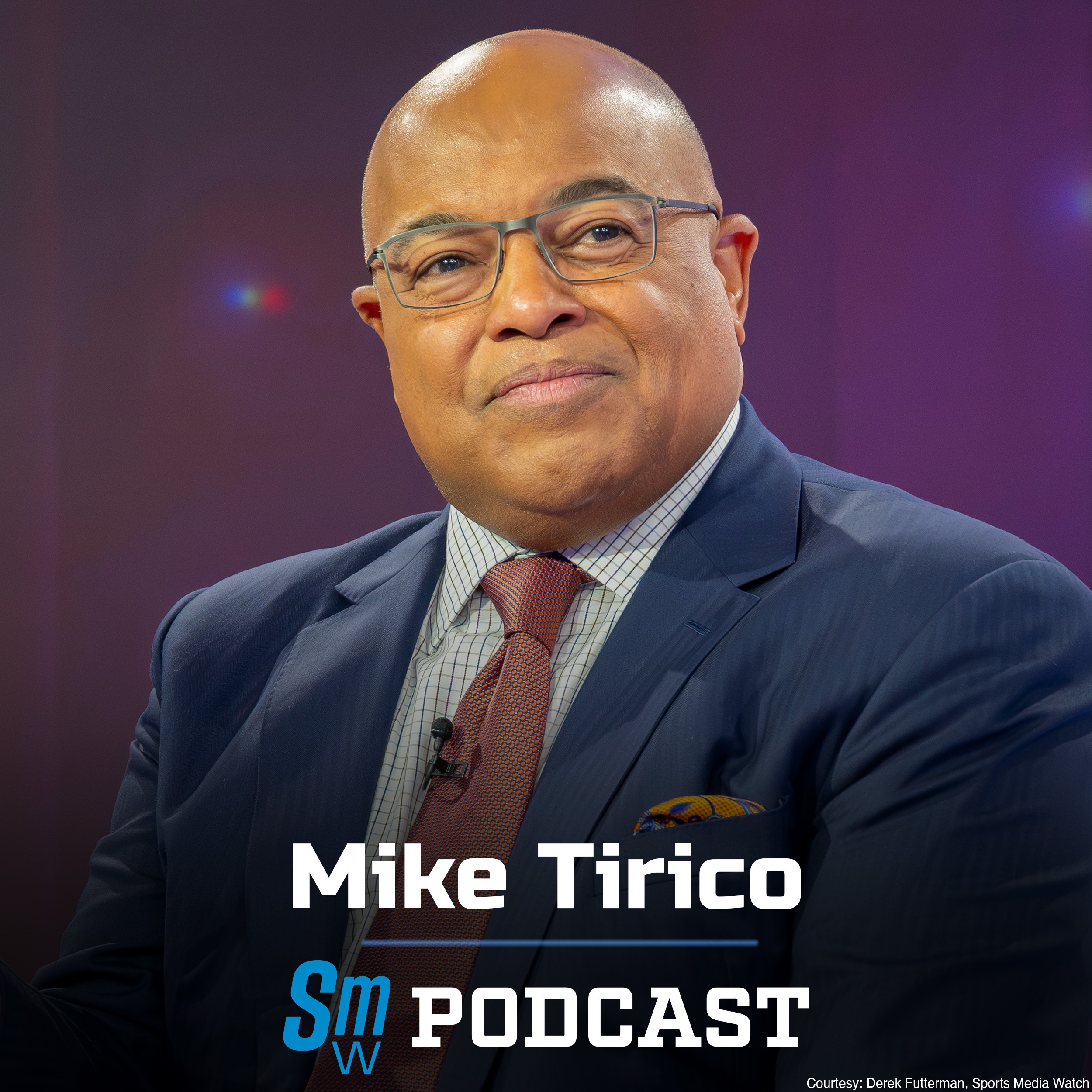
Longtime NBC Sports host and play-by-play voice Bob Costas joined Jon Lewis and Armand Broady on the Sports Media Watch Podcast this week in a wide-ranging interview covering the final years of his career on TBS, the criticism he received for his work in last year’s postseason, his relationship with NBC Sports, the golden years of his career and much more.
[Related: the following piece about the conclusion of Costas’ play-by-play career, written by Armand last year, is discussed during the podcast: On Bob Costas, aging announcers, and changing times]
Listen to the full episode below. The Sports Media Watch Podcast is available on Apple Podcasts, Spotify and more.
Costas on his final years with TBS
“So Jeff Zucker — whose first job out of Harvard had been as Bryant Gumbel’s researcher, and mine, at the ’88 Olympics in Korea — by then is running CNN. He says, why don’t you come over and be a contributor at CNN to talk about when sports crosses over into news? Sure, that’s great. He’s my friend, that’s a comfortable situation.
For about an eye blink, Jeff becomes the head of Turner Sports. … He wants me to join their baseball coverage in a much more expansive way than I was comfortable with. I didn’t want to bump anybody else who was in the prime of their career. He convinced me to at least do the Division Series. And I thought, okay, you know what? I didn’t quite get the closing note at NBC. You know, I didn’t need, as I’ve said many times, a brass band and a parade, but you don’t want to just disappear without the slightest bit of closure.
I would have been happy to host some program and then for two minutes at the end say, well, it’s been a wonderful ride. Thanks a lot, everybody. So long. But without that, there’s an empty feeling. So, I’m thinking maybe baseball, for one season with Jeff, can give me that. …
My mistake was, after that one season, I should have said, ‘I’m only here because of Jeff’s invitation, I’ll leave now.’ But TBS wanted me to do a couple more years. I thought, okay, I will. If I thought that I couldn’t perform at least close to my past standard, I wouldn’t have done it.
I realized that I was no longer at whatever my level was, but I thought I could get close enough. I prepared very hard, and I thought I made allowances for any diminution in sharpness or whatever. And it didn’t quite turn out that way. But that’s the reason that all of this happened as it did.”
Costas on the end of his tenure with NBC
“NBC and I get sideways. That’s in the process of mending itself now, so that maybe I can achieve that grace note back where I belong at NBC, but that’s a separate story. So we get sideways, mostly over my comments about CTE in football, and the IOC’s troubling affinity for authoritarian regimes.
At that point, and I think it was shortsighted on both parties, some passive aggressive stuff going on. Both of us couldn’t see the forest for the trees and we threw up our hands and said, okay, it’s been a good long run. …
It should have ended more graciously and in a more mutually respectful way. I think quite possibly, had it happened that way, I might not have done the baseball on TBS. … I suggested to them — and maybe if we’re able to work out a return, this will happen in some form — I had suggested back in 2018, why don’t we do a show called ’40 Years of NBC Sports’? It would be natural in the minds of the audience for me to host. That show you do it on some fallow Saturday or Sunday when there isn’t much out there, and it’s like catnip to the audience.
Not just all the great events. It’s all the great voices. It’s Marv Albert. It’s Curt Gowdy. It’s Don Criqui. It’s Tom Hammond. It’s Vin Scully. It’s on and on, and I would be the host of it. A handful of the dozens and dozens of play by play calls would be me, but I’d be almost incidental, except as the host.
Then right at the end, I would say something like, which I could say right here off the top of my head, ‘Wow, what an incredible 40 years. So many great moments. And it was my good fortune to be part of so many of them. Thanks to everyone I worked for and with. Thanks to all of you for watching. I’ll see you somewhere down the road. For all of us at NBC Sports. Bob Costas, so long.’ That would have been more than good enough for me.
You know, a lot of other people — and I’m happy for them, they deserved it — but a lot of other people whose tenure was not as long, nor as wide, in terms of, of all the things I did, both in and out of sports, for NBC, a lot of people received a much more fulsome tribute, and they deserve every bit of it. I’m happy for them.
But that was, that was a little off, that it happened that way. And that sort of left me for looking for the ribbon and, and maybe, in a bit of poetic justice that ribbon is found right back at 30 Rock, but we’ll have to see. Nothing certain yet, but maybe.”
On staying with NBC Sports
“Staying in sports, part of that decision was my kids. When [David] Letterman offered me — and CBS offered me — the hour after his, which would have been to do the same type of show that I had been doing at NBC, kind of an eclectic interview show, they included within that a correspondent position at 60 Minutes.
Which was very tempting and very prestigious, but as I put it, the shorthand is you can’t say to an eight-year-old kid, ‘I’m interviewing the Secretary of State. Want to come?’ But you can say — not just in theory, it happened all the time throughout their childhood — ‘let’s go to the NBA Finals, let’s go to the World Series, let’s go to the Olympics.'”
On the NBA on NBC
“Dick Ebersol and all of the people who worked under him, I don’t think a network could possibly do a better job of presenting and legitimately — not hype — legitimately dramatizing a league. You know, all those openings that people miss and they hope that NBC reprises them, those dramatic openings, they weren’t bulls**t.
They took stuff that was true and amplified it and dramatized it. It was a combination of a form of journalism, but also theater. That’s what we tried to do.
We had identifiable people in our studio setups and our producers and directors were just so good, just so good. We were so in sync. You know, every shot matched or every, every little bit of B roll that supplemented what I may have been saying or Marv or Tom Hammond might’ve been saying was pitch perfect.
There was such synchronicity between the booth, the studio and the truck. I don’t think you can do it any better. And then there was John Tesh’s “Roundball Rock.” You need a signature, right? I’d finish or Marv would finish, whatever that setup was. “Game five, next.” Da na na na na na, da na.
I think that what we did — and you think about Tom Hammond, you think about Dick Enberg who played a role in it, you think about Marv Albert — I don’t know how, top to bottom, a sport can be covered any better than the NBA and NBC in the 90s, and I think that’s why people are looking forward to its return, even though most of those people aren’t there anymore.”
Costas on what made the 1990s a different era of mass culture
“It was when the past and future met in a glorious present. It wasn’t in black and white anymore. We could show you a close play from six different angles. By then we had some pretty advanced production techniques. The media landscape had not exploded.
When you talk LeBron versus Michael, you can make an objective statistical basketball argument for LeBron, but you cannot make any argument when it comes to stardom or a certain kind of transcendent greatness. Because, there were games that were on TNT, but the biggest games were on NBC — and in the ’80s they were on CBS, Bird and Magic. The average fan, the casual fan, was talking about those games at the water cooler the next day at the office. I’ve used this example before, just a little hyperbolic — no little old lady has ever said, ‘You know, Mildred? I’d love to play bridge with you tonight, but I gotta watch LeBron.’
But a million metaphorical little old ladies like that said that about Michael Jordan, even if they had no idea why Phil Jackson was now sending Jud Buechler into the game instead of Bill Wennington. They didn’t care. And part of that was, of course, part of that, the big part, was Michael himself. … But a good portion of it was, it was right there on NBC, and it wasn’t just the games. The promos are on Seinfeld, and ER, and [The] Cosby [Show], and Friends, and The Tonight Show, and The Today Show. It’s everywhere.
I think leagues are coming to terms with that now. The NFL is in its own category. They can just print money and have their own way. You see both the NBA and MLB now trying to get back into more of network television. … The leagues may have thought they took the bigger paycheck from cable, but they lost a lot of casual viewers in the process.”