What makes a Game 7 special is that it delivers on the promise to crown a champion. There are no more travel days, no more “if necessary”, no more slanted advantages. Two teams enter the court and one leaves as a champion, the other heads home.
Sunday night’s experience in Oklahoma City was no different. Having been to all four of the Finals games in OKC, the energy was noticeably bigger for Game 7 in the city. Prior to Game 1, a severe thunderstorm moved over downtown. It seemed thematically appropriate for a meteorological-themed NBA franchise, but was perhaps foreshadowing the gut-wrenching feeling fans throughout the city felt after Tyrese Haliburton hit a last-second shot to steal Game 1 from the Thunder. Sunday night there were no clouds, just the summer heat as the crowds swelled outside Paycom Center for Game 7.
The pregame ceremonies continued in the same manner as the other games, but the reality started to dawn on patrons: this could be it. There is no guarantee that OKC will return to this stage soon — the Thunder’s last Finals appearance was thirteen years ago, and only two franchises have appeared in the Finals more than once this decade. A sense of finality lingered over the proceedings, as the clock ticked toward tip-off.
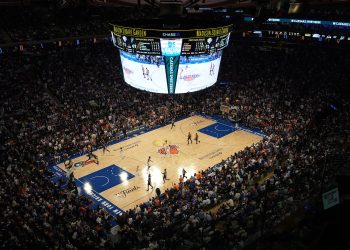
The Thunder’s event production team did not hold back in its presentation for Game 7, with the arena DJ keeping the energy high through the night. The introduction of Oklahoma native Kristen Chenoweth to perform the national anthem drew a particularly loud response from the home crowd. The first quarter proceeded with a tight, back-and-forth matchup as Thunder fans anxiously cheered on their squad.
Disaster struck with five minutes to go in the first quarter. Haliburton, while trying to drive past Shai Gilgeous-Alexander, slips on the court. The ball rolls out of his hands to Alex Caruso, who tosses it back to Gilgeous-Alexander, who takes it to the other end before swinging it to Jalen Williams for an easy dunk and the Thunder lead by two. The Pacers take a timeout as Haliburton is still on the ground.
From this writer’s perspective in the upper deck, the energy did not seem to dip in the arena. Haliburton is quickly helped to the bench, and then back to the locker room. The video board shows a replay of Williams’s dunk while high-energy music keeps going. When the game resumes, there are no injury updates, no locker room reports, no grave proclamations about the state of the game. There is still a Game 7 being played, one where the outcome is certainly still in doubt.
The Pacers, sans Haliburton, take a one-point lead at halftime before the Thunder explode in the third quarter to take a thirteen-point margin. It is at this point that Thunder fans begin to ramp up the energy. They can certainly feel a championship could be coming, but they saw a 15-point lead disappear in less than 10 minutes in Game 1. The crowd explodes with every basket, especially when a 3-pt shot from Jalen Williams extends the lead to 21 with eight minutes remaining.
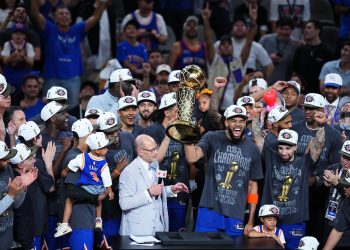
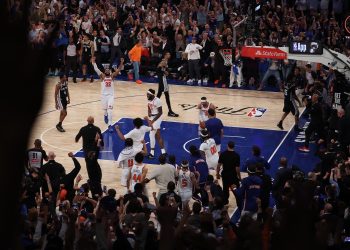
The Pacers refuse to go away quietly. With just over two minutes remaining, the Thunder lead is down to 10 points. This contest is certainly not over — there’s a real, palpable tension from the OKC crowd. The game concludes with a series of foul shots as the Pacers make their last grasp at a championship. As the Thunder dribble out the final seconds of the game, the DJ cues “I Gotta Feeling,” a song released in the second year of the franchise’s time in Oklahoma City. The confetti begins to fall but no one in blue is headed for the exits. The entire crowd remains in place to watch their beloved franchise raise the Larry O’Brien trophy.
An NBA championship in Oklahoma City represents a triumph over several negative events in the city’s history. In 1992, following a long period of economic hardship, Oklahoma City was competing with several other cities to be the site of a new maintenance facility for United Airlines, which would bring new jobs and economic investment to the region. The contract was eventually awarded to — of all places — Indianapolis, with quality of life cited as the reason for the choice. That loss led OKC mayor Ron Norick to develop the urban renewal initiative that included the construction of the building now known as the Paycom Center, where the city’s first pro sports championship was clinched Sunday night.
In 1995, a truck bomb exploded outside the Alfred P. Murrah Federal Building 30 years ago, killing 168 people in the deadliest act of domestic terrorism in U.S. history. Historians have written much more elegantly on this topic (Sam Anderson‘s “Boom Town” is the authoritative text), but the tragedy of thirty years ago and the triumph of today are closely linked. The urban renewal efforts in the aftermath of the bombing included further investments in downtown, without which the arrival of the Thunder would not have been possible. On Tuesday, the Thunder will march down the street in front of the Oklahoma City National Memorial, celebrating a championship triumph over the tragedy of 30 years ago.
Similarly, the disaster that was Hurricane Katrina resulted in the New Orleans Hornets temporary relocation to OKC, who welcomed the franchise with open arms. The success of the Hornets in OKC demonstrated to the NBA the city’s ability to support a permanent franchise, which would come just a few years later.
There have been other setbacks for the city and the franchise even after the team’s arrival. The 4-1 loss to Miami in 2012, losing the 3-1 lead in the conference finals in 2016 and the subsequent loss of Kevin Durant. In July 2019, the Thunder traded away franchise cornerstone Russell Westbrook and All-Star Paul George for a haul of picks and a second-year player from the Clippers named Shai Gilgeous-Alexander.
All of these events, from the most serious to the comparably trivial, were disastrous in the short-term but had long-term effects that resulted in an NBA championship. The city is on top of the basketball world today, ready to celebrate a championship run that will be remembered here forever.