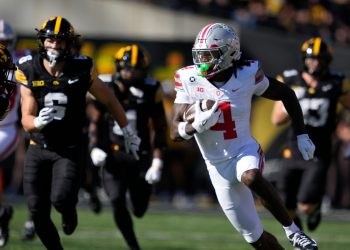
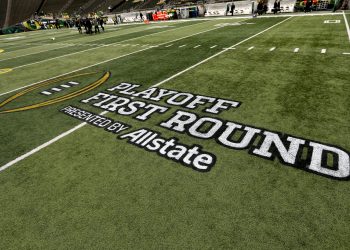
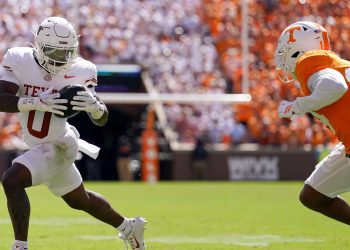
Led by the Rose Bowl, the quarterfinals of the College Football Playoff helped overcome a first round decline.
The College Football Playoff quarterfinals averaged 19.3 million viewers across the ESPN cable networks, up 14% from last year. The double-digit bump helped overcome an NFL-fueled decline for the first round of the playoffs, bringing the two-round average to 14.4 million — up 3%.
Keep in mind that between last season and now, Nielsen expanded its out-of-home viewing sample to cover 100 percent of markets and shifted to a new “Big Data + Panel” methodology that combines its existing panel with data from smart TVs and set-top boxes. Those changes could account for much, or even all, of the year-over-year increases.
The Indiana-Alabama Rose Bowl topped the charts with 23.9 million, up 13% from Ohio State-Oregon last year (21.1M) and the largest audience in the two years of the 12-team College Football Playoff format (19 telecasts) — surpassing last year’s Ohio State-Notre Dame National Championship (22.1M). Indiana football had previously circulated a viewership figure of 22.5 million for the game.
Indiana’s blowout win, which peaked with 25.6 million viewers, ranks fifth out of the eight total Rose Bowl games with playoff or title implications — two BCS National Championship games (2002 and 2006), four CFP semifinals (2015, 2018, 2021 and 2024) and two CFP quarterfinals (2025 and 2026).
In addition to last year’s quarterfinal, it topped the 2021 Alabama-Notre Dame semifinal that was moved to Arlington, Texas (19.3M) and the 2002 National Championship that featured AP-ranked #4 Nebraska (21.6M). (As might go without saying, those prior year figures include less out-of-home viewing or none at all.)
It should be noted that the Rose Bowl had an earlier-than-usual 4 PM ET start that resulted in the game ending before sunset in Pasadena, CA. While Nielsen’s methodological changes make it difficult to gauge real changes in viewer behavior (as opposed to how that behavior is measured), the earlier start does not seem to have had an impact.
Leading out of the Rose Bowl, Mississippi’s Sugar Bowl win over Georgia averaged 18.7 million viewers — up 18% from Notre Dame-Georgia last year, which was moved from primetime on New Year’s Day to the following afternoon after a terror attack in New Orleans. Compared to the previous Sugar Bowl to be held as scheduled, a CFP semifinal two years ago, viewership slipped from 18.8 million for Washington-Texas.
Starting off the New Year’s Day slate, the Oregon-Texas Tech Orange Bowl averaged 15.9 million — down 8% from last year’s Texas-Arizona State Peach Bowl in the same window (17.3M).
With the Rose Bowl moving up to 4 PM ET, both games started earlier than in past years. The Sugar Bowl started about 45 minutes earlier than its previously traditional 8:45 PM ET start. The Orange Bowl started at Noon, rather than 1 PM.
Finally, the Miami-Ohio State Cotton Bowl averaged 19.0 million in primetime on New Year’s Eve — up 37% from last year’s Penn State-Boise State Fiesta Bowl in that window (13.9M).