Ratings are not everything, but in college sports they are of unusual import. The expansions that have functionally eliminated regional conferences were made largely with television markets in mind. At least one major conference, the ACC, uses television ratings to help determine revenue distributions to schools. Last year, ESPN college football writer Heather Dinich reported that one College Football Playoff model under consideration would award conferences more bids based on team records “and maybe even TV ratings.”
If the television ratings can help determine which leagues are most deserving of playoff berths, what — if anything — can they say of the broader health of college sports? The end of the 2025-26 collegiate sports season, which concluded last Monday night, offers an opportunity to take stock of how the various collegiate sporting events fare, both against past performance and each other.
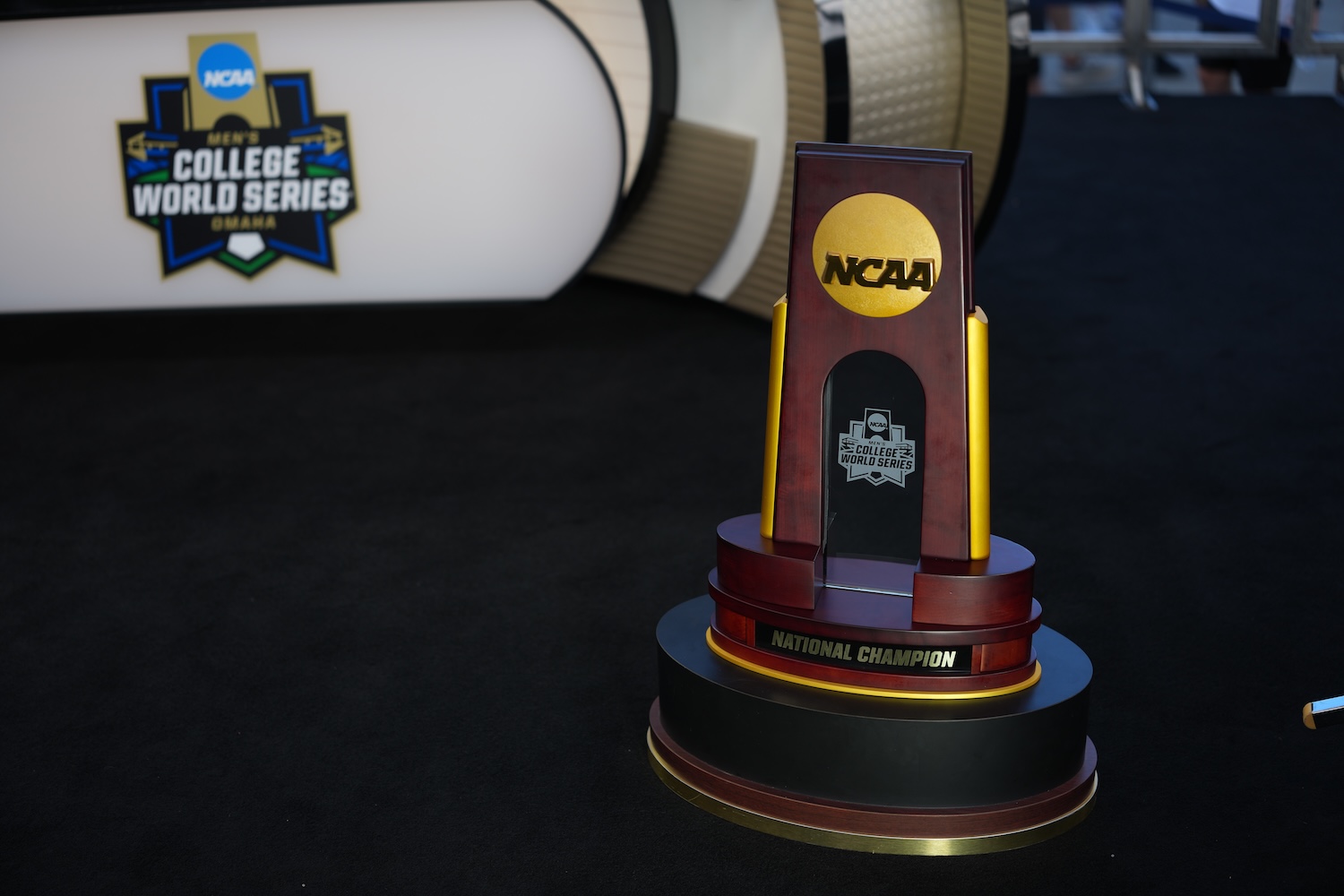
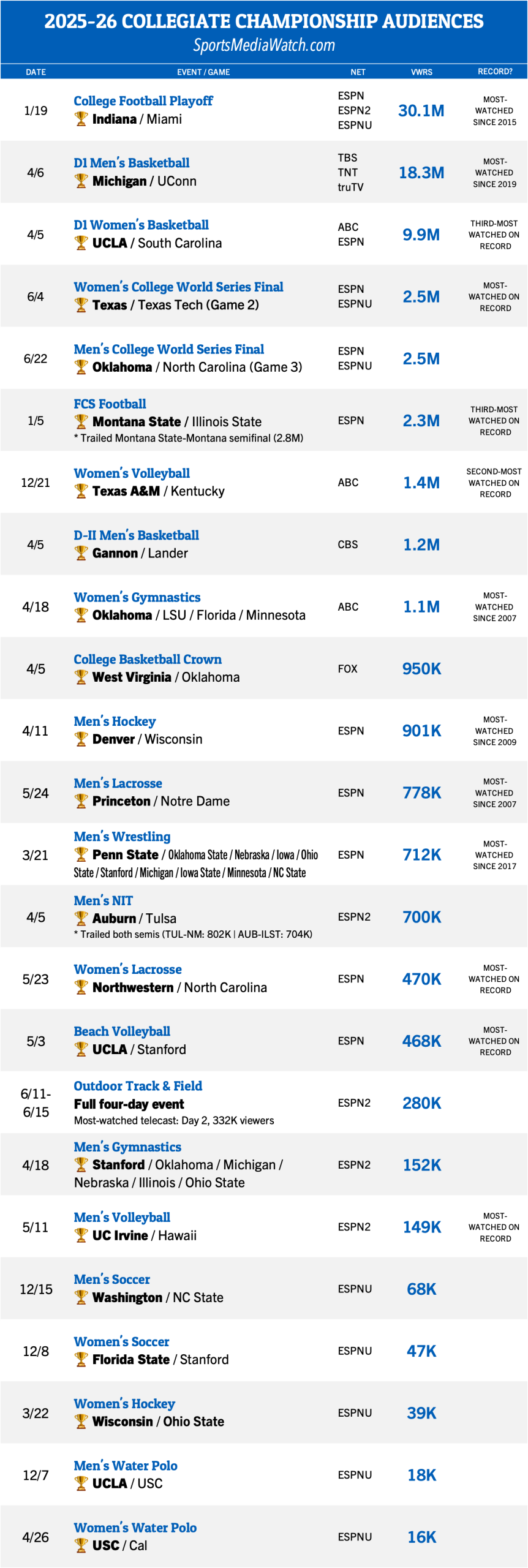
The college sports season concluded last Monday night with Oklahoma’s blowout of North Carolina to win the Men’s College World Series. With viewership down 24% for the Sooners’ Game 3 coronation, it was a quiet end to what was a banner year for the various college championships. In an era of rising sports viewership, triggered partially by Nielsen’s shift to “Big Data + Panel” methodology last fall, the various college championships recorded a slew of viewership highs during the 2025-26 season.
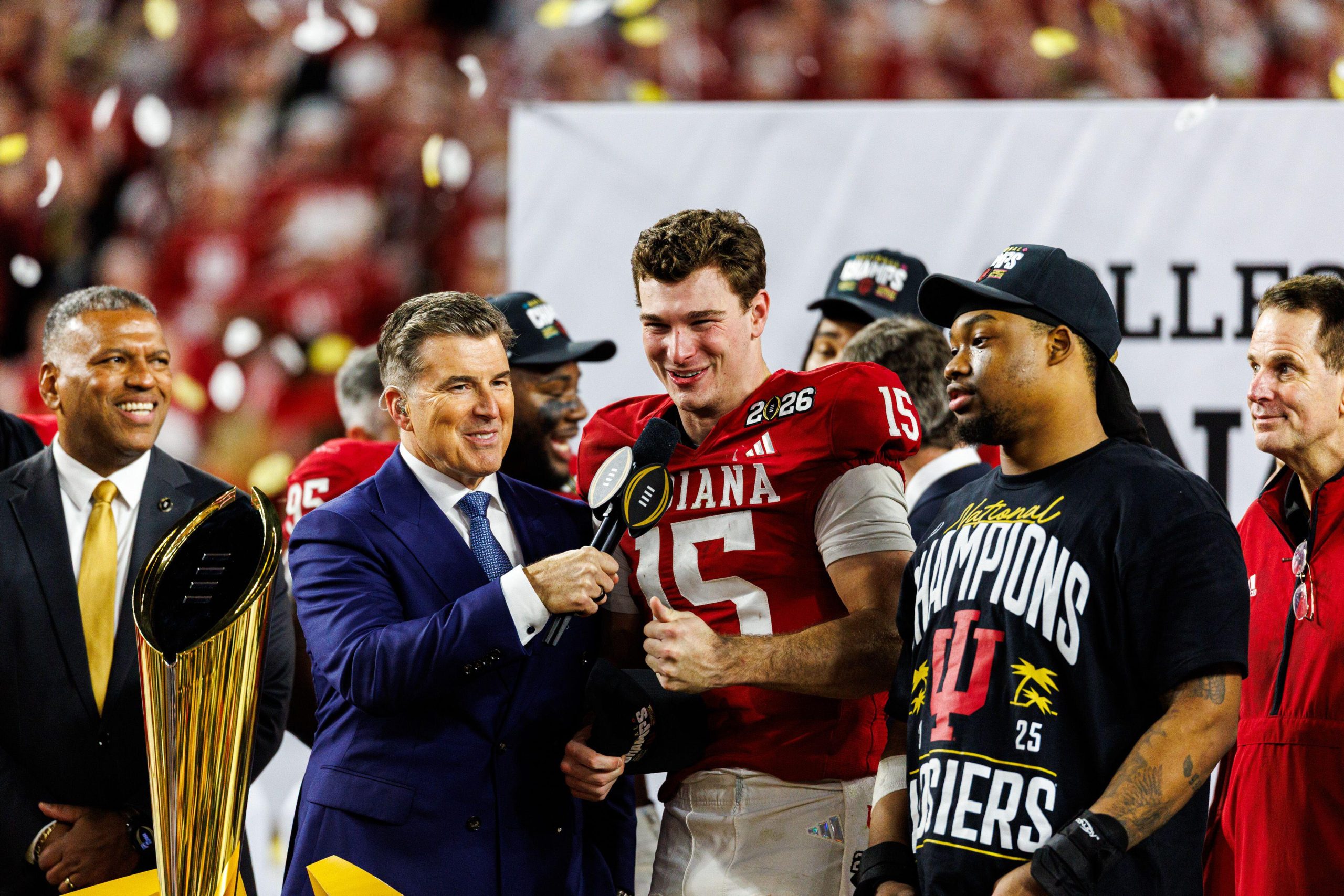
Start with January’s College Football Playoff National Championship. The CFP title game had cracked the 25 million mark just once this decade, and the previous year’s seemingly-titanic pairing of Ohio State and Notre Dame mustered only 22.1 million, on the low end of the historical scale. This year’s matchup of Indiana-Miami did not seem poised to change that trend, coming off of a pair of semifinals that were the least-watched of the CFP era.
No matter. Indiana’s stirring win, capping one of the all-time college sports turnarounds, delivered 30.1 million viewers — the largest for a title game since the inaugural year of the playoff in 2015 and third-largest of the BCS era. Eight million more viewers tuned in than the previous year, well beyond the figure that could be explained by Nielsen methodological changes.
The basketball national championships also exceeded expectations. Despite airing on cable, Michigan’s win over UConn in the men’s title game clocked in at 18.3 million on TBS, TNT and truTV, officially ranking as the most-watched men’s college basketball game since 2019. (In all likelihood, it would have trailed last year’s CBS title game if not for Nielsen’s shift last fall to “Big Data + Panel.”)
There was no multi-year viewership high for the women’s title game, but UCLA’s historically-lopsided rout of South Carolina still mustered nearly ten million viewers, the third-largest audience on record for the national championship. In addition to the usual changes regarding changes in Nielsen methodology, note that the game aired on Easter Sunday — when out-of-home viewership is typically higher. (The household rating, which does not include out-of-home viewing, was actually down year-over-year.)
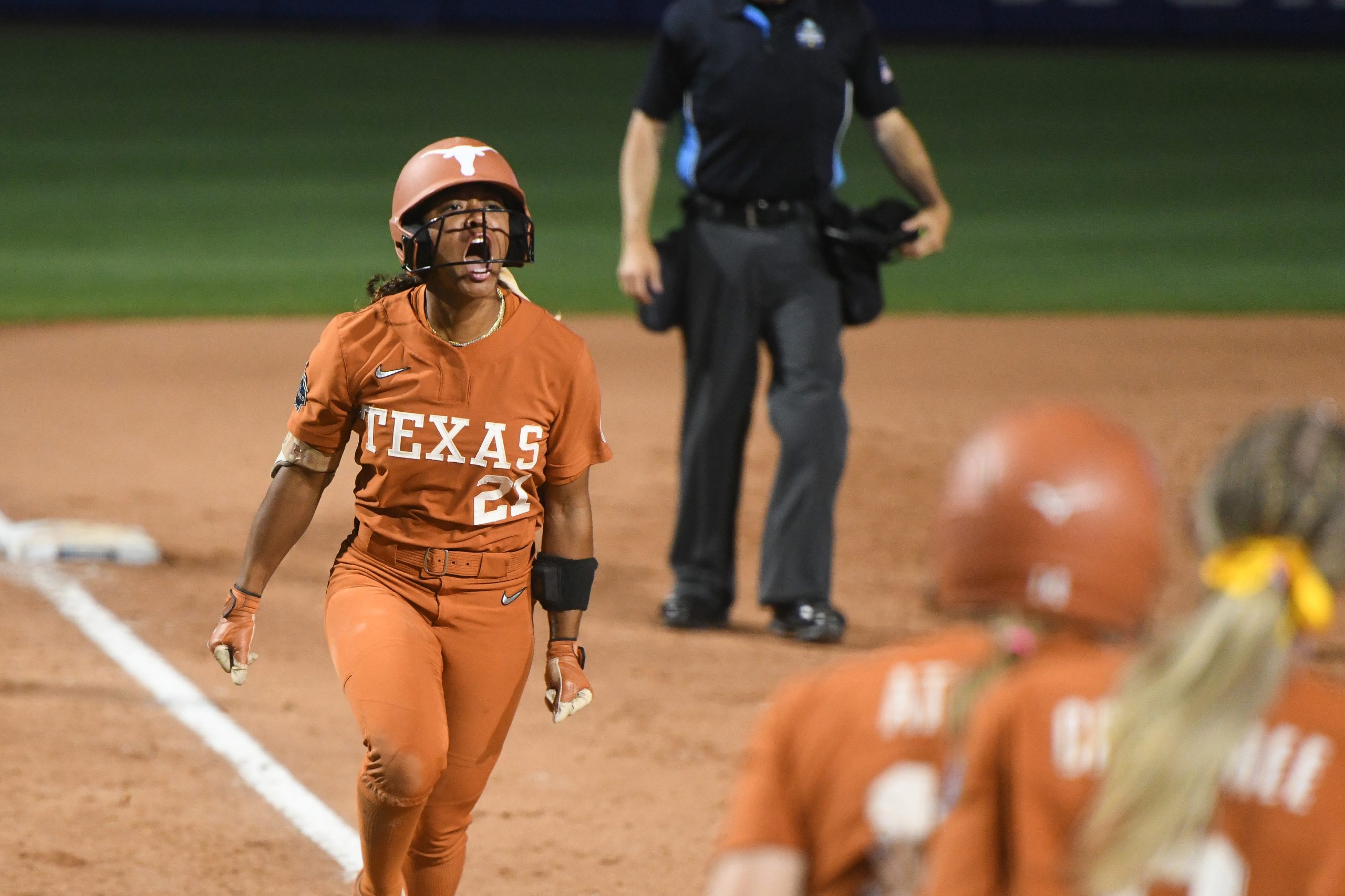
The women’s softball national championship — Texas over Texas Tech in Game 2 of the Women’s College World Series Final — set a new record with 2.48 million viewers, officially the largest audience for a college softball game. For the first time in four years, the most-watched game of the WCWS outdrew the most-watched game of the Men’s College World Series, edging Oklahoma’s previously-mentioned win over North Carolina in Game 3 of the MCWS Final (2.45M). (Note that the MCWS faced the World Cup and the WCWS did not.)
The records kept falling from there. The FCS national championship may not have been the most-watched on record (Montana State’s win over Illinois State was only the third-most watched, and actually declined from last year), but this season still produced the largest FCS playoff audience on record — 2.8 million for a Montana State-Montana semifinal that aired on ABC with a College Football Playoff lead-in.
The women’s gymnastics national championship delivered its largest audience since 2007 with Oklahoma’s coronation drawing 1.1 million on ABC. The men’s hockey national championship, which moved up from ESPN2 last season to ESPN, scored its largest audience since 2009 as 901,000 watched Denver defeat Wisconsin. The Princeton-Notre Dame men’s lacrosse title game (778K) was the most-watched since 2007 and its women’s counterpart between Northwestern and North Carolina (470K) the most-watched on record. Penn State’s win in the wrestling championship was the most-watched since 2017 with 712,000, and the full championship the most-watched since 2013.
Both beach and men’s volleyball set new records in May, while women’s volleyball fell just short with its second-most watched national championship on record last December. The men’s gymnastics national title game could set no records in only its second year on Nielsen-rated television, but its audience of 152,000 still constituted a 42 percent gain.
There were only a select few title games that failed to increase over last year. In addition to the MCWS Game 3, viewership declined for both the men’s and women’s soccer finals and the women’s hockey national championship.
Viewership for collegiate championship events in the 2025-26 season
At a time when the college sports industry is at a crossroads, does the nearly across-the-board growth in viewership for NCAA championships this year bode well for the future of non-revenue sports? Is it a signal of growing interest even in the most niche pursuits? A rising tide that can sustain everyone equally?
In an era of ever-rising viewership and ever-shattered records, the significance of any individual gains is frankly hard to discern. To repeat a question underlying most of the sports viewership stories of the past year, is this conversation about viewer habits or about how those habits are being measured?
And even if one takes the gains at face value, how meaningful is it if the men’s volleyball national championship rises 86% to a record high, but the viewership figure is still just 149,000? The massively outsized popularity of football and men’s and women’s basketball relative to every other sport — even relatively healthy draws like college softball and baseball — is a reminder that the hierarchy is especially top-heavy, perhaps enough to qualify as unstable. Lower-division title games like the FCS in football and Division-II in basketball, or consolation prizes like the College Basketball Crown and NIT, outdraw the top-level title games of other sports.
The audience for college national championship events spans from fewer than 20,000 (men’s and women’s water polo) to more than 30 million. If one were to add up all the national championships covered by ESPN’s deal with the NCAA — so all save for football and men’s basketball — one would have fewer viewers than the football game drew alone. None of that data is particularly shocking, but it is a reminder that the core question in college sports, both within football and generally, is how much longer the biggest and most powerful entities will continue subsidizing everyone else.
A rising tide can lift all boats, but can it keep non-revenue sports from being tossed overboard?
Why NBC made the right move sticking with golf over Yankees-Red Sox
Airing both the PGA TOUR Travelers Championship and MLB “Sunday Night Baseball” for the first time, NBC set its programming strategy months in advance. “We are going to be really smart about taking a lot of our big sports audiences and bringing them into [Sunday Night Baseball] games,” NBC Sports EVP/programming Justin Byczek told Sports Media Watch for a piece published in January.
“The Travelers golf tournament is moving over to NBC — another signature golf event, always a great finish — it’s a New England based event up at TPC Cromwell up here in Connecticut, and we’ve put Yankees-Red Sox behind that. So, we’re strategically trying to tie together big events to bring audiences into some of these other new pieces of our company. But that’s a programmer’s job, to try to string these audiences together and to bring those viewers along.”
It was far from a bad idea. The previous week’s Mets-Phillies game, which led directly out of the U.S. Open, was the most-watched of the season outside of NBC’s Opening Night contest. But NBC’s best-laid plans were doused by a rain delay that pushed the conclusion of the tournament deep into the timeslot set aside of Yankees-Red Sox. NBC decided to stay with the dramatic final round, leaving the first full hour of “Sunday Night Baseball” on Peacock and NBCSN. The decision was not well-received. But was it the right one?
From a ratings perspective, yes. Last year’s Travelers Championship averaged 3.5 million viewers, more than any MLB telecast that season, the most-watched of which averaged 3.0 million. (That audience, it should be noted, was for a FOX regional window that featured Yankees-Red Sox.) Last year’s audience peaked with 5.4 million as Keegan Bradley mounted a stirring comeback to win. This year’s tournament featured even greater drama by way of a leaderboard stacked with major champions, including world #1 Scottie Scheffler. At least on paper, this year’s primetime finish seemed poised to deliver an even larger peak audience.
While it was a tremendous inconvenience for the viewers, having the first three innings of Yankees-Red Sox on Peacock and NBCSN was not necessarily the worst outcome from a ratings perspective. The Nielsen-rated portion of the broadcast will only include the final two hours, which for a tightly contested game that went to extra innings would almost certainly be the highest-rated portion. Given the outsized golf audience that likely led into the game, and the fact that the lower-rated early innings will not be included in the viewership average, it seems fairly likely that Yankees-Red Sox will ‘pop’ even more in the ratings than if it had not been preempted.
Shortened telecast windows are never ideal, but lopping off the first three innings of a baseball game or the first quarter of a basketball game is certainly one way to improve the overall average, particularly if being preempted by a higher-rated event. In the final season of NBC’s old NBA rights deal in 2001-02, the most-watched regular season game — by far — was a Lakers-Blazers contest that was preempted 45 minutes by the end of the Daytona 500.
As noted above, ratings are not everything, and NBC would surely have preferred to avoid infuriating some of the most vocal fans in all of sports, those of the Yankees and Red Sox. Nevertheless, the network should have a good story to tell when the viewership figures come out on Tuesday.