Just days after recording the top non-playoff bowl audience in six years, ABC surpassed that mark thanks to two of college football’s marquee programs.
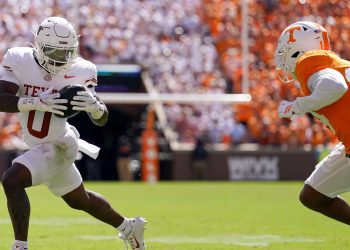
The New Year’s Eve Texas-Michigan Citrus Bowl averaged a 4.3 rating and 9.05 million viewers on ABC, marking the largest audience for any non-CFP bowl game since Michigan faced Alabama in the same game on New Year’s Day 2020 (14.00M). The Longhorns’ win, which peaked with 15 million viewers, surpassed the previous non-CFP high set by the Pop-Tarts Bowl on ABC just four days earlier (8.70M).
Keep in mind that Nielsen did not begin tracking out-of-home viewing in its estimates until 2020 and did not do so in 100 percent of markets until February of last year. In addition, Nielsen has shifted to a new “Big Data + Panel” methodology that combines its traditional panel with data from smart TVs and set-top boxes. Those changes generally skew historical comparisons.
Viewership more-than-doubled last year’s Citrus Bowl audience of 4.26 million for Illinois-South Carolina. Unlike last year, when the Citrus Bowl barely beat ESPN’s competing Baylor-LSU Texas Bowl (4.21M), this year’s matchup dominated the competing ESPN game, Nebraska-Utah in the Las Vegas Bowl. That game had a 1.4 and 3.02 million, up from last year’s late night edition (2.75M).
ABC aired the four most-watched non-CFP bowls, with the previously noted December 27 tripleheader of the aforementioned Pop-Tarts Bowl (Georgia Tech-BYU: 3.9, 8.70M), Pinstripe Bowl (Penn State-Clemson: 3.8, 7.60M) and Gator Bowl (Virginia-Missouri: 2.8, 5.97M) ranking second, third and fourth.
The December 30 Illinois-Tennessee Music City Bowl rounded out the top five with a 2.6 and 5.38 million on ESPN, more-than-doubling last year’s 2.82 million for Missouri-Iowa and ranking as the largest audience for the game since 2021. That led into the USC-TCU Alamo Bowl at a 2.4 and 4.92 million, down sharply from last year’s 8.00 million for BYU-Colorado on ABC. The following day’s Iowa-Vanderbilt Reliaquest Bowl drew a 2.3 and 4.60 million, also down sharply from last year, which featured a more attractive Michigan-Alabama matchup (6.55M).
Shifting to the post-New Year’s games, ESPN drew a 1.7 and 3.4 million for the Navy-Cincinnati Liberty Bowl last Friday, part of a tripleheader that also included the Wake Forest-Mississippi State Duke’s Mayo Bowl at a 1.3 and 2.61 million and the Rice-Texas State Armed Forces Bowl at a 1.0 and 1.80 million. All three games declined, with last year’s equivalent figures being 4.21, 3.38 and 2.85 million.
The ESPN family of networks averaged 3.1 million viewers for the bowl games unaffiliated with the College Football Playoff, up 13% from last year and the networks’ highest average since the 2015-16 bowl season. In particular, ABC averaged 6.2 million for its six bowl games and ESPN drew 2.4 million for its 26. (Nielsen methodological changes could account for much of that increase.)
Overall, the ESPN networks carried the 17 most-watched non-CFP bowl games, no real surprise given they carry the lion’s share of said games. The Arizona-SMU Holiday Bowl on FOX averaged a 1.3 and 2.34 million — down from Syracuse-Washington last year (2.93M) — and the Arizona State-Duke Sun Bowl on CBS drew a 1.2 and 2.17 million (-7%).
As for the FCS, Monday’s Montana State-Illinois State national championship averaged 2.3 million viewers — down from last year (2.4M) but still the third-largest audience on record for the game (with all the previously noted methodological caveats). It was not the most-watched game of the FCS playoffs, as the December 20 Montana-Montana State semifinal drew a 1.5 rating and 2.84 million on ABC in a window that led out of a College Football Playoff game.
The full FCS postseason averaged 1.4 million viewers across the Nielsen-rated ESPN networks, up 8% from last year, though that margin is within the range that can be explained by Nielsen’s methodological changes. Officially, it ranks as the most-watched FCS postseason on Nielsen-rated TV since 2009-10.