Welcome back to “On the Air,” in which Sports Media Watch Podcast co-host Armand Broady will offer in-depth breakdowns of broadcasters, on-air performance and career journeys, plus chronicle broader trends in the industry.
Dick Enberg’s love affair with sports began in the 1940s on a farm in Michigan, where on weekends he would sell apples at the family fruit stand with his radio by his side.
Like many impressionable fans, Enberg discovered his sports hero early — though he may have found the word hero to be inadequate. Ted Williams was more than a great baseball player. To Enberg, Williams was perfection personified.
“Oh, what a show he (Williams) would put on during batting practice,” Enberg wrote in his posthumous 2018 book Being Ted Williams: Growing Up with a Baseball Idol. “To watch his practice was to listen to Arthur Rubinstein rehearse on the piano, never producing a sour note, only sweet music.”
In the 1950s, Enberg joined the baseball team at Central Michigan University, hoping to make his own sweet music. Though that dream was short lived, he would find a way to stay close to the game.
“I’d listen to all of my favorites and the Lions and the Tigers and University of Michigan and Michigan State, and I’d dream about someday maybe that would be me,” Enberg told CBS News in a 2004 interview. “Not ever knowing that someday, I would be the guy on the radio or the guy on television talking about the heroes.”
Few broadcasters have ever talked about the heroes as eloquently as Enberg. With a poet’s grace and a professor’s erudition, the affable Michigander documented the careers of some of sports’ most formidable characters — men and women known not merely by their numerous championships, but by the sheer force of their personalities.
Men like John Wooden, whom Enberg repeatedly described in interviews as “the greatest man besides my father that I’ve ever known.” Enberg was the voice of Wooden’s UCLA basketball teams during their dynastic run of the 1960s and 1970s.
In 1975, Enberg joined NBC Sports, where he would become the network’s most prominent play-by-play voice — calling eight Super Bowls, nine Rose Bowls, numerous French Opens, Wimbledon, the NCAA Basketball Tournament, U.S. Open Golf, the Ryder Cup, the Olympic Games, and more.
With each championship event, Enberg found exciting ways to bring magical moments and stories to life.
He chronicled the exploits of tennis legends Martina Navratilova, John McEnroe and Chris Evert; basketball icons Michael Jordan, Magic Johnson and Hakeem Olajuwon; gridiron greats John Elway, Dan Marino and Joe Montana.
And on a humid summer night in 1996, Enberg witnessed the indomitable will of Muhammad Ali, whose iconic torch-lighting moment at that year’s Summer Olympics in Atlanta elicited a spirited “Oh My!” from the genial broadcaster.
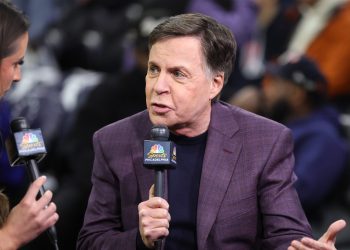
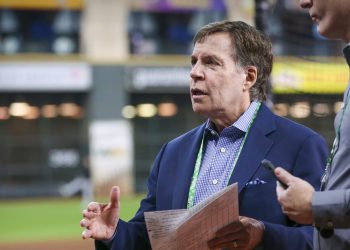
Bob Costas, who worked with Enberg at NBC Sports from 1980 until Enberg’s departure in 2000, said of his former colleague, “If you asked overall, who was the play-by-play face and voice of NBC Sports, that was Dick Enberg through the 80s and into the early 90s. At his peak and for a very long time, he belongs on the Mount Rushmore of network play-by-play guys.”
After an award-winning 25-year run at NBC, Enberg moved to CBS Sports, bringing with him that same boyish enthusiasm and that sentimental touch. You could hear it in his voice during every game he called. Every touchdown pass, every jump shot, every match point, every birdie putt, every “Oh My!” — it all meant another chance for the humble kid from Michigan to crack a youthful smile and fall in love with sports all over again, as he’d done decades before whenever he heard the name Ted Williams.
That sentimental touch was not confined to a broadcast booth. Countless stories from former broadcast partners like Billy Packer, Jay Bilas and Bill Walton underscore Enberg’s decency and humility. One of the best stories is told by Costas.
“There was a time in the history of the Sports Emmys when host and play-by-play were a combined category,” he recalled. “Dick and I were nominated. I was doing play-by-play, but I was also hosting the NFL, whereas Dick was calling the NFL. They open the envelope and I win and we’re sitting at the same table. He jumps up and hugs me and says it’s your time. That was such a classy and gracious thing to do.”
Enberg spent the final years of his career calling Padres games in San Diego, a city that held special meaning to him. San Diego was the childhood home of Williams, his beloved idol. Enberg was still working for the Padres in 2015 when he won the Ford C. Frick Award, the highest honor a broadcaster can receive from the Baseball Hall of Fame. Not even 20 seconds into his speech, Enberg’s voice began to crack as he reflected on the “personal joy” the honor had brought him.
The most enduring element of Dick Enberg’s legacy is not the many major events he called, but the standards he set. During a career that spanned nearly 60 years, he frequently reminded us that the athletes we admired and emulated were sons and daughters, students and professionals, strivers in pursuit of perfection, shaped by pressure and preparation. And he did it all with a childlike glint in his eyes, the same glint he had at the family fruit stand selling apples with his radio by his side.