Sports Media Watch presents thoughts on recent events in the industry, starting with thoughts on NBC’s Mike Tirico following his performance at the Olympic Games.
There exists a perception that the biggest names in sports broadcasting have inflated egos, and surely there is some truth to that in a few cases (or maybe even more than a few). But it is not uncommon for some of the most accomplished voices in the industry to display humility and self-awareness, whether Joe Buck confronting head-on the criticisms he receives as the son of a famed broadcaster, or Bob Costas acknowledging the declining quality of his play-by-play work in recent years.
Perhaps then it should be no surprise that the most celebrated broadcaster of the present day may be the person least impressed by his own exploits. “You know, nobody cares, honestly,” NBC’s Mike Tirico said during a recent conference call when asked by this writer about all the attention paid to his busy schedule. “I appreciate the kind words, but people just want to watch the Super Bowl, and people want to watch the Olympics.”
Tirico would have every reason to enjoy an inflated ego, receiving as much praise in the past 24 hours as any broadcaster in recent memory. He is, as they say, ‘having a moment.’ Milan-Cortina was his sixth Olympics with NBC and fifth as its lead host, but it feels almost as if he was under the radar before. Or to put a finer point on it, he was a sportscaster in prior Olympics. Now, he’s becoming a public figure in the way that his predecessor Costas once did. That means something different in 2026 than in Costas’ heyday, so do not expect Tirico to get a late night interview show on NBC, or to interview a president, or to cameo in movies. But he is starting to gain notice among people who do not necessarily just watch sports.
One of the ways in which this is true is the attention toward his aforementioned schedule. Frequent travel is the name of the game in sports television, and not just for on-air talent. But in little more than a month, Tirico has gone from Chicago on Jan. 18 for the NFC Divisional Round to New York the following day for the NBA, to Milan for Olympic preparation, back to New York for the Feb. 1 premiere of “Sunday Night Basketball,” to the Bay Area for the Feb. 8 Super Bowl, and then immediately back to Milan the very next night for the Olympics.
Tirico is far from the first to rack up such frequent flier miles; Chris Fowler annually goes from the College Football Playoff title game to the Australian Open. His broadcast partner Kirk Herbstreit may be the closest to Tirico level, sometimes working from three different cities in 72 hours between “Thursday Night Football,” “College Gameday” and his weekly ESPN/ABC college football game. And going into the wayback machine, Ernie Johnson once anchored Wimbledon, flew to New York for the NBA Draft, and then flew right back out to Wimbledon.
But even if Tirico is not unique (NBC’s Kaylee Hartung and Maria Taylor also went straight from the Super Bowl to the Olympics), it is hard to imagine any on-air talent in this industry working as many events in as many places at such high a level in a single month — much less calling a Super Bowl and hosting an Olympics, on-site on either side of the Atlantic, on back-to-back nights. And it is gaining notice in ways that are unusual. On Sunday, ESPN NBA announcers Dave Pasch and Doris Burke celebrated him on-air, the kind of shout-out one just does not typically see of another network’s talent. (It should be noted that Tirico worked at ESPN for years and shares an alma mater with Pasch.)
It is of course true, as Tirico said, that viewers are primarily watching for the games and events, not the people broadcasting them. But among those wired to notice the broadcasters — and media professionals (plus the people who cover them) are more than a bit overrepresented in that sample — his approval rating would seem to be the highest it has ever been.
Case in point, Tirico’s signoff from Sunday’s hockey game seemed to be going massively viral on social media, embedded in multiple posts that were each receiving tens of thousands of likes. It was not necessarily what he said — the idea of sports ‘bringing us together’ is not exactly groundbreaking — but his increasingly rare ability to gather not just his own thoughts, but organize the feelings of a broader, millions-strong audience in a clear, concise way.
The kind of broadcaster that Tirico has become — the essayist who can provide perspective, the emcee who can keep the show moving, the play-by-play voice who can meet the moment, is not just a rarity historically — it is virtually nonexistent in an era of specialization. That is particularly true of the essayist role, which has fallen out of favor in an era of shouting provocateurs.
One imagines that Tirico, if asked about the praise he has gotten, would probably deny that he had done anything too special. And from a historical perspective, he would be correct. He is not the first of his kind. But in an industry that has moved away from a lot of what defined its early days — the authoritative, generalist broadcaster who you knew would be at every major event, contextualizing the action both on-field and off, capable of putting words to the feelings held by a mass audience — he may be the last.
In his on-air commentary Sunday, Tirico offered an appeal to the younger audience watching. “So for all the young people out there, not just the hockey, but all the Olympics you’ve watched — those dreams are formed now. Go chase ’em and go get ’em.” It was a call to action for young people to play sports, not broadcast them. But if the road from Jim McKay to Bob Costas to Mike Tirico is to continue into another generation, his performance at the Games will have to be as influential.
That seems frankly unlikely in an era defined by social media influencers and cable TV instigators, where in all probability Stephen A. Smith has been more impactful to young eyes and ears than any actual journalist. But if there is to be a next Tirico, the example is at least being set.
Milan extended Olympics’ momentum
If there was any question whether Paris was an aberration or a return to glory for the Olympic Games, they would seem to have been answered in Milan-Cortina. Certainly, it did not seem immediately like the Winter Olympics would come through for NBC, marred early by a crushing end to Lindsey Vonn’s comeback attempt — which she said Monday nearly resulted in her losing her leg — and a shocking swoon by figure skater Ilia Malinin. One might have begun to sense the ghosts of the 2021 and 2022 Olympics, which largely featured vulnerability and disappointment for the biggest American names.
But gold medal performances by Mikaela Shiffrin, Alysa Liu — who became the first American woman to win an individual gold in figure skating since 2002 — and both U.S. Olympic hockey teams put this year’s Games in line with Paris in 2024, a ‘feel-good’ Olympics that featured no shortage of American success stories. (As an aside, Liu will be an interesting test of where figure skating stands in the public perception. An American women’s figure skating champion is an eternal pop cultural figure. The name Dorothy Hamill is still known 50 years after she won at Innsbruck. But is that still true?)
Television ratings are, to be frank, no longer a reliable gauge of viewer interest compared to past years. There have been too many changes in how Nielsen calculates the numbers and how NBC reports them for there to be a meaningful comparison to even Beijing four years ago, much less PyeongChang, Sochi or Vancouver. So one is forced to rely on vibes. There were no good feelings coming out of the Beijing Olympics; the men’s hockey competition was irrelevant with the absence of NHL players, one would be hard pressed to even remember who competed in women’s figure skating, and Shiffrin struggled. It was a COVID-impacted Olympics that NBC mostly covered remotely from Stanford, Connecticut (Tirico started in Beijing, flew back for the Super Bowl, and was supposed to return to Beijing — but that plan was not only abandoned, he ended up leaving Beijing earlier than planned).
There is no question that this particular Olympic cycle at Paris and Milan improved significantly in terms of relevance, performance and production over the COVID cycle in Tokyo and Beijing. That is a low bar to clear, those were arguably the two worst Olympics since the U.S. boycott of Moscow in 1980. It felt bigger than PyeongChang and Sochi as well, though it is hard to quantify that comparison. Perhaps the last time the Winter Olympics seemed to resonate so much was Vancouver in 2010, the last North American Olympics until the next one — Los Angeles in two years.
Olympics conclude ‘legendary’ month for NBC Sports
If Mike Tirico is having a moment, so too is NBC. The network’s “Legendary February” has produced the largest football, basketball and hockey audiences of the ongoing television season — Super Bowl 60, the NBA All-Star Game and the United States-Slovakia Olympic hockey semifinal (which will obviously be surpassed by Sunday’s United States-Canada gold medal game as soon as those numbers are reported).
NBC’s acquisitions of the NBA and Major League Baseball have seemed to revitalize the company’s sports division. And while many have noted the massive expense of the network’s NBA deal, its bargain-basement baseball rights fee means that the network acquired two “Big Four” sports leagues for less than $3.0 billion/year combined.
Other networks will have their moment in the sun — FOX will have the FIFA World Cup and MLB All-Star Game in July — but it is hard to think of a better month any sports division has had in recent memory.
Plus: “Inside the NBA” falls into old habits
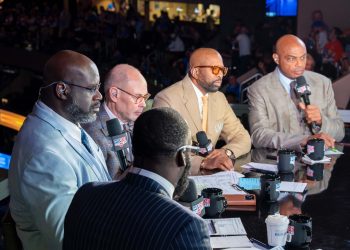
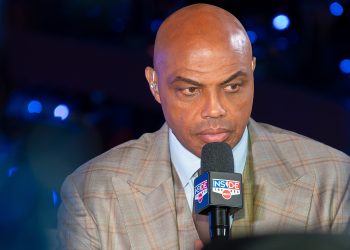
Beyond the Olympics and NBC, the TNT-produced “Inside the NBA” was falling back into old habits in its first three-day weekend on ESPN/ABC. The Lakers seem to bring out the worst in Charles Barkley, who retreats to his grumpiest form whenever they are on the air. He seems genuinely angry and irritated whenever he discusses them, and worse yet has very little insight to provide other than ‘people keep making us talk about the Lakers’ and ‘they’re not good.’ (Contrast that with Prime’s studio, which earlier this year offered actual substantive criticisms about where the Lakers fall short.) A cantankerous Barkley is bad television without the disarming wink that was once a hallmark of his persona.
As for the other end of the “Inside” desk, Shaquille O’Neal should reconsider his habit of confronting players on-air with his opinions about their game. One might be tempted to give O’Neal credit for not only standing by his words, but saying them directly to players’ faces. But at times it just feels like open disrespect, as when he told Nikola Jokic immediately after winning the MVP that Shai Gilgeous-Alexander should have won instead. The only value in the conversation between O’Neal and Karl Anthony Towns after Saturday’s Rockets-Knicks game — in which O’Neal took issue with Towns not playing more in the post — was in the discussion it prompted among the TNT crew immediately afterward, in which Barkley (somewhat patronizingly) defended Towns as ‘a nice guy’ and made an insightful comparison between the very different personalities of Kenny Smith and his 1990s Rockets teammate Vernon Maxwell.
“Inside” is still a dramatic improvement over the ESPN-produced NBA pregame shows, and still packs a relevance that the other pregame shows lack. (The analysis and discussion on Prime’s “NBA Nightcap” has already surpassed that of “Inside,” but that show is simply too new and unknown to be considered authoritative.) But the two biggest stars always seem more than a little edgy when they talk about the game, with Barkley only perking up during Sunday’s shows — thanks to the United States’ gold medal in hockey, which he seems to enjoy quite a bit more than basketball. Fair enough. The problem is that people who like basketball tend to be the ones who tune in.