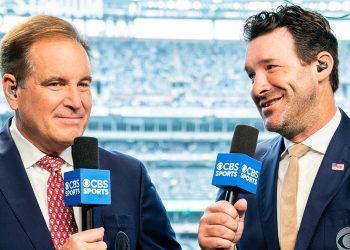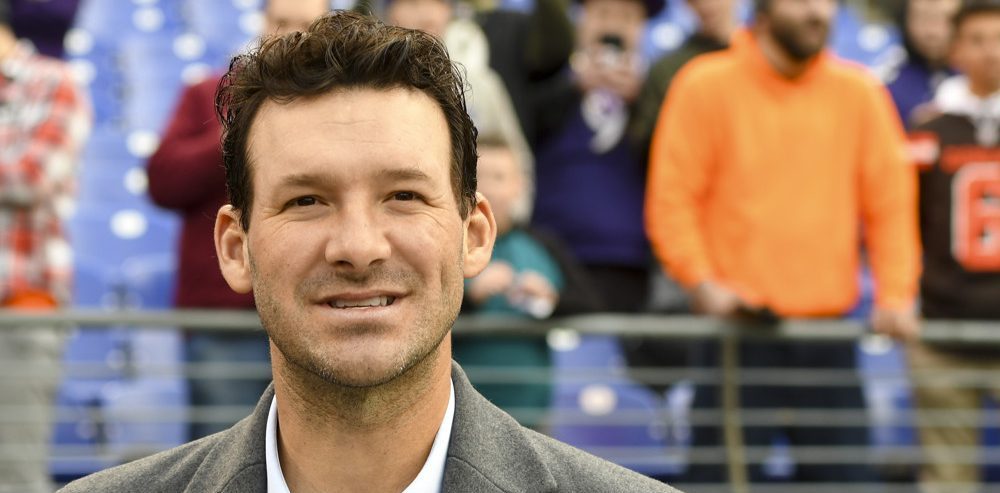
Heading into his third Super Bowl broadcast in 2024, CBS NFL analyst Tony Romo received a vote of confidence from the network’s outgoing sports president Sean McManus. Told in a SiriusXM interview with Chris “Mad Dog” Russo that “a lot of the bloom is off the rose” with Romo, McManus replied that most of the criticism was “undeserved” and that fans still enjoyed the broadcast team of Romo, Jim Nantz and Tracy Wolfson.
For most of Romo’s tenure at CBS, those kinds of comments have reflected the position of network brass. But after Romo’s arrest last week and the subsequent decision by CBS to place him on leave “until further notice,” it is clear the relationship is at a crossroads.
How did we get here? How did a man once described in an NFL.com article as “perhaps the most trusted NFL game analyst since John Madden” end up sidelined by the network that signed him to one of the most lucrative contracts in sports broadcasting history?
Romo debuted in 2017 and became the cool new kid on the block. His fresh energy, pre-play predictions and winsome personality earned him a massive 10-year, $180 million contract in 2020. That contract also opened him up to more scrutiny, as sports media observers wondered aloud whether Romo would begin to rest on his laurels.
Over the years, Romo, once a sports media darling, has regressed. While fresher analysts like Tom Brady and Greg Olsen have emerged, the quality of Romo’s commentary has failed to meet the level of a lead network analyst.
Romo’s freewheeling approach to broadcasting was charming early in his career, but he backed up that charisma with an ability to talk strategy, especially late in games. His praiseworthy performance during the 2018 AFC Championship Game — during which he predicted key plays before they happened — was Romo at his peak.
Over the last few years, Romo’s analysis is often schtick and storylines over strategy. Attempts at humor often fall flat. Frequently, his commentary bleeds into Nantz’ play-by-play. One of the most obvious examples is his performance in Super Bowl LVIII. After the Kansas City Chiefs’ win over San Francisco, Romo smothered the moment with needless chatter.
While Nantz and others at the network have often publicly defended him, the network at one point staged “something of an intervention” for him, per a 2023 report in the New York Post — suggesting that the network has been aware of his regression.
When CBS announced that J.J. Watt would be transitioning from the studio to the booth, sports media followers saw the move as something of an insurance policy. Now, with Romo’s leave, Watt slides over to the lead team, leading some to believe that he is in line to take that position permanently.
At this critical juncture, the question is whether Romo dug too deep a hole for himself. Can he recover from this storm? If he returns, the margin for error becomes that much smaller. Should CBS decide to move on, there is no guarantee that he will get this kind of chance — with that kind of contract — again.
Plus: ESPN’s sloppy handling of Karl Ravech’s departure
It seems this chapter of Karl Ravech’s time at ESPN can be described as “The Long Goodbye.”
A week after being told his 33-year tenure with the network would be ending, Ravech was surprisingly back on ESPN Thursday night, calling the Washington Nationals-Atlanta Braves game. The image was jarring. Viewers who had spent days reading about and discussing his dismissal were hearing the familiar voice of a man who had supposedly been shown the door.
While bizarre, Andrew Marchand of The Athletic provided a simple explanation. Because the layoff came in the middle of the baseball season, Ravech was given the option to finish several assignments, including select MLB games and the Little League World Series. He accepted.
But the optics are hard to ignore. It is mind-boggling that a company could handle the termination of one its longest-tenured broadcasters so sloppily, then have him back on the air a week later.
None of this is an indictment of Ravech. He has been the network’s baseball face for years, now. Though he is miscast as lead play-by-play announcer, Ravech still brings warmth and passion to the broadcasts. Nothing about his performance Thursday night would have led viewers to believe that he had been let go from the company.
ESPN and ESPN alone deserves the criticism. Ravech reportedly learned of his dismissal when contacted by a reporter seeking comment rather than directly from his employer, a head-scratching failure for a company of ESPN’s stature. Upon his unexpected return Thursday night, viewers were left to wonder if he had actually been laid off, whether reports were inaccurate, or if ESPN had reversed course. Had the company handled these layoffs with greater care and coordination, none of those questions would have existed.
This follows another uncomfortable episode involving NFL analyst Ryan Clark, who was informed of his layoff while working on NFL Live. Viewed together, the incidents paint a troubling picture. ESPN has every right to restructure its workforce. Media companies make difficult personnel decisions all the time. But there is a meaningful difference between making difficult decisions and handling them poorly.
For more than three decades, Ravech has been synonymous with ESPN baseball. He anchored “Baseball Tonight” through the sport’s highs and lows, called countless marquee games, and became the voice of the Little League World Series. Even those who preferred another play-by-play announcer would struggle to deny his loyalty and professionalism.
After years of dedicated service, Karl Ravech was deserving of a layoff process free of chaos and confusion. ESPN’s strategy has done just the opposite.