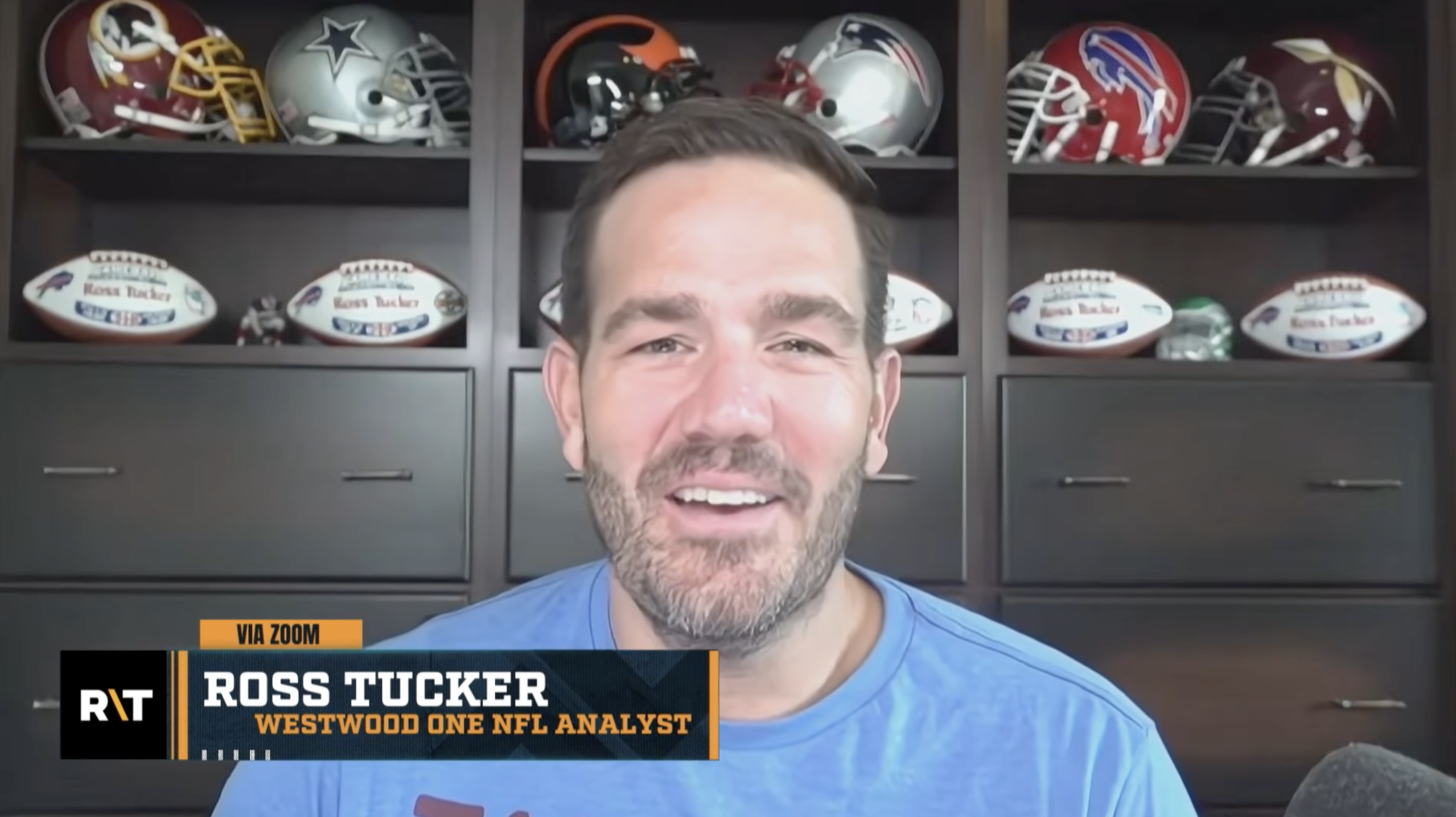
The casual sports fan likely knows very little about Ross Tucker. He is not a Pro Football Hall of Famer. He is not a former quarterback. Though he suited up for some of the league’s most popular franchises — Washington, Dallas and New England — his playing time was limited. Tucker had about as unremarkable a seven-year career as one could have.
That relative anonymity is about to change. CBS announced Tuesday that it was naming Tucker as its new, albeit temporary, #2 NFL analyst.
Tony Romo’s situation is the obvious catalyst. Romo, who has served as CBS lead NFL analyst since 2017, was arrested last month in Wisconsin on suspicion of operating a motor vehicle while intoxicated. CBS subsequently placed him on indefinite leave and moved #2 analyst J.J. Watt to the lead crew with Jim Nantz. CBS Sports president David Berson said Tuesday there was “no timetable or final decision” on Romo’s status.
While the circumstances surrounding his promotion are anything but ideal, Tucker has received the opportunity of a lifetime. And he’s worked for it.
Given their star power, Romo and Fox lead analyst Tom Brady were given prestigious TV jobs right away, despite no prior broadcasting experience. Tucker, meanwhile, has been building his broadcasting resume for nearly two decades.
He joined Sports Illustrated as a columnist in 2008, hosted a SiriusXM Radio show for many years, and eventually built his own podcast network. For more than a decade, he has called NFL games for Westwood One. In 2023, he joined CBS as a college football and NFL analyst. He has also been a frequent guest and occasional fill-in host on “The Dan Patrick Show.”
Tucker has methodically worked his way up the broadcasting food chain. It’s a path that mirrors that of the late Bob Trumpy and current “Sunday Night Football” analyst Cris Collinsworth.
After he retired from the NFL in 1978, Trumpy joined NBC Sports as an analyst. While John Madden was being credited with revolutionizing football commentary at CBS in the 1980s, Trumpy was at NBC becoming one of the network’s most reliable voices. He called two Super Bowls for NBC TV with Dick Enberg, as well as a pair for NBC Radio with Don Criqui. In addition to his national work, he was a talk radio host in Cincinnati, where he became known as “the father of Cincinnati sports talk.”
Collinsworth entered NBC’s NFL booth in 1990 with an impressive playing résumé, but his status as one of the NFL’s top receivers did not earn him a fast track at the network. He worked just five games that year, most of them non-marquee contests. Over time, however, he built a reputation as a polished and versatile broadcaster. His work on HBO’s “Inside the NFL” helped raise his profile. By the mid-90s, Collinsworth had become one of the network’s premier NFL commentators, a distinction he still holds.
Charles Davis is another well-known broadcaster who reached the heights of the industry without the benefit of name recognition. After being cut by the Dallas Cowboys during training camp and never appearing in an NFL game, Davis committed himself to broadcasting. He worked in local radio, covered the sidelines for college basketball, pro basketball and college football at various networks, and called Arena Football League games in the mid-2000s before being named Fox’s lead college football analyst in 2006.
This season, Davis returns to college football, where he’ll join Brad Nessler in the booth for Big Ten games on CBS.
Network executives spend years and millions of dollars chasing recognizable names. There is nothing inherently wrong with that. Cultural cachet has its place. But occasionally, the industry rewards those who put in the time to commit to the craft.
It took a confluence of extraordinary circumstances, but if Tucker performs well, it could serve as a reminder that there is still a path to the top, even for the broadcasters who lack crossover appeal. Tucker’s job will be made easier by a familiar voice, play-by-play announcer Ian Eagle. Outgoing Sports Illustrated media writer Jimmy Traina noted in his column Tuesday that Tucker has worked at least 20 games with Eagle over the years on Westwood One.
The two have already shown they can make for an entertaining pairing. When then-Giants quarterback Daniel Jones stumbled on a long run against the Eagles in 2020, Eagle called the play-by-play while Tucker giggled at Jones’ slip and fall. The moment made for entertaining radio — and offered a glimpse of the chemistry the two have developed over the years.
Ross Tucker should not (and likely won’t) treat his promotion as a consolation prize. It is, in fact, the latest milestone in a career that has been progressing for years. Even if Romo returns to his lead spot and forces him back down the depth chart, Tucker will have at least a handful of high-profile TV games alongside one of the industry’s top announcers to prove that he belongs.
Plus: Tomlin shows promise in Football Night in America debut
With Mike Tomlin joining the desk, NBC’s “Football Night in America” should be a better show. In recent years, “FNIA” has seemed somewhat directionless, with too much talent spread across too many places and too little sense of cohesion. NBC’s decision to part with Jac Collinsworth, Chris Simms, Rodney Harrison, Tony Dungy and Matthew Berry should create more space for Tomlin to become a central part of the program.
During NBC’s pregame coverage of the Hall of Fame Game, host Maria Taylor wasted little time putting the former Steelers coach to work. Tomlin was smooth and authoritative discussing the new Hall of Fame inductees and offered engaging analysis on topics involving his former rival Myles Garrett and Aaron Donald.
Ultimately, the success of “Football Night” may hinge on Tomlin’s willingness to be himself. If he plays it safe, sidesteps sensitive subjects and steers clear of controversial game moments, the show will miss an opportunity. But if Tomlin embraces his reputation for candor and delivers something close to his unvarnished opinion, he has a chance to become a real television star.