Sports Media Watch presents 20 notable sports media stories of the year 2010. Today, #5-#2, including embattled athletes attracting big ratings, a new television deal for one of the marquee events in sports, and contentious collective bargaining agreements.
#5: LeBron Boosts NBA Ratings
LeBron James was the NBA?s biggest attraction in 2010, as the drama that surrounded his move from Cleveland to Miami garnered significant hype ? and big ratings.
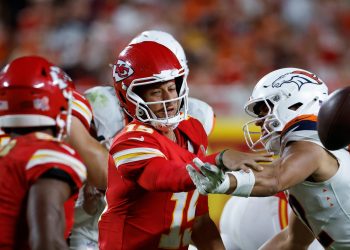
James? final game with the Cavaliers ? their season-ending loss to the Celtics in the 2010 playoffs ? earned nearly nine million viewers on ESPN May 13, the largest audience ever for a first or second round NBA Playoff game on cable TV. Months later, his one-hour The Decision show on ESPN, in which he announced that he was joining the Heat, earned nearly ten million viewers ? the third-largest non-NFL audience in the 30-year history of ESPN.
James? drawing power continued into the 2010-11 NBA regular season, as his debut with the Heat drew 7.3 million viewers on TNT, the largest regular season audience on cable since 1996. His return to Cleveland in December drew another seven million, also on TNT, the second-largest cable audience since ?96. Over on ESPN, games involving James? Heat now account for four of the network?s twelve most-viewed NBA regular season games since reacquiring rights to the league in ?02. All of that was topped by Miami?s Christmas Day win against the Lakers on ABC, which earned a 6.4 rating and over 13 million viewers ? the highest rated, most-viewed NBA regular season game on any network since Heat/Lakers six years earlier, when Shaquille O?Neal played against Kobe Bryant for the first time.
While the Celtics/Lakers NBA Finals was by far the NBA?s biggest ratings hit of 2010, James moved the needle like nobody else ? for better or worse.
#4: CBS/Turner Net NCAA Tournament Rights
In March 2009, CNBC reported that the NCAA could opt out of its ongoing 11-year NCAA Tournament television deal with CBS at the end of the 2010 NCAA Tournament (cnbc.com, 3/12/09). An opt-out would benefit both the NCAA, as the value of the current deal was no longer ?as impressive? (cnbc.com, 3/12/09) as it was when it was first agreed to in 1999. More importantly, an opt-out would benefit CBS ? which was so desperate to avoid anticipated hefty losses over the remainder of the current deal that it briefly discussed paying ESPN to absorb the remainder of the contract (nytimes.com, 5/4/10)
Speaking of ESPN, speculation began almost immediately that the network would try to acquire the NCAA Tournament. Just months earlier, ESPN obtained rights to the Bowl Championship Series, and as ESPN?s Mike Soltys told Sports Media Watch in February, the interest was certainly there: ?College basketball is such an important part of several of our networks. It?s something that we would love to be a part of. ? Certainly, there is interest from ESPN?s end? (sportsmediawatch.net, 3/3/10). ESPN was ?considered the front-runner,? partly because, unlike CBS, it would ?not need a partner? (nytimes.com, 4/22/10).
CBS solved that problem by partnering with Turner Sports for a joint bid, under which the two entities would not only split coverage of the tournament, but the rights fee as well ? alleviating some of the financial burden CBS has been dreading. Shortly after the 2010 NCAA Tournament, it became clear that CBS and Turner were likely to get NCAA Tournament rights, outbidding ESPN by approximately $40 million per year. The deal became official days later, with CBS and Turner agreeing to a 14-year nearly $11 billion deal to televise the event. Under the deal, CBS retained rights to every Final Four through 2015, alternating coverage from 2016-2024.
#3: Coverage of Tiger?s Return
The Tiger Woods saga stretches back to late 2009, when the golfer?s image took a major hit after news of widespread marital infidelity became public. Woods essentially went into hiding in the aftermath, making no public comments ? outside of statements on his website ? from November ?09 to February ?10. Woods? disappearing act fueled tabloid coverage, with rumors flying about where he was and what he was doing. People were so hungry to hear or see anything about Woods that there was even hubbub over a supposed picture of him published in one tabloid.
When Woods finally did decide to make his first public appearance, making a televised public statement at a golf course near his home in February, it became one of the most overhyped television events in years. The Woods statement was not just broadcast sports networks or even just on sensationalist cable news networks, but on the Big Four as well. The four supposedly prestigious broadcast news divisions took time out of their schedules to give Woods ?special report? coverage. The music and graphics usually set aside for terrorist attacks and unexpected deaths were instead used to lead into an athlete apologizing for being unfaithful.
Woods made another public appearance in March, giving brief interviews to ESPN?s Tom Rinaldi and The Golf Channel?s Kelly Tilghman, before making his return to golf at The Masters. There were high expectations for Woods? return, with CBS Sports and News president Sean McManus predicting that it would be the ?biggest media event other than the Obama inauguration in the past 10 or 15 years? (nydailynews.com, 3/16/10). The numbers were indeed bigger than usual. First round coverage on ESPN drew the largest audience ever for golf on cable. But while CBS? third and final round coverage hit nine-year highs, the numbers did not come anywhere close to Woods? 1997 and 2001 victories.
#2: Lockout Talk
One of the biggest stories of 2010 figures to be the single biggest story of 2011 ? the prospect of work stoppages in both the NBA and NFL. The NFL?s collective bargaining agreement expires on March 4 of 2011, while the NBA?s CBA expires on July 1. Owners in both leagues maintain that their current financial structures are unsustainable, and that they are losing money. NBA Commissioner David Stern contends that his league has lost hundreds of millions of dollars each year since the most recent CBA went into effect in the 2005-06 season. By contrast, the NFL and NBA players associations maintain that their respective sports are doing quite well, and have questioned the owners? assertions of doom and gloom. Other factors, such as the move to an eighteen-game regular season in the NFL, and the NBA?s age limit, have also been points of contention.
In December, NFLPA president Kevin Mawae said it was unlikely that a new NFL labor deal would be struck by the February 6 Super Bowl, and that there had not been any ?significant progress? (Bloomberg.com, 12/30/10) in negotiations since the previous month. That came weeks after NFLPA Executive Director DeMaurice Smith told agents ?that he still believes the NFL is planning to lock players? (sportsbusinessdaily.com, 12/15/10). Citing league sources, Sports Business Journal reported that it was unlikely that the NFL and the NFLPA would reach an agreement prior to the expiration of the current deal (sportsbusinessjournal.com, 12/20/10).
The talk has been even more negative in the NBA. The NBA has proposed major changes ?including a hard salary cap, shorter contracts, smaller annual raises, less guaranteed money and a nearly 40 percent reduction in salaries and benefits? (nytimes.com, 11/22/10). The players? counterproposal excludes ?virtually all of the significant changes to the salary and cap structure proposed by the owners? (cbssports.com, 7/2/10).
?I think the owners are going to try to break the players in the next collection bargaining agreement,? Turner?s David Aldridge predicted in an interview with Sports Media Watch in August, adding, ?I put it somewhere in the mid-to-high 90s that we will have a lockout next year. Of some length. I can?t tell you how long, but of some length? (sportsmediawatch.net, 8/9/10). NBAPA exec. director Billy Hunter echoed that sentiment in October: ?[I]f the owners maintain their position it will inevitably result in a lockout and the cancellation of part or all of the 2011-2012 season? (nytimes.com, 10/21/10). One month later, Hunter said he was ?99 percent sure as of today that there will be a lockout? (nytimes.com, 11/22/10).
The #1 story of 2010 is coming up.