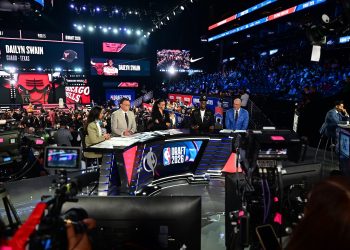
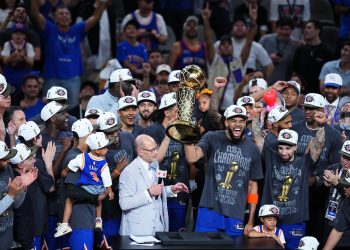
The NBA season opened with the league’s most-watched Opening Night in five years and its most-watched Opening Night game in three.
Tuesday’s NBA’s Opening Night doubleheader averaged 3.3 million viewers on TNT, up 17% from last year and the highest average since 2017. The five-year high was largely driven by a sharp increase for the Sixers-Celtics opener, which posted a 1.7 rating and 2.98 million viewers — up 31% in ratings and 36% in viewership from last year (Bucks-Nets: 1.3, 2.20M) and the most-watched early game on Opening Night since the aforementioned 2017 edition (Cavaliers-Celtics: 5.60M).
The previous high was 2.95 million for the same Sixers-Celtics matchup in 2018, a figure that it should be noted did not include out-of-home viewing.
The big gains came despite formidable competition in the Philadelphia market. The Phillies’ NLCS Game 1 and a Flyers game both aired on national television in the same window.
The Lakers-Warriors nightcap averaged 3.55 million viewers, up 4% from the same matchup last year and the league’s largest Opening Night audience in three years (2019 Clippers-Lakers: 3.58M) and the fourth-largest in the past nine years. Ratings were not immediately available. The Warriors’ easy win also ranks as TNT’s most-watched NBA game overall since that 2019 Opening Night. (NBA Opening Night viewership over the past decade is presented below.)
NBA Opening Night viewership, past decade

The NBA games trailed both of Tuesday’s MLB Postseason contests — Game 5 of the Guardians-Yankees ALDS averaged 4.95 million on TBS and Game 1 of the Phillies-Padres NLCS 4.10 million on FS1 — but came out ahead in the key young adult demographics. Lakers-Warriors finished as the day’s top program on any network in adults 18-49 (1.4), 18-34 (1.3) and 25-54 (1.5). Sixers-Celtics placed second in 18-49 (1.2) and 18-34 (1.1) and third behind Guardians-Yankees in 25-54 (1.3).
In addition to the five-year viewership high, the Opening Night games also averaged a record share of 6.2% — up 32% from last year (4.7). As the number of viewers watching linear television declines, audiences will tend to make up a larger percentage of the shrinking linear TV audience than in years past.
(Nielsen estimates from Programming Insider 10.19, ShowBuzz Daily 10.19)