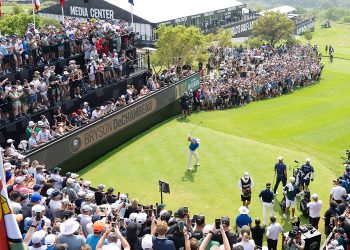
Sports Media Watch contributor Drew Lerner was granted inside access at LIV Greenbrier to interview LIV’s Chief Media Officer Will Staeger and tour the league’s broadcast facilities. This is part one of a two part series that will focus on LIV’s status as a sports property amid professional golf’s new world order, and examine the broadcast innovations LIV is making that they believe will change golf telecasts for the better. Part one will focus on where LIV stands as a commercial entity in the context of a potential PGA Tour partnership, how their viewership is trending, and their relationship with The CW.
WHITE SULPHUR SPRINGS, W.V. — For those on the outside looking in, the challenges facing the Saudi-backed LIV Golf league seem existential. But for all the questions swirling around the future of men’s professional golf, LIV’s Chief Media Officer Will Staeger seems unfazed. “It’s all systems go. It’s full steam ahead, because what we’re presenting for the fans in person and on television and on their device is working,” Staeger tells me from his trailer on Sunday at LIV Greenbrier.
In its second season of operation, LIV Golf, fairly or unfairly, has yet to shake its sideshow reputation. Despite the massive investment and notable improvement in its broadcast product, first impressions can be hard to overcome. If LIV Golf is perceived as an inferior product and airs on an inferior network, can one really be blamed for writing them off?
Maybe existential dread has softened rhetoric from those inside LIV following the bombshell partnership announcement with the PGA Tour in June. When asked if LIV would continue to schedule events across the PGA Tour should an agreement be reached, Staeger didn’t mince words. “The LIV Golf league is an additive league in the golf ecosystem. It’s always been conceived as that, it’s always been scheduled that way. So we don’t schedule against the majors, and we don’t schedule against the more significant PGA Tour events … the notion has always been to fit inside the schedule of the other significant events.”
Staeger is right. Prior to the PGA Tour taking a hard line against players who wanted to play on a hypothetical Saudi-funded golf circuit, the prevailing thought was that such tournaments would take the form of a fall series opposite a lower profile portion of the PGA Tour season. Whether LIV Golf always saw itself as “additive” is debatable, but it’s fair to say the intention was never to overtake the PGA Tour.
The upcoming schedule releases for the PGA Tour and LIV Golf should provide some indication as to the status of any potential partnership. The PGA Tour is set to officially release its 2024 schedule on Tuesday, with LIV’s unveiling set for some time thereafter. If a partnership is imminent, one would think any competing tournaments would be kept to a minimum, or not exist at all, in an effort to maximize viewership.
Since its inception, LIV has used the tagline “grow the game” to defend its existence as a disruptor in professional golf. Sitting at The Greenbrier in White Sulphur Springs, WV — a venue the PGA Tour left behind after 2019 — it wasn’t exactly apparent that scheduling a golf tournament here was “growing the game.” An official inside LIV Golf didn’t push back on this perception, but noted that international events will comprise half of next year’s 14-week schedule (as compared to five international and nine North American events this year).
“Growing the game” can mean many different things in a golf context, but for LIV, the phrase means attracting a more diverse and younger set of viewers by shifting the way we view golf as an entertainment property. Eyeballs have been a sensitive topic for LIV, whose sparse viewership data paints a bleak picture for the tour’s commercial viability independent of a PGA Tour partnership. In fairness, any new product takes time to grow.
LIV Senior Vice President, Production James Watson noted that LIV’s broadcasts receive upwards of 90% positive sentiment in focus groups across demographics. Further, CMO Staeger cites a 48% increase in global viewership on LIV’s digital platforms since the beginning of this season, and over half of viewers are under the age of 45.
Of course, such data is largely devoid of context. In the world of viewership metrics, Nielsen is the gold standard by which advertisers base their decisions. Prior to the start of this LIV Golf season, Staeger told James Colgan of GOLF.com, “there will certainly be viewership data [offered]. It’s critical to all our plans.” However, just one tournament — the first event of the season in Mayakoba — saw Nielsen data publicly released, which showed under 300k viewers for both a Saturday and Sunday broadcast window on LIV’s linear television partner, The CW.
For two events, LIV and The CW released data from another ratings agency, iSpot, the Hydrox to Nielsen’s Oreo. Those numbers looked more favorable for LIV, 537k for the first event in Mayakoba, and 409k for the second event in Tucson. Still, even the more favorable iSpot numbers were only about a quarter of the PGA Tour’s comparable Nielsen numbers those same weeks. It’s unclear how advertisers, who were presented iSpot and internal data during LIV’s upfront in New York City last week, will value these figures.
Despite the lack of viewership transparency, LIV’s bet on The CW seems like it could pay off for both parties. When The CW and LIV reached a broadcast agreement in January — which Sports Business Journal reported is a two-year deal with a one-year option, but Staeger and LIV Golf officials call a “multiyear deal” — LIV was the first and only live sports property for The CW. Now, that portfolio includes the NASCAR Xfinity Series, a package of ACC football and basketball games, and Inside The NFL. Those inside LIV Golf are hopeful that The CW’s commitment to becoming a destination for live sports will prove a boon for the league.
Staeger spoke glowingly of LIV’s relationship with The CW. “The partnership is phenomenal. They’re a committed partner. As their first live sports property, we got the nice white glove treatment. We’re treated like the NFL.” Its interesting to consider the possibility that, should a partnership be reached with the PGA Tour, The CW could end up a big winner as LIV tournaments take on greater importance.
At the moment, everything regarding men’s professional golf must be considered in the context of the impending partnership agreement between the PGA Tour and the Saudi Public Investment Fund. After spending a morning talking with those intimately involved in producing LIV’s broadcast, one could walk away without the slightest clue that the world of golf has been turned upside down. Their focus is singular: to produce a golf broadcast that they find innovative, rid of all the dead weight they feel hinders traditional telecasts.
That attitude — that golf broadcasting needs a refresh and the people at LIV are the right people to achieve it — is pervasive within the organization. The massive investment into their broadcasts (over 50 cameras, 100 microphones, and a broadcast crew of more than 200) would seem to indicate they don’t believe they’re going away any time soon. These innovations, many of which are highly impressive technical feats, will be the subject of part two of this series.
I’d be remiss to not mention that any discussion about LIV’s commercial viability is a bit farcical. For all the talk about viewership, advertiser interest, and TV deals, the future of LIV realistically comes down to two individuals: Chairman of the Saudi Arabian Public Investment Fund Yasir Al-Rumayyan and Saudi Crown Prince Mohammed bin Salman. They have bought their seat at the table of global professional golf, and ultimately through their investment, will determine if LIV as an entity is worth protecting in any potential partnership.
For now, all we know is what was present in the framework agreement. The joint entity, “will undertake a full and empirical data-driven evaluation of LIV … and will make a good faith assessment of the benefits of team golf in general.” The agreement continues, “PIF, the PGA Tour and the DP World Tour will work together in an effort to determine how to best integrate team golf into PGA Tour and DP World Tour events going forward.”
The phrase “integrate team golf into PGA Tour and DP World Tour events” seems to leave open the possibility of abandoning LIV altogether. It could also mean a LIV circuit that runs concurrent with the PGA Tour and DP World Tour schedules. Regardless, the future of LIV is anything but certain.
LIV Golf moves onto Bedminster, NJ this week before stops in Chicago, Saudi Arabia, and Miami to wrap up the season. As the golf world prepares for takeover by its new financial backers in Saudi Arabia (no matter who holds the board seats), it’s hard to imagine such a heavy investment into the LIV product would be cast aside entirely. For that reason alone, I think it’s likely that a LIV Golf league will remain in some capacity. Though to be fair, it’s hard to imagine anything that’s happened these past few years in professional golf.