Welcome back to “The Needle,” a ratings-focused column on Sports Media Watch that will break down the numbers, attempt to put some context behind the data, and discuss broader trends in measurement and television viewing.
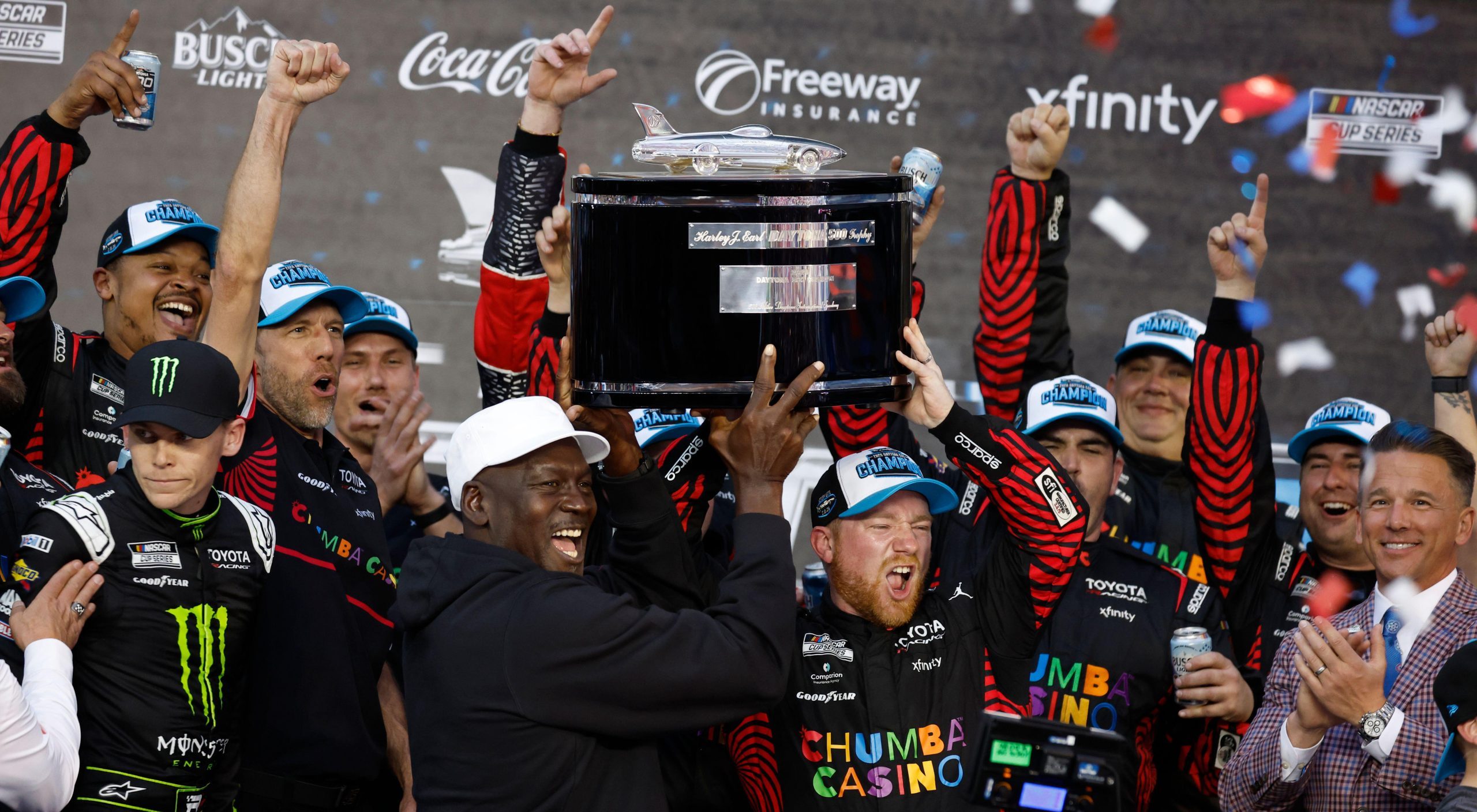
It was two years ago that Tyler Reddick won at Talladega, marking the first time that a 23/XI driver won a Cup Series race with owner Michael Jordan in attendance.
Heading into this year’s Talladega race, Jordan has become a regular sight in victory lane thanks to Reddick’s historic start to the season. Reddick entered Sunday in pole position to win for the sixth time in the first ten races this season. He was the first driver since Dale Earnhardt Sr. in 1987 to win five of the first nine.
While Reddick is clearly the story within the racing community, his success has made Jordan arguably NASCAR’s most prominent face to the wider sporting public. The NBA great has long been involved with racing, but his position in the sport is now attracting mainstream notice — including a recent interview at a racetrack with Gayle King on CBS. (Some of that notice can also be attributed the 23/XI legal fight against NASCAR.)
Between his torrid start and his world-famous boss, Reddick would seem poised for the kind of breakthrough into the mainstream that NASCAR once enjoyed behind Dale Sr., Dale Earnhardt Jr., Jeff Gordon and Tony Stewart. Perhaps that is in the offing. For now, however, there are no real indicators that Reddick — or Jordan — are moving the needle in any real way.
Reddick’s win last week at Kansas posted a 1.6 rating and 2.9 million viewers on FOX, up considerably from both the same race last year (2.3M) and the equivalent race of last season (Bristol: 2.1M), and the most-watched edition of the spring Kansas race since 2016. But that had much more to do with the race moving up to broadcast television after a decade-plus run on FS1 than anything else.
For all other races this season, Reddick wins or otherwise, viewership has been pretty much unchanged from a year ago. His season-opening win at Daytona got a solid increase and three-year high, but that was largely due to the race avoiding the lengthy rain delays that marred past years.
In between Daytona and Kansas, the results have been nondescript. His subsequent wins at Atlanta (4.5M) and COTA (3.9M) declined 2 and 5 percent respectively. Those were followed by a 1% increase for Phoenix (2.8M) and 11% decline for Las Vegas (2.8M), before another Reddick victory at Darlington — which increased a fraction of a percent (from 2.42 to 2.43M). The next two races both slipped, with Martinsville (2.4M) down 1% and Bristol (1.9M) down 5%.
In a ratings landscape marked by wild swings — usually upward of late — the NASCAR numbers are about as stable as it gets. Note that NASCAR has not traditionally gotten the substantial lift from Nielsen’s new “Big Data + Panel” methodology that has helped fuel multi-year highs almost across the board in the industry.
For a sport that is generating as much publicity as at any point in recent years, that has simply not translated into any meaningful ratings bump, at least not overall. “I would say broadly speaking, essentially flat year-over-year,” NASCAR Senior Vice President/Broadcasting & Innovation Brian Herbst told Sports Media Watch last week. “I think when you look under the hood, the way that we’re getting to that flat number is interesting, because we’re seeing increases in 18-34 that are pretty significant.”
Viewership in that demo was up 22 percent through Bristol, which Herbst said could signal “a casual interest or a little bit more buzz that’s driving that younger demo.” That added buzz and relevance, he said, “could be partially attributable to 23/XI.”
But even on that front, it is not clear that Reddick or Jordan are the reason.
Herbst also credited a “carryover effect” from last season’s five races on Amazon Prime Video. “We were up eight percent with 18-34 through the Fox portion of the season in 2025. That grew significantly during the Amazon portion of the season, just because our audience got younger when we moved to streaming. And then by the end of 2025, we were actually up 16% from 2024.”
Perhaps that is to be expected. The 18-34 demographic is by and large too young to have watched Jordan during the prime of his NBA career, and frankly, it is hard to imagine the idea that young people (or really, anyone) would watch more NASCAR because of someone who played another sport three decades ago. The other big demo gain has been among older adults, an age group more likely to have watched Jordan during his prime NBA years. But Herbst theorized that growth is due to the new Chase format NASCAR announced in the offseason.
Much has been made of NASCAR on FOX getting more interviews with Jordan this season than NBC has for their NBA coverage, despite the latter network touting him as a “special contributor.” Have those victory lane ‘walk and talks’ with Jamie Little moved the needle? Again, there is no conclusive evidence. “That’s always where we peak in general,” Herbst said, “so we’re usually probably around 25-30 percent higher of a viewership base by the time we get to checkered flag. … It’s tough to understand or attribute how much is to just the end of the race and everybody’s tuning into the last 20 or 30 laps, versus a potential MJ effect.”
With little firm data pointing toward a Tyler Reddick effect, much less a Michael Jordan effect, what to make of the apparent buzz surrounding NASCAR this season? Good publicity never hurt anyone, but perhaps it is important not to overstate its impact either. Good publicity does not necessarily translate into viewer behavior.
Plus: PGA Tour Heritage, Gymnastics, Wrestlemania, EPL
Much has been made of The Players Championship as the “fifth major” in golf, but from a ratings perspective, the RBC Heritage may have a good argument as well. Last weekend’s final round averaged a 2.4 rating and 4.35 million viewers on CBS — actually down from last year (4.36M), when the Easter Sunday holiday boosted viewership to the highest level since 2002, but on par with the final round of The Players last month (4.4M between Nielsen and Adobe Analytics).
Viewership peaked at 6.7 million, not far off the level of The Players (7.1M).
To put those numbers in perspective, last year’s PGA Championship final round averaged 4.8 million and peaked with 6.9 million, albeit before Nielsen shifted to its current “Big Data + Panel” methodology.
Last weekend’s NCAA women’s gymnastics national championship averaged 1.1 million viewers on ABC, up 10% from last year and the highest for the event since at least 2007. Perhaps that figure could be seen as an endorsement of ESPN’s coverage, or alternatively an indication that the network’s approach is not serving the sizable audience for the event. At least some of those viewers must have been tuning in for Minnesota — making an unexpected trip to the final — which publicly criticized the ABC broadcast for missing several of its routines.
Gymnastics ‘quad meets’ are a recipe for missing live action — or alternatively, showing it in a tiny box on screen — and that is probably easier to get away with when the audience is under seven figures.
Live Wrestlemania coverage averaged 1.82 million viewers on ESPN last Sunday, ranking as the most-watched program on ESPN that day — topping the Bruins-Sabres Stanley Cup playoff game later in the night (1.71M). (Note that ESPN’s Bruins-Sabres telecast was non-exclusive, and at nearly three hours, sustained its audience for far longer than the one-hour WWE window).
The more impressive figure may have come the previous night, when coverage on ESPN2 averaged 1.62 million. Seven figure audiences are of course nothing new for pro wrestling, which consistently hits that mark for “WWE Smackdown” and years ago delivered some of the top cable audiences of the week — every week — for “WWE Raw.” But it is nonetheless notable that the WWE delivered some of the biggest ESPN audiences in a week that featured Stanley Cup playoff games and the network’s MLB season premiere.
Last weekend’s Manchester City-Arsenal English Premier League match was the most-watched EPL match on record on U.S. television, averaging a combined 2.6 million viewers on NBC, Telemundo, and Peacock across Nielsen and Adobe Analytics. (The Nielsen-only, NBC-only audience was 1.59 million.) The previous high was set by the same exact matchup two years ago (also 2.6M).
NBC has now aired two of the three most-watched EPL matches on record just this season alone, with Arsenal’s matchup against the other Manchester side — United — averaging 2.5 million last August. (Arsenal has played in each of the top five matches on record, all in the past four seasons.) Nielsen methodological changes skew all historical comparisons, but it’s not every property that can get to 2 1/2 million viewers in a morning window, even across multiple networks and measurement companies.