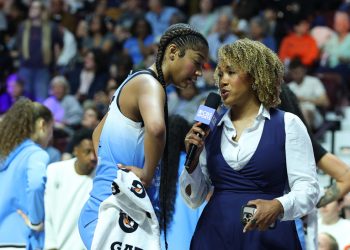
The WNBA is set to earn $200 million/year in the NBA’s new media rights deal, for a total of $2.2 billion over the full 11-year term, Mike Vorkunov of The Athletic reported on Tuesday. While a dramatic increase over the league’s current rights deal ($43 million/year, per multiple reports), the reaction from within the league has been less-than-enthusiastic. “We look forward to learning how the NBA arrived at a $200 million valuation — if initial reports are accurate or even close,” WNBA players union leader Terri Jackson said in a statement, adding that there “is no excuse to undervalue the WNBA again.”
Cheryl Miller — the USC great and former Mercury coach who returned to the sidelines for Saturday’s All-Star Game — was more blunt. “Lowball. That’s a lowball. Not enough, not even close. … Two [billion]’s nice, an eight would be better.” Is Miller’s assessment correct? Is the WNBA on the verge of a bonanza or a raw deal?
The primary WNBA media rights deal is unusual in pro sports, as it is included as part of another league’s larger, more expansive contract. Rights to the WNBA are included in the bundle of rights the NBA negotiates with its media partners and the league determines the fee allocated to the league. “We have wondered for months how the NBA would value the WNBA in its media rights deal,” Jackson said, noting that the league is not only in control of its own destiny, but that it “controls the destiny of the WNBA.” This arrangement was beneficial for the league during its lean years. It is unlikely that the WNBA would have secured anything close to its current $43 million/year on the open market when the expiring rights deal was negotiated in 2014, an era in which the league was an especially weak draw and barely on television.
The growth over the past decade had been incremental until this season, when a star-studded rookie class — Caitlin Clark in particular — arrived in the league. Viewership has soared to levels not seen since the league’s early years, and in some cases ever before. In just the first half of the season, more games averaged a seven-figure audience (16) than any full season in league history. By contrast, not a single game managed even 900,000 viewers last season, even the clinching game of a highly-regarded WNBA Finals.
Based on the first half of this season, it seems likely that the WNBA could hold its own on the open market. The NWSL, whose audience is in-line with the WNBA’s pre-Clark norm, was able to negotiate a $60 million/year deal last year. Instead, the WNBA remains part of the NBA bundle, and subject not to the dictates of the market but instead to the bigger league’s determination of its value — and more importantly, the NBA’s timeline.
It is not necessarily the case that $200 million per year is chump change or even a low-ball offer at this current juncture. It is still too early to know whether the WNBA can sustain the lofty figures that it has earned so far this season, and given the status quo that existed for nearly two decades prior to Clark’s arrival — when not a single game hit the million viewer mark for 16 years — it is fair to want a sample size greater than half a season. The issue is that this deal does not go into effect until 2026 and then lasts through the 2036 season. In the event that the current growth is not only sustained into the second half of the season, but continues apace into future years, $200 million/year could look like a severe underpay even by the time the deal begins, to say nothing of how it might look in 2030 or 2035.
In 2011, the National Hockey League signed a ten-year deal with NBC Sports for the same $200 million/year, at the time the largest-ever television contract for a league that had gone years without a rights fee for its over-the-air package. In relatively short order, the deal proved to be a significant underpay. The issue was not the rights fee, as it is unlikely the NHL would have been in position to earn more from another bidder when the deal was negotiated. Instead, the issue was the deal term. Locking in that price for a full decade meant that when the NHL experienced a surge in popularity on the back of the dynastic Chicago Blackhawks, it was in no position to capitalize. It also meant that by the time a new deal was negotiated a decade later, the league was working from a modest base — meaning that even with the massive increases in rights fees it earned from Disney and Warner Bros. Discovery, its U.S. rights are still going for less than $700 million per year, chump change for a “Big Four” league.
The primary issue facing the WNBA in this negotiation is that the league is operating on the NBA’s timeline. For the NBA, locking in $7 billion a year for 11 years is the smart move, given the uncertainty about where the industry will be by the mid-2030s. There is no reason to expect a meaningful change in the NBA audience over the next 11 years, at least not one that would make $7 billion look like an underpay. If there is any point in the next 11 years in which $7 billion/year can be called a bargain, then the league will be in excellent shape, and the industry will have proven durable to what should be existential changes in the years ahead.
For the WNBA, locking in $200 million/year means 11 years of being paid like a fledgling league on the cusp of growth. Perhaps that is where the league will remain; there are, after all, no guarantees in this business. With that said, the widespread expectation is that the growth in the first half of this season is merely the beginning of something akin to the NBA’s rise to prominence in the Magic and Bird era (if not at the same scale). That potential may never come to fruition, but it will be impossible for the league to capitalize if it does, at least not until Clark is a 34-year-old veteran.
It should be noted that the WNBA will still reserve the right to sell media rights deals separately from the NBA. Depending on the reporting, the league will have one or two additional packages to put up for market. The league already sells separate rights deals, having struck agreements with CBS Sports, Scripps (ION) and Amazon. Per a source, the value of these deals in a new agreement could add an additional $60-$100 million/year to the WNBA rights haul.
Yet it should also be noted that the main rights deal figures to make the additional contracts less appetizing. The NBA currently has two broadcast partners, Disney and Warner Bros. Discovery, of which only one (Disney) airs WNBA games. As a result, the CBS, ION and Amazon deals constitute the league’s “B,” “C” and “D” packages, if one wanted to use that terminology. In the new NBA deal, WNBA games would air on all three of the NBA’s partners — Disney, Amazon and Comcast (NBC) — meaning the additional packages would be for the “D” and “E” packages. At a certain point, there is not enough inventory to go around to justify being fifth on the depth chart. Even if the WNBA is able to secure two partners on relatively short-term deals, any rights fees would likely to be too constrained by limited inventory to maximize the league’s earning potential.
Ultimately, the WNBA has benefited for years from operating under the aegis of the NBA, but eventually the league was going to reach the point where it would need to grow on its own. Perhaps it is has not quite reached that point yet, but if it that remains the case in 2036, it will have severely underachieved its potential in the Clark era. In the situation the league faces, a short-term deal of perhaps even as few as three years would seem to make the most sense — with the league negotiating packages in advance of a U.S.-based 2028 Olympics that should feature Clark and the rest of the current rookie class. Perhaps the NBA deal will mimic that of the NFL and include an opt-out at the league’s discretion, but even that would surely not go into effect until six or seven years down the line.
Per a source, the WNBA deal does include a clause allowing for a revaluation of the media rights fee after the 2028 season. (Vorkunov also reported the revaluation clause.) The revaluation would be done at the discretion of the WNBA, not the NBA. This three-year look-in is not the same as an opt-out that would put the rights on the open market, but it does create an opening for the league and networks to increase the rights fee in the near-term.
Even if the WNBA were to secure a larger rights fee in the current negotiation, that would not change the primary issue — than an 11-year-deal for a league at the beginning of a growth cycle is simply too long to be responsive to shifts in popularity. As it stands now, the only way an 11-year-term will be beneficial for the league is if its popularity stalls or even reverses.