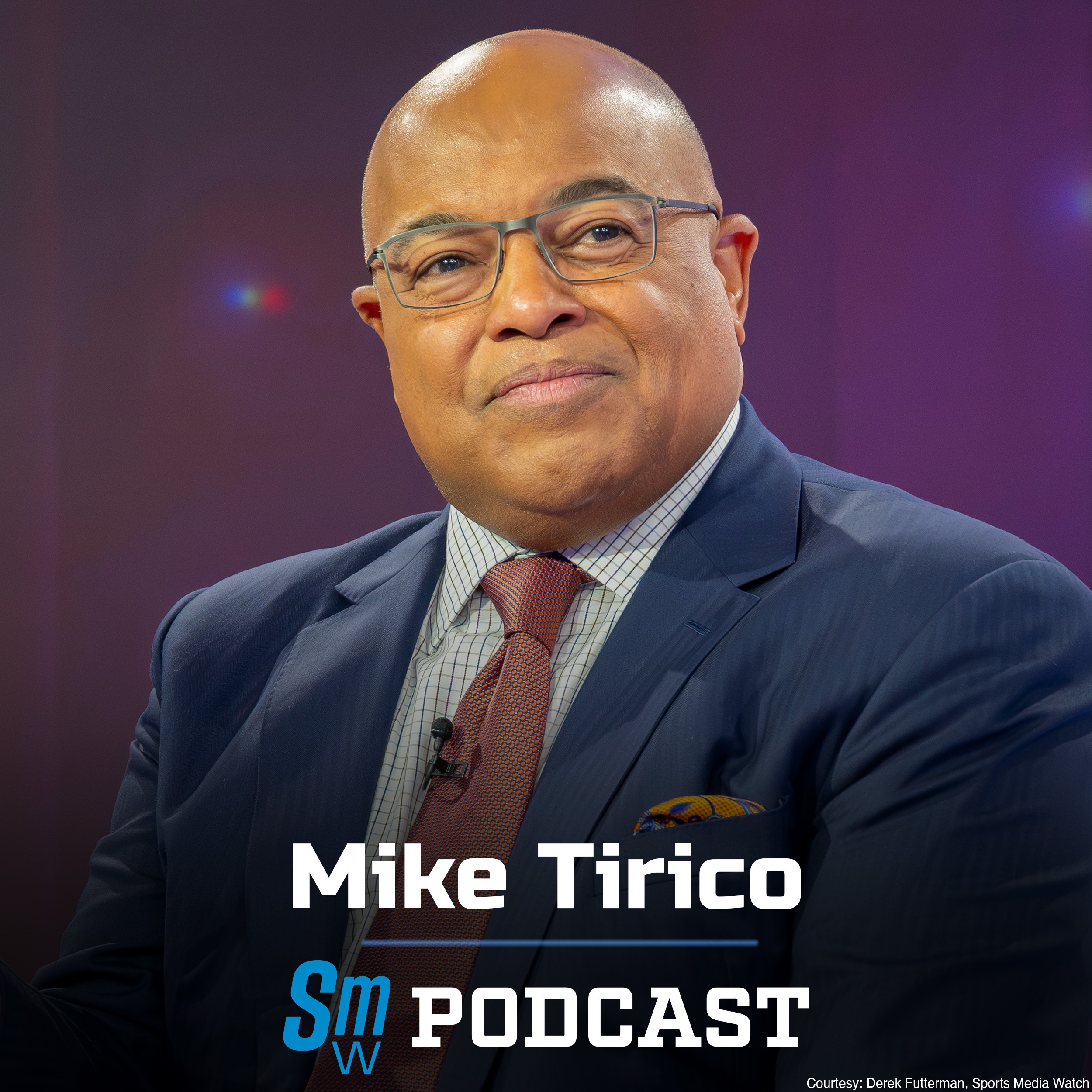
Jon Lewis caught up with the lead CBS college football team of Brad Nessler, Gary Danielson and Jenny Dell prior to Saturday’s Michigan-Illinois broadcast to discuss the network’s transition from its longtime association with the SEC to its new Big Ten contract.
In this era of collegiate realignment, even the networks are not immune. On Saturday, when the SEC featured a matchup of top five teams, the CBS college football crew was in an unlikely locale — Champaign, Illinois, for a top 25 Big Ten matchup of Michigan and Illinois.
After a transition period last season, when it carried only a handful of games because it still had a full SEC schedule, CBS is now officially all-in on the Big Ten. Unlike its SEC contract — for years one of the best bargains in sports television — CBS is not the lead Big Ten broadcaster, getting the best game every week. The network is part of a rotation with NBC and the conference’s “A” partner FOX for the best games.
The network has still had its fair share of attractive matchups, including USC-Michigan last month, but few can deny that going from paying $55 million as the “A” SEC broadcaster to $300 million as the “B” or “C” Big Ten broadcaster is a step down. Yet, for the network’s lead broadcast team of Brad Nessler, Gary Danielson and Jenny Dell, the new status quo is no downgrade.
“Football is football to me,” Nessler told Sports Media Watch from the CBS production truck Friday. “I think the biggest adjustment we probably had to make is travel.” In the three weeks prior to Saturday, the CBS lead team had gone from USC to Ohio State and back again; the same three weeks last year saw them make the considerably shorter trek from Auburn to Texas A&M to Tennessee. For Nessler, who said he has done a game from every ‘Power Four’ stadium except for Notre Dame, it has been an opportunity to reacquaint himself with certain programs and locales. “I mean, nobody likes red-eye flights coming back from USC to the East Coast, but the fact that you get to see stadiums that you haven’t seen in quite awhile, it’s been kind of fun, kind of a new challenge. You can teach an old dog new tricks sometimes, and this is a trick for us — it’s good.”
Dell echoed that sentiment, telling SMW that the new deal has pushed the CBS crew out of what had become a comfort zone in the SEC. “To be able to now experience everything fresh with a new set of eyes and to be part of the Hawkeye wave — and to even be here for a game like this — bring such joy to my job in particular.”
The challenge ahead is creating an association between CBS and the Big Ten that in any way approximates the bond the network built with the SEC, an inextricable link of conference and network that is rare in sports TV and made “Verne and Gary” — and later “Brad and Gary” — household names for a generation of football fans in the South. Listening to Danielson, who spent 18 years working CBS SEC games, that might be easier than one might think.
“I never pretended to be part of the SEC,” Danielson told SMW. “Sometimes it hurt me a little bit on social media, because I refuse to pretend I’m an SEC guy. I kept saying, ‘No, I’m a football guy, and I’m calling it like a referee. So I didn’t partake in some of the things, some of the beauty of the SEC — where the grove is, the boats coming up to Tennessee. I just refused, because I think it’d be kind of cheap to pretend you’re something you’re not.”
For Danielson, that down-the-middle approach remains the same whether in the SEC or the Big Ten, and whether the best game of the week or one a rung or two down. “Here’s how I look at it. I want to do games of consequence. So for this game [Michigan-Illinois], this is a game of consequence. To the national audience, is it Georgia-Texas? No, but for these guys and what we’re preparing for, it’s a game of consequence for them. That’s good enough for me.”
Indeed, CBS is taking the same ‘big game’ approach to the Big Ten that it gave the SEC, even down to its new “B1G Time” slogan. The network sent its studio team to the USC-Michigan game earlier this season — a rare event even during its SEC days — and gave special attention to Illinois’ 100th anniversary re-dedication of Memorial Stadium on Saturday, including a special open.
Even the ordinary aspects of the CBS production are enough to convey marquee status, from the theme music — which was never SEC-specific — to the presence of Nessler and Danielson themselves. “I think any time that Brad Nessler and Gary Danielson’s names are tied with a broadcast, people realize that it’s a big deal,” Dell said. “I’m honored to be a very, very small part of it, but they’ve just been such legendary announcers for so long that whether it’s the coaches or the players we’re meeting with or fans on the street as we’re walking into the game, they’re always so excited that Brad and Gary are here and announcing their games.”
Danielson echoed that statement: “We get great responses from everywhere we go, because kids have watched us all over. They’re happy to see us walk in. ‘Oh, wow, you guys are covering our game’ — you know, they watched SEC football for all those years.”
Indeed, the “SEC on CBS” was a truly national package that often finished as the most-watched of a college football season. In more than two decades carrying SEC games in a consistent 3:30 PM ET window, CBS was able to create enduring viewer habits and associations that will take considerable time to rebuild with a new conference.
It goes almost without saying that CBS has seen its viewership decline this season — the network’s 3:30 PM ET Big Ten windows have averaged 3.65 million viewers, down 28% from a mixture of Big Ten and SEC games in the same window at the same point last season (5.10M) and 26% lower than ABC’s competing 3:30 PM ET SEC slot (4.94M). (CBS is not disclosing Nielsen figures as the parties are at an impasse, but its viewership is still widely reported by industry publications.)
Given the early returns of the “SEC on ABC,” which thus far this season accounts for 12 of the 20 largest college football audiences — not even counting neutral site SEC games that are not technically part of the package — there is little doubt that the nine-figure rights fee CBS is now spending on the Big Ten would have been better spent renewing with the SEC. Nevertheless, the Big Ten deal has kept the network in the game, which was no sure thing.
Losing the SEC was the kind of blow that could have functionally ended CBS as a college football player, reducing the network’s fall Saturdays to a smattering of bull riding, soccer and sailing. Instead, CBS is airing relevant matchups involving some of the prominent teams in the sport — even if not “The Best Game From the Best Conference,” its longtime tagline for SEC games.
Michigan-Illinois — a top 25 matchup featuring the defending national champions against an upstart with big market ties — was an unexpected addition to the network’s schedule, a function of some of the horse-trading between networks, Nessler said. CBS gets the Illini again next week against title-contending Oregon, a likely top 20 matchup that looks far better than anyone could have anticipated at the beginning of the season. These are not the kind of top five, blockbuster games the SEC has brought to ABC this year, but they are more than enough to move the needle, and perhaps over time reestablish the appointment viewing CBS had for so many years with the SEC.
“I think that over the years,” Nessler predicted, “we’ll grow into CBS being the place at 3:30 to watch a great Big Ten game.”