It has been several years since the baseball gods were kind to FOX. Though social media erupted in outrage for suggesting as much, last year’s World Series pairing of the Texas Rangers and Arizona Diamondbacks was uninspiring on paper, not much better on the field and the lowest rated and least-watched ever — its mere 4.7 rating and 9.11 million viewers falling even below the COVID-depressed year of 2020.
That was no aberration. The past four World Series rank as the four lowest rated and least-watched, none of them managing to hit the 12 million mark. The matchups were not always subpar, featuring big market teams like the Dodgers and Phillies, but nor were they particularly compelling — teams paired almost at random, with little in the way of shared history. That will not be a problem this year, as the World Series features one of its most traditional matchups, and one of the best possible pairings any sport could hope for: the New York Yankees and the Los Angeles Dodgers.
To begin with, Yankees-Dodgers is a matchup of the nation’s top two television markets. It has been a decade since a team from New York faced a team from L.A. in a “Big Four” final series. In 2014, the NHL Stanley Cup Final pit the Rangers against the Kings in a matchup of the respective cities’ flagship teams. The Kings won relatively easily, opening up a 3-0 lead before finishing off New York in a compelling double-overtime Game 5, and ratings and viewership actually trailed both the previous year (Blackhawks-Bruins) and the following year (Blackhawks-Lightning).
Indeed, New York vs. L.A. is not always a league’s best-case scenario. For the NHL, the dynastic Blackhawks were more popular — and nationally relevant — than the Rangers or Kings. Market size is not everything.
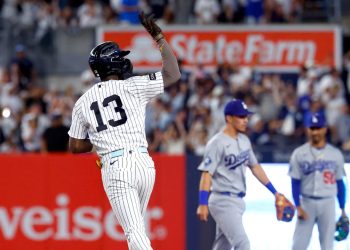
It would be one thing if all Dodgers-Yankees had going for it was market size, but the matchup also reignites one of the great rivalries in baseball history. This year’s meeting marks the 12th time the Dodgers and Yankees are facing each other in the World Series, making it the most frequent pairing in the long history of the Fall Classic.
The last time any “Big Four” final featured its most-frequent matchup was in 2010, the last time the Lakers faced the Celtics in the NBA. That series, the rivals’ second Finals matchup in three years, was the most-watched title series in nine years and was not surpassed for another five — until the first of four-straight matchups of the Cavaliers and Warriors. Yet even a historical rivalry is no guarantee of strong ratings. Go back two years and the 2008 Celtics-Lakers series — their first matchup since 1987 — was a relative dud, averaging an audience shy of 15 million viewers that would be surpassed by every single NBA Finals in the 2010s, even the Raptors-Warriors series at the end of the decade.
Consider the difference between the 2008 and 2010 series. In 2008, the NBA had to lean heavily on memories two decades old, as neither the Lakers nor Celtics had even won a playoff series the prior three years. In 2010, the league could market a pairing of the last two NBA champions. Contemporary beats retro.
It would be one thing if all Yankees-Dodgers had going for it was history, but this series pits the two biggest stars in the sport, the kind of home run hitting behemoths that the sport once championed. New York’s Aaron Judge and the Dodgers’ Shohei Ohtani are the type of superstars who could transform any World Series pairing into a marquee matchup. Per FOX on its pregame show Friday, this is the first World Series since 1966 to feature the top home run hitters in each league. Put Judge on the Blue Jays and Ohtani on the Pirates and this is still a World Series of note (if not quite as appetizing for television).
It is not just Judge and Ohtani, though they are the headliners. Per FOX, this is the first World Series to ever feature five MVPs. It is the first since 2013 to feature the top teams in the respective leagues.
It is not just that the Yankees and Dodgers hail from the top two media markets, that they have a storied rivalry, that they feature the two biggest stars in the sport and the best records in their respective leagues. It is all of those things that make this World Series that rarest of matchups, a true best-case scenario.
The last time MLB had its best-case matchup was arguably eight years ago, when the Cubs faced the Indians in the World Series — two curse-addled teams embedded in the popular culture by way of Hollywood movies. That series went the full seven games, with the finale delivering more than 40 million viewers in an era before out-of-home viewership was tracked in Nielsen estimates. The full series averaged 23 million, more than any World Series since 2004.
Much has changed since 2016, particularly in the realm of television ratings. The sharp drop-off in television usage that accelerated during COVID-19 has lowered the ceiling on what is possible for live sports, at least outside of the NFL and burgeoning attractions like women’s basketball. It does not seem entirely possible, even in the era of out-of-home viewing, to average more than 20 million viewers for seven games — or certainly 40 million for one.
Since the wave of cancellations and postponements that decimated the sports industry in March 2020, only one World Series game has managed to crack the 14 million viewer mark — the Braves’ title-clinching win over the Astros in 2021. Going from that to an average of 20 million is a tall order, even for Yankees-Dodgers. It may even be a tall order for this year’s Fall Classic to match Astros-Dodgers in 2017, another seven-game series that performed far better than anyone expected with an average of nearly 19 million. These kinds of numbers require a cultural phenomenon — akin to a Caitlin Clark or any given NFL Sunday – and it remains to be seen just how deeply this matchup will resonate in an increasingly splintered popular culture.
Furthermore, the schedule does no favors. The one thing that did not go baseball’s way this October was the Mets winning Game 5 of the NLCS last Friday, extending that series to six and ruling out the possibility of moving up the World Series to Tuesday. With its now-traditional Friday start, the World Series is set for four of a possible seven games on the two lowest-rated nights of the week, Friday and Saturday — including a Saturday night Game 7.
At worst, this will be the most-watched World Series in seven years, surpassing the five-game Red Sox-Dodgers in 2018 (14.13M). The change from last year’s all-time low Rangers-Diamondbacks series to Yankees-Dodgers will be significant, resulting in the kind of massive year-over-year increases that are rare for a championship series.
Prediction
What is baseball’s ceiling in the post-COVID era? This series is the best-case scenario, but it may not provide the answer. MLB is leaving viewers on the table with its schedule, making it unlikely that even Yankees-Dodgers will be able to live up to its full potential as a ratings draw. Even so, a seven-year high is a virtual lock, and these numbers figure to blow most post-COVID sporting events out of the water.
Prediction: 17.1 million viewers over six games, 18.7 million over seven.