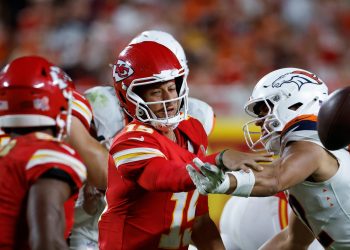
Super Bowl Sunday has arrived, and it is rare that the “Big Game” features such a familiar matchup — the same teams and even the same network as two years ago, Chiefs-Eagles on FOX. Only in the mid-1990s, when the Cowboys and Bills squared off on NBC in back-to-back years, has the Super Bowl provided such little novelty.
Even the lack of novelty is itself no longer novel. This year’s game is not the first non-consecutive sequel of the decade, as the Chiefs faced the 49ers in 2020 and again last year.
Chiefs fatigue?
Novelty is of course hard to achieve in an era so dominated by one team. Kansas City is in the Super Bowl for the fifth time in six years this decade, seeking the first “threepeat” in major North American team sports since the Lakers of Shaquille O’Neal and Kobe Bryant from 2000-02. That was the fourth threepeat in little more than a decade, coming off of the Yankees’ run from 1998-2000 and the Bulls pair of threepeats from 1991-93 and 1996-98.
For both of the Bulls’ runs, the third championship was the most-watched in league history, 1993 setting a record that would be broken in 1998. For the Lakers and Yankees, the third title set ratings lows, with the 1998 World Series the lowest rated ever and the 2002 NBA Finals the lowest rated ever in primetime.
There was Lakers fatigue, Yankees fatigue, but no Bulls fatigue. Why?
The key difference between those teams was of course the enduring popularity of Michael Jordan, but also the simple fact that the Bulls had a much tougher road to the title in 1993 and 1998. In both years, one could argue that Chicago pulled an upset — defeating teams in Phoenix and Utah that boasted home-court advantage and formidable Hall of Fame players. Both series came down to the wire, with Chicago clinching the titles with last-second Game 6 heroics.
The Lakers and Yankees cruised, the former with a sweep of the Nets and latter a gentlemen’s sweep of the Mets.
This site has already argued that the Chiefs have much in common with the Jordan Bulls of the past. Putting aside popularity — no present-day athlete matches Michael Jordan’s level of popularity, but it is also the case that the nature of celebrity is impossibly different now than in the 1990s — the real commonality is on the field. The Chiefs play close games with regularity. They win not with dominance, but with last second magic. That is the difference between a compelling dynasty and one that grates over time.
Facing an Eagles team that nearly beat them in the Super Bowl two years ago — and now boasts a superstar running back in Saquon Barkley — the Chiefs enter Sunday in similar position to that of the Bulls in their threepeat years. Not an underdog, but certainly far from a lock.
Kansas City has trailed in all four Super Bowl appearances of the Mahomes era, mounting late comebacks to win three (the fourth, a blowout loss to the Buccaneers in a half-empty stadium due to COVID, is the exception). It is hard to imagine that this will be the year that they pull off a rout.
A tough act to follow
Of course, even a close game will be hard-pressed to match the drama of last year, when Kansas City won in the final seconds of overtime. Indeed, last year’s Super Bowl will be a tough act to follow for a number of reasons, from the game itself to its unusually strong pop cultural relevance to even the networks carrying the game.
Last year’s Super Bowl aired on a higher rated English-language network (CBS, rather than FOX) and a more prominent Spanish-language network (Univision, rather than Telemundo). More importantly, it had the benefit of a second English-language broadcast (Nickelodeon), the first such occurrence since Super Bowl I. None of those factors are overwhelmingly significant, but they could add up enough at the margins to ding viewership, even if game quality is the same.
After last year’s Super Bowl generated exhaustive media attention for the presence of one of the best-known pop stars, the only off-field intrigue entering this year’s game is the Super Bowl broadcasting debut of Tom Brady. Any reader of this site knows that Brady has made zero impact on the ratings thus far (announcers rarely do). FOX had its least-watched NFL season in five years and all three of the network’s postseason windows have declined.
The above is seemingly another point in favor of last year’s game, which came on the heels of a postseason that was the most-watched on record. By comparison, most of this year’s playoff games have declined. Yet the Chiefs have been a noted exception. Both of their games this postseason are among only three total playoff windows to increase over a year ago.
Though there are signs pointing to this year’s audience falling short of a year ago, there is one major factor that could outweigh any potential shortfall. The measurement company Nielsen said last week that it is expanding its coverage of out of home viewing from two-thirds of the country to the entire nation, which should give this year’s game a leg up in any comparison to a year ago.
As it is, methodological changes are already the reason why last year’s game is considered the most-watched Super Bowl (and U.S. TV program) in history, even though it is a certainty that prior editions of the game attracted larger audiences. Next year’s Super Bowl will be the first of the new Nielsen “big data” era, meaning that the game could well have a threepeat of its own — three-straight viewership records — just off of methodological changes.
Prediction
At worst, this year’s game seems unlikely to fall too far from last year’s figure of 123.4 million viewers. At best, 124, 125, maybe even closer to 130 million viewers may be in play. (Will more viewers actually be watching this year’s Super Bowl than last? At this point in the ratings game, questions like those may no longer matter.)
On the Programming Insider website, this writer offered a prediction of 122.78 million viewers for the “Big Game.” For the sake of consistency, that prediction will be repeated here. Realistically, it seems unlikely that the Super Bowl will go without a viewership record any time in the near future.
Prediction: 122.78 million.