Sports Media Watch presents thoughts on recent events in the industry, starting with a look at the new ESPN direct-to-subscriber app and the resiliency of the cable bundle.
The official unveiling last week of ESPN’s new direct-to-subscriber streaming service, titled simply “ESPN,” marked what has been thought to be a watershed moment in sports broadcasting. ESPN, the defining cable network, will be available outside of the traditional bundle starting this fall — an outcome that ten years ago would have been seen as the death knell of the cable industry.
Yet the news did not seem revolutionary. Perhaps that is because it was first announced last year, and was in the works for far longer. Or perhaps the idea of watching TV sports unencumbered by the cable bundle is now old hat, given that sporting events on NBC, CBS and TNT Sports have for some time been available to watch on those platforms’ respective streaming services. Perhaps the biggest reason is that the meteor has already hit cable, and to a large extent the industry is — if staggered — still standing.
To that last point, consider that ESPN is now in fewer than 63 million homes, per Nielsen estimates reported by John Ourand last week. That would have been a disastrous figure ten years ago, when being in fewer than 93 million was cause for concern. Yet the network’s viewership has remained by and large resilient. ESPN in the past 14 months has aired its most-watched college basketball and hockey games, and is coming off of its most-watched Q1 since 2017 — and its most-watched in primetime since 2012.
Some of that is of course the ever-expanding addition of out-of-home viewing to Nielsen’s viewership estimates. But it says something that ESPN’s viewership is close enough to 2013 — when the network was still in nearly 100 million homes — for methodological changes to make a difference. The collapse in cable subscribers has not prevented the network from remaining in striking distance of cable’s heyday.
There are a few reasons why. Start with the fact that the era of 100 million homes was facilitated by people who never watched ESPN — never watched sports — nonetheless paying for the network as part of the cable bundle. It has been clear for some time that the majority of cord-cutters are those who are not particularly interested in live sports. The absence of those viewers from the bundle is a massive financial blow to ESPN, but not a particularly significant one from a ratings perspective.
At the outset of the cable exodus, there was much concern about Disney potentially spinning off ESPN, or ESPN having to cede important sports rights, but neither occurred. Instead, the financial toll has fallen on employees. ESPN has undergone round upon round of layoffs over the past eight years, in some cases ending careers in sports television, even as it has been able to renew or strike new media rights deals with the NBA, NFL, NHL, College Football Playoff, SEC, NCAA, and much more. This is a cold industry, and ultimately the jettisoning of loyal, quality employees — from Suzy Kolber to Howie Schwab — is not something the typical viewer would notice, certainly as compared to ESPN losing the NFL or NBA.
So if the majority of cord-cutters rarely watched sports, and the financial toll of their departure has not meaningfully prevented ESPN from conducting its core business, what are the stakes? Is the new app going to change how people watch sports? That seems unlikely.
For $30/mo, the new “ESPN” is unlikely to be a better deal than the existing bundle. Often the discussion of the bundle focuses on the old-school — cable boxes, contracts, long phone calls to customer service — but remember that the bundle is as much now YouTube TV, Sling, Fubo or Hulu + Live TV. Even at their most expensive, these options are generally cheaper than cable was even ten years ago, and given the wealth of sports networks available on most of those services, it is doubtful that the median sports fan will get as much bang for their buck subscribing directly to ESPN.
The new “ESPN” may well be a mere backstop to keep a certain handful of viewers — the cord-cutter who still wants to watch sports, but is willing to only watch the sports carried by ESPN. The reality is that direct-to-subscriber services can be a convenient, cheaper option for those with an interest in specific niche or sport, but for the general sports fan, it is hard to see the appeal.
On multiple occasions during his long political career, Senator John McCain (R-AZ) introduced bills that would have required cable operators to provide channels à la carte, meaning that viewers would be able to choose what channels they wanted to pay for. These efforts went nowhere, but to an extent the desired outcome has been reached. Starting this fall, one can choose to pay for ESPN, Fox Sports, TNT Sports, NBC Sports and CBS Sports individually across the new ESPN app ($30/mo), Fox One, HBO Max ($17/mo), Peacock ($10/mo) and Paramount+ ($10/mo). Assuming a $15/mo price tag for the newly announced Fox One, that would come to about $82/mo. For a few dollars more, one could just get YouTube TV and access to all of those channels, plus any number of others in and outside of sports.
The fact is that ‘à la carte’ only made sense for the non-sports viewer. The bundle took advantage of those viewers who merely wanted to watch HGTV, or one particular news channel over another. For the sports fan, it has been a mostly good deal. It has meant being able to watch pretty much any sports content one can imagine, and while sports fans have had to pay for news and entertainment channels they do not watch, the combined expense of those networks is marginal compared to the sports channels for which they are paying. Sports viewing à la carte makes little sense when playoff series shift from one network to another depending on the day.
Thus, the market for an expensive, ESPN-only app seems limited. It also seems fairly clear that for all involved, the continued existence of the bundle — even at the reduced levels of the present day — is both desirable and surprisingly tenable. As a result, what once seemed like the ultimate sports media transition is instead a news item of somewhat limited significance. Yes, it is a milestone, but more an evolution than a revolution.
Plus: Draymond, Sky-Fever, Around the Horn, James Brown
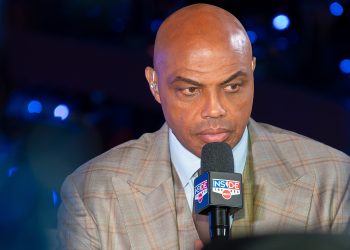
TNT announced Monday that Golden State Warriors F Draymond Green will again join its “Inside the NBA” studio show for the conference finals. Green is set to appear with the usual quartet of Ernie Johnson, Kenny Smith, Charles Barkley and Shaquille O’Neal from Games 1 and 2 in New York. As has been said in this space previously, Green’s talent is unmistakable, but his use of said talent to settle scores and take cheap shots is regrettable.
Hopefully Green will play to his strengths — providing the kind of contemporary basketball insights that are sometimes lacking from TNT’s usual cast — and shy away from the invective that marked his appearances in last year’s conference finals and February’s NBA All-Star Weekend. Remember, this is the final conference final on TNT, but not the last of “Inside the NBA.” The core four will be back at the Eastern Conference Finals for ESPN next year, and it certainly seems likely that Green will be there with them.
If every meeting of the Sky and Fever is going to turn into culture war fare, and there is no reason to expect that to change any time soon, the WNBA would be wise to adequately prepare. The league is in a truly untenable position, with no good outcomes: either a fan in the stands Saturday made racist noises toward Angel Reese, or the league’s biggest fanbase is being falsely smeared as racist by social media. That is what life is like in the culture war, where the league is firmly situated.
Given the sheer number of unreliable narrators on either side of a feud that seems to go so far beyond the individual players, the WNBA should have been cautious about adding fuel to the fire by drawing attention to this possible incident before the claims were effectively investigated.
The end of “Around the Horn” this week marks the end of an era for ESPN. “Horn” was never as popular was “Pardon the Interruption,” but any show that airs daily in the same timeslot for 23 years is a core element of a network’s history. “Horn” and its primary host Tony Reali helped define an era of ESPN programming.
Before Reali took over in 2004, replacing Max Kellerman, the show was rough around the edges and the literal template for the “30 Rock” spoof “Sports Shouting” (to say nothing of the ‘cheesecake’ shots of celebrities that often sent the show to break).
Under Reali, it softened considerably, ultimately mirroring the warmth and decency of its host in ways unusual for sports television. It became more intellectual, inclusive, open, even empathetic — characteristics that fairly or unfairly coded it as politically progressive. Its lack of edge meant it did not always have anything interesting to say, or a clear reason for existing. It was inoffensive, to put it mildly, and inoffensive means expendable.
What probably did “Horn” in more than anything was that it was too expensive, per CNBC’s Alex Sherman. (The ratings — which paled in comparison to “PTI” — were not a factor in ESPN’s decision, network executive David Roberts told the New Yorker.) Add to that the simple fact that it had run its course and seemed a bit outdated on an ESPN defined by brash personalities willing to say or do anything to generate engagement.
James Brown may have been the hardest working man in sports business. While many remember his role as an NBA play-by-play voice and sideline reporter for CBS in the 1980s, some may be surprised to learn (as this writer was) that he was an NBA analyst for the network as well. Brown, who was drafted by the Atlanta Hawks in 1973, was just as smooth breaking down the game alongside the late Frank Glieber (and Verne Lundquist after Glieber’s sudden passing in the middle of the 1985 playoffs) as he is in the studio.
Consider Brown’s resume. NFL and Super Bowl studio host for two different networks, NBA play-by-play voice, analyst and sideline reporter (and a host on a few occasions), NHL studio host for Fox Sports, March Madness play-by-play voice, “CBS Evening News” host — and that is not an all-encompassing list. A few months ago, the sports media world had the occasion to pay tribute to Brown’s longtime CBS Sports colleague Greg Gumbel upon his passing. It is always a good idea to pay tribute to those who are still with us. Brown, who one could argue is underappreciated, is certainly worthy.