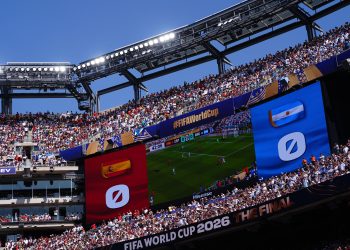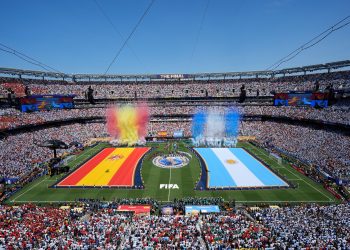
Legendary soccer announcer Andrés Cantor is renowned for calling matches with unbridled passion, and that trademark enthusiasm was on full display during Argentina’s thrilling comeback victory over England in Wednesday’s World Cup semifinal match.
When Lautaro Martínez scored the go-ahead goal, Cantor erupted with his signature “¡Gooooool!”
For viewers watching on Telemundo, the call likely evoked memories of the 2022 World Cup Final, when Argentina defeated France to capture its first world championship in 36 years.
As Gonzalo Montiel nailed the decisive penalty kick, Cantor unleashed another unforgettable “¡Gooooool!” before breaking into tears. His voice cracked as he repeatedly declared, “¡Argentina campeón del mundo (Argentina, champion of the world)!””
The emotion was more than professional. As a proud Argentine, Cantor wasn’t simply narrating history; he was experiencing it alongside millions of his countrymen.
After Wednesday’s contest, Cantor delivered a heartfelt monologue that underscored what the victory meant to him.
In some ways, both the 2022 Cup Final and Wednesday’s semifinal felt like personal expressions of euphoria. It is difficult to watch a match called by Cantor — especially one involving Argentina — and not be captivated by his high energy and fervor. It’s an approach that has defined Cantor for decades.
“The very first time I auditioned, I yelled in my first play-by-play game — I never meant to yell,” Cantor told Fast Company magazine this past week. “It came out naturally because that’s the way I grew up listening to soccer, both on television and radio. So I didn’t know any better.”
That explanation gets to the heart of why Cantor’s calls feel so different from most American sports telecasts.
As Argentina stormed back against England, Cantor wasn’t attempting to remain detached. He wasn’t pretending neutrality. Instead, he allowed viewers to hear exactly what millions of Argentines were feeling.
Cantor himself does not hide that reality.
“I’m not a hypocrite,” Cantor said during an appearance last year on Dan Le Batard’s South Beach Sessions podcast. “You ask me who I want to win? Argentina.”
On Sunday, Cantor was denied the chance to celebrate an Argentina triumph as Spain defeated the defending champions in the World Cup final. He still delivered his signature call for Ferran Torres’ decisive goal, though it lacked the emotional intensity that accompanied Lautaro Martínez’ winner.
While many, if not most, American soccer fans appreciate Cantor’s honesty and enthusiasm, some have complained that his calls are melodramatic and self-involved. These objections reveal a philosophical difference between Cantor’s broadcasting and the style to which American fans have grown accustomed.
American soccer coverage has evolved — particularly with commentators such as Ian Darke, Derek Rae, and John Strong — yet in this country, the prevailing style still prioritizes information over immersion. Analysts explain tactics. Play-by-play announcers identify players and summarize the action. The broadcast remains carefully structured. Get in, get out, don’t be a part of the story.
To an announcer like Cantor, the opposite is often true. Emotion comes first.
That distinction helps explain why Cantor’s tears resonate so strongly with viewers, particularly those with Latin American roots. Even English-speaking viewers who didn’t understand every word understood the emotion. The tears required no translation.
For other viewers, those tears cross a certain professional line. As the old saying goes, “there is no cheering in the press box.” American fans watching a national broadcast have been conditioned to expect more temperance from announcers. As the final seconds of this year’s NBA Finals ticked away, Knicks and ESPN voice Mike Breen encouraged New York fans to “go ahead and cry.” It was a moment for which he received widespread praise. Had Breen been the one in that moment doing the crying on air, the reaction would have been very different.
Is one style better than the other? That is largely a matter of audience expectation.
For the most part, viewers have come to expect clarity, context, and deliberate storytelling in sportscasts — but on Spanish-language television, passion, personality, and celebration are often woven directly into the call.
That passion enabled Cantor to connect with audiences far beyond native Spanish speakers. During the 1990s, when he served as Univision’s lead World Cup announcer, even viewers who did not fully understand Spanish tuned in to experience his emotional style of calling matches.
“People who didn’t fully understand Spanish switched to Univision because of a way of interpreting the game, and, let’s say, the passion of the Hispanic commentator,” Cantor said in a 2014 interview with NPR.
Some styles — like the measured brilliance of a legend like Vin Scully — invite reflection. Other styles — like the joyful exuberance of Andrés Cantor — inspire celebration. Both approaches have produced unforgettable broadcasters and iconic moments, and both figure to continue to have a place behind the microphone.
Plus: The decline of the tough on-air interview
Last week, longtime radio host and former ESPN and NBC Sports personality Dan Patrick made headlines after calling out WNBA commissioner Cathy Engelbert for canceling a scheduled appearance on his show. Patrick said he and his producers waited two hours for Engelbert before being informed that she would not be joining the program.
“If you want to be treated as a serious league, then do this,” Patrick said during his on-air response. “This is a fair outlet for you. I will treat you with respect.”
Some interpreted Patrick’s comments as an unnecessary criticism of the WNBA, while others argued that Patrick no longer carries enough influence to challenge a league commissioner publicly. Both reactions miss a larger point: Accountability requires access, and leadership requires a willingness to answer difficult questions.
At 70, Dan Patrick remains one of the most respected interviewers in sports broadcasting. The WNBA has no shortage of important topics to address. A league frequently caught in culture-war debates surrounding Caitlin Clark, while also navigating a new collective bargaining agreement, and welcoming two expansion franchises — the Portland Fire and Toronto Tempo — would have benefited from placing its commissioner in front of a wide audience willing to engage those issues seriously.
Engelbert’s change of heart is a reminder of how increasingly difficult it has become to hold sports leaders accountable. The era of challenging interviews and investigative sports journalism continues to fade. Today, much of sports media has shifted toward player-driven podcasts, viral clips, and opinion-based discussion.
Those platforms can offer valuable insight and personality, but they often prioritize empty conversation over healthy confrontation and cheap content over accountability. A serious sports league needs more than visibility; it needs leaders willing to step into the spotlight, face difficult questions, and explain their decisions.
The willingness of a commissioner, or any bold-faced sports name, to answer tough questions on-camera is not a sign of weakness, but of confidence.