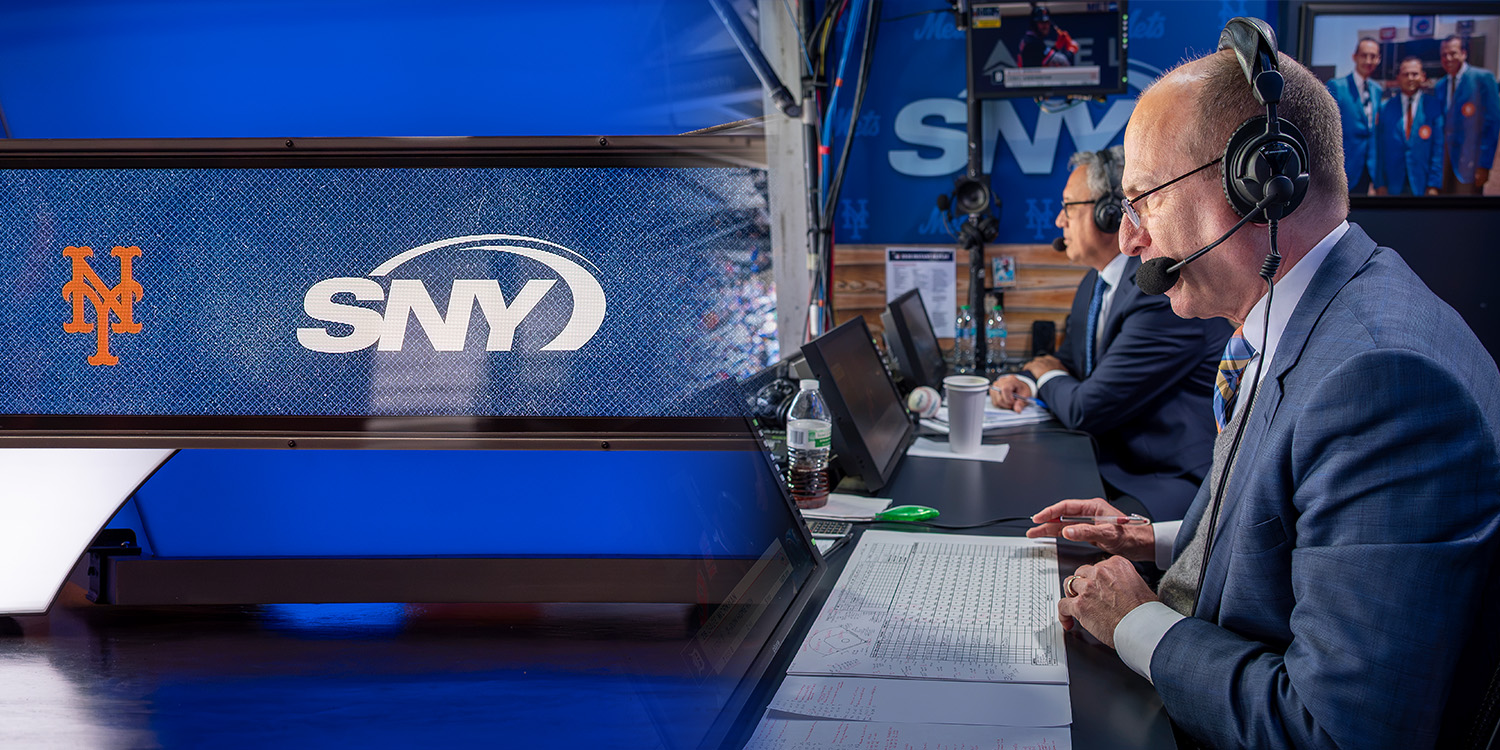
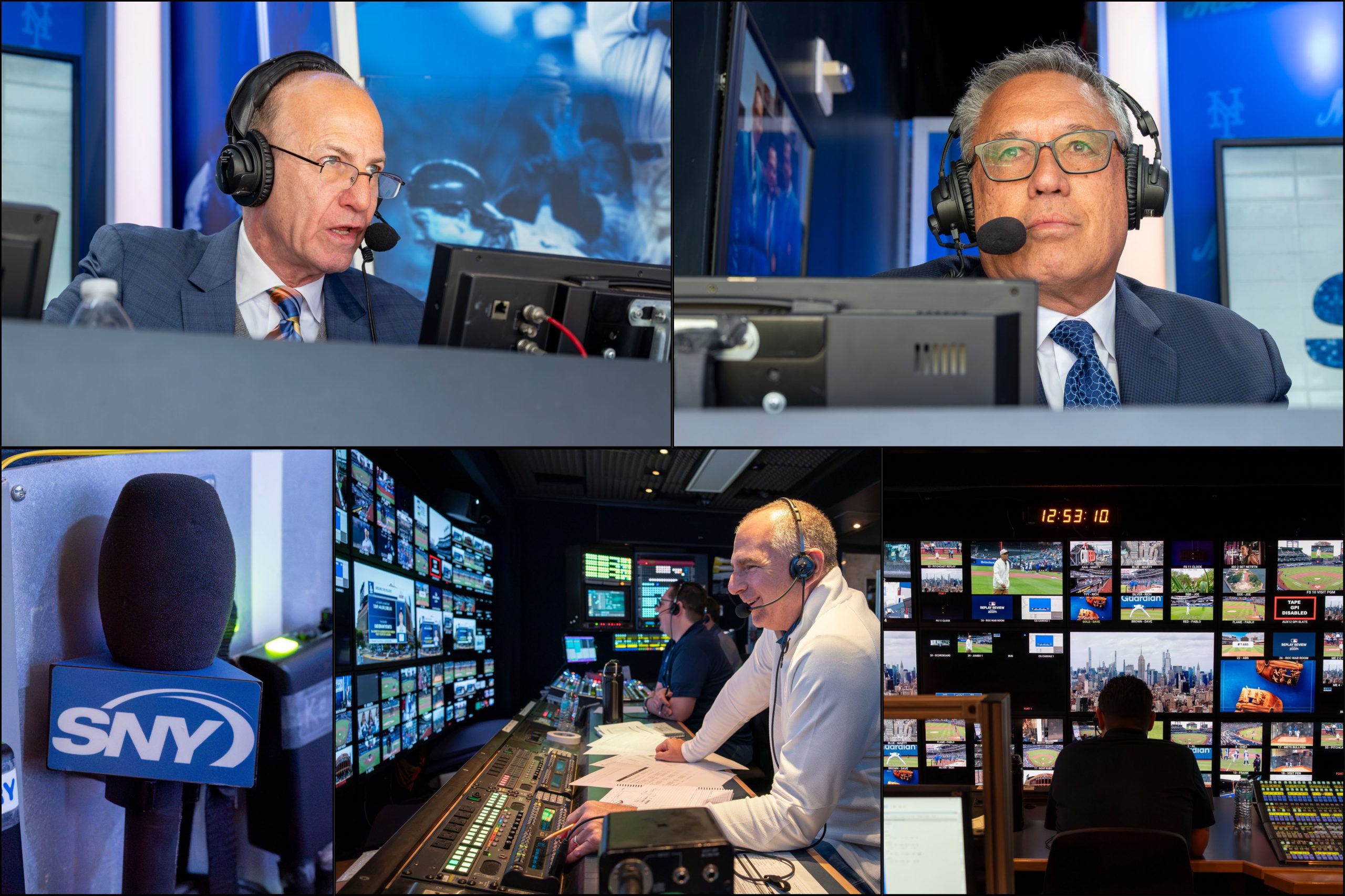
When Gary Cohen calls New York Mets baseball for SportsNet New York, he and his colleagues in the booth are occasionally shown on camera reacting to a key moment, such as a walk-off hit, game-ending strikeout or pulchritudinous defensive play. The affiliated social media account for SNY Mets content even sometimes posts a teaser photo of their jubilation ahead of publishing the video in full. The camera — aptly named “Booth Snoop” in the production truck — takes viewers beyond the ‘fourth wall’ on a broadcast whose appeal transcends the diamond.
Although the pattern is somewhat routine — a momentary reaction, Cohen delivering the call (and his subsequent pen slam) and the group marking their scorecards — there is an allure to seeing what goes on behind the curtain, even if it differs from their perception of reality.
“It’s really weird to me, and I’m never conscious of it in the moment, but basically my job in that situation is to accentuate the words on the big play,” Cohen said. “That’s my job, and the histrionics that they might see from me are not me rooting for the Mets. It’s punching the words, and what Keith and Ron are doing [is] giving me that space to do my job, formulating their thoughts about what they’re going to then add to that once I’m done.”
And a pleasant good evening
Cohen is the anchor of the award-winning broadcast booth featuring Keith Hernandez and Ron Darling, forming the longest-tenured announcing trio in franchise history. From the moment SNY signed on the air two decades ago from Mets spring training in Port St. Lucie, Fla., its presentation of the national pastime has stood out for its amiable vibe, energy and commentary. Through it all, the broadcast does not lose the essence of the game.
Gregg Picker, the senior coordinating producer for Mets broadcasts on SNY, has worked alongside the broadcasters since the beginning and maintains a philosophy of paying attention to the nuance associated with baseball.
“When you get through a season and you realize all the little nuanced things that you have observed and presented, that’s a big part, hopefully, of our success,” Picker said, “and we like to use the phrase, ‘See what you’re watching.’ You’re not just looking at the monitors, you’re really seeing it, and if you operate like that, both up in the booth and in the production truck, together you’ll be able to find interesting content.”
Cohen, Hernandez and Darling, colloquially known as “GKR,” work from a television booth in the press box named after Ralph Kiner, who called Mets games from the inception of the organization through the 2013 season. For most of his career, he broadcast games as part of a trio with Bob Murphy and Lindsey Nelson, which had been the longest-tenured Mets broadcasting team until the current SNY team broke its record in 2023.
Cohen grew up in Queens watching Mets baseball at Shea Stadium, and he later had the chance to call the ballpark his office, broadcasting with Murphy for 14 years on radio and announcing select games with Kiner on television.
“They kind of created the sound of what Mets baseball sounded like,” Cohen said. “We will never replace that — never. All we could hope is to have lived up to the legacy that they left us.”
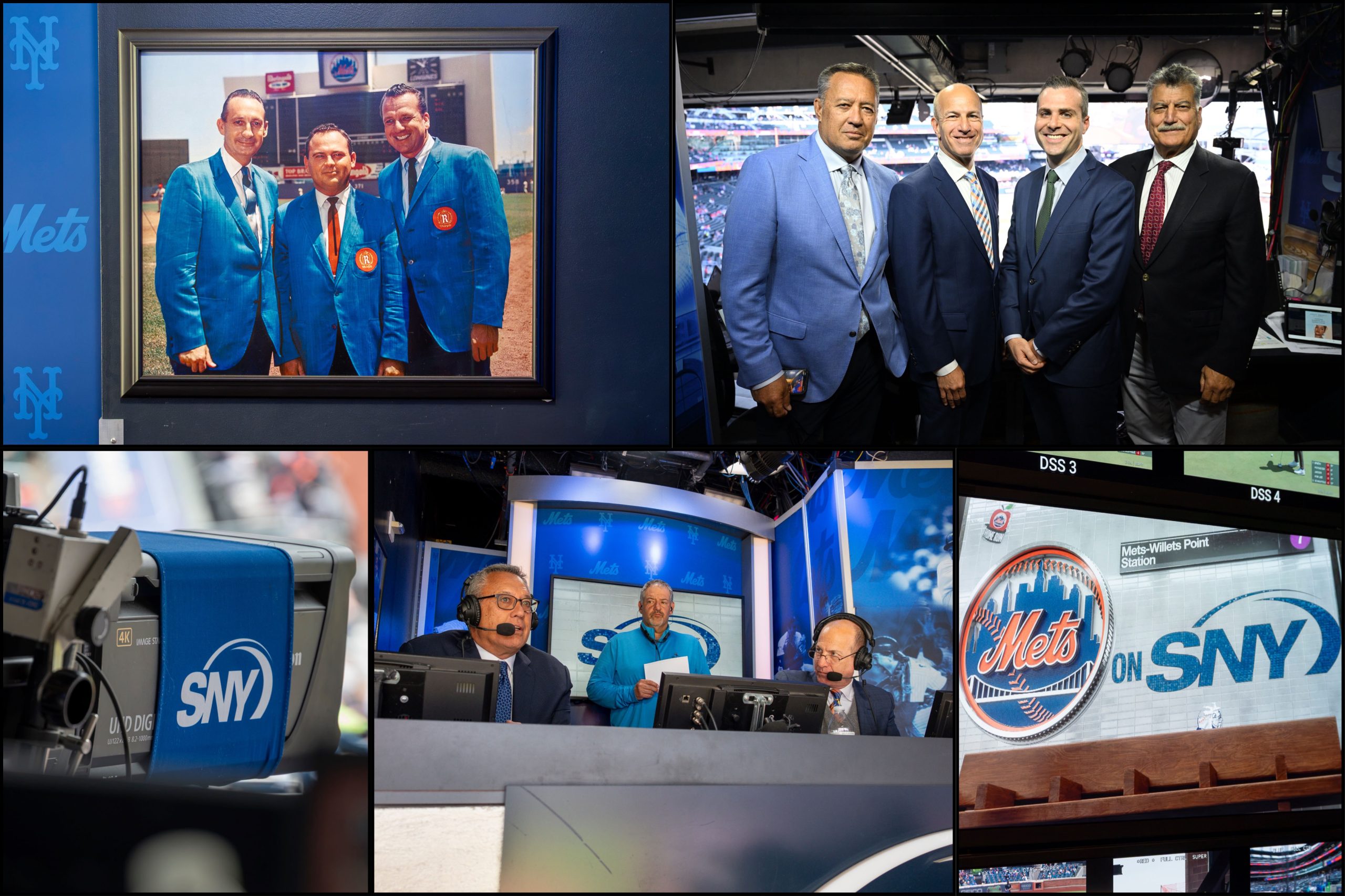
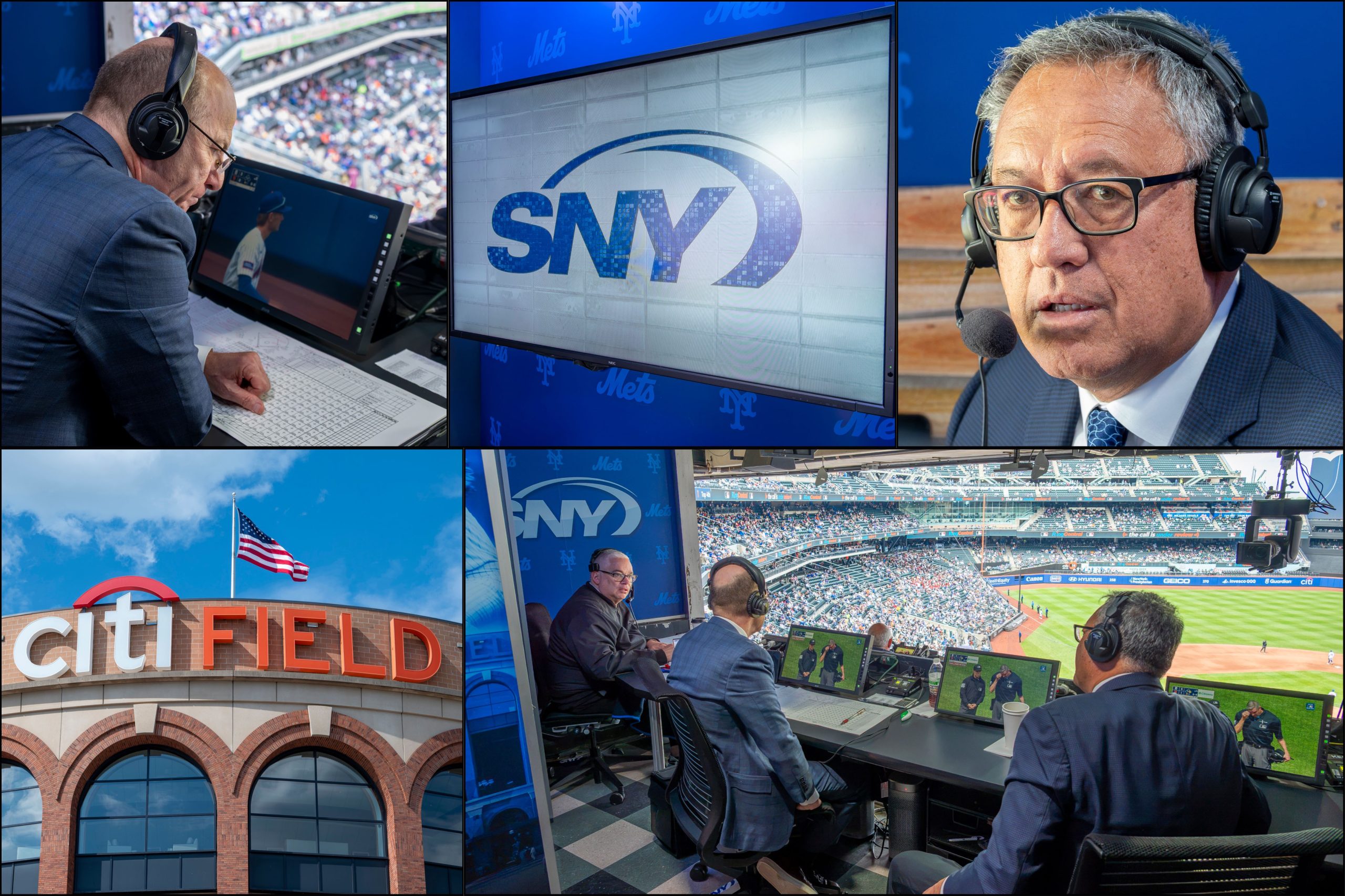
Although SNY is the home regional broadcasting team for Mets games, the group works out of a smaller television booth than the visiting network, which is frequently used for national broadcasts as well. The space features an LED screen with the SNY logo, along with a blue-tinted backdrop featuring images of former Mets stars such as Tom Seaver, Mike Piazza and David Wright.
Stage manager Russ Relkin moves around the booth and helps manage the operation, while statistician Dave Fried sits to Cohen’s left and provides research throughout the game. Picker and other broadcast professionals are located inside the production truck behind left field working on graphics, replays, audio and switching.
“I think very much like a team on the field, we’re a team in the production truck and as an extension of all the guys in the booth, and I can’t emphasize enough what a team effort it is,” Picker said. “We are very lucky at Citi Field when we do our home games to have among the best technicians in the world at what they do, so none of what we do is possible without the pictures coming from the camera guys, the skill level of our audio people, just the overall ability of everybody to work together as a team.”
Picker considers his role as akin to a coach, trying to coordinate everything related to the broadcast rather than focusing on a singular responsibility.
“We have always said that the last thing we want to read in the paper or hear on talk radio the next day [is] that we miss something, so I think if I don’t see something, I count on the director,” Picker said. “If the director doesn’t see something, he counts on the analyst in the booth, and we’re very much in lockstep with one another, and hopefully when we walk out of a truck at the end of the game, we feel like we kind of did our job to present the game of baseball in a smart, intellectual and entertaining fashion.”
Going beyond the diamond
The broadcast booth frequently goes viral for moments that, on its surface, feel more akin to free-flowing conversations on a podcast than a regional baseball broadcast. Whether it is Hernandez lamenting what he believes to be the end of his family line or Cohen talking about proper etiquette for drivers in the left lane, viewers are treated to a variety of topics without missing the game. Field reporter Steve Gelbs also frequently ventures into the stands and has a new hit hot dog segment on the road this season as well.
“[H]e is not only the creative juggernaut for this broadcast, but he also gets bored so easily that he doesn’t want to hear the same thing, and if he hears the same thing, he really gets in a foul mood,” Darling said of Picker. “Like, he wants ‘New’ all the time, and it pushes us to want [that too]. ‘New’ might be rephrasing something about pitching or hitting that we’ve said 100 different times. He wants it the 101st time or the 102nd different way of doing it, and at the end of the day, he’s not going to be denied.”
“I guess our objective is always to entertain and hold viewers as long as we can,” Picker said, “and what the game calls for or a particular telecast calls for is always different. I give a lot of credit to the guys in the booth because they are always willing to try stuff.”
Whether it is trading baseball cards, musing through the media guide or opening a concession stand in the ballpark, the SNY Mets broadcast has had no shortage of memorable moments away from the diamond. When it is time to get down to the business of the game, the group offers praise when warranted but pulls no punches when the team is struggling.
“We have never had people telling us what we can and can’t say,” Cohen explained, referencing the franchise’s ownership changes through the years. “We’re smart enough and we’re savvy enough and we’ve been around the game long enough and we’ve been in the media long enough to know where you don’t go, except maybe occasionally, but we’ve never had people tell us what you can and can’t say, and I hope that in those team-run operations, that’s not the case either.”
For one thing, the broadcasters do not try to make the game about themselves. Although the Mets have had stretches of futility and glimmers of success since last hoisting the Commissioner’s Trophy in October 1986, the team’s voices separate themselves from the results on the field.
“Our lives are not their lives,” Cohen said. “They have a job to do on the field, we have a job to do in the booth, and whether the Mets have won 12 in a row or lost 12 in a row, it doesn’t really change that. The game today is really all that matters, and I don’t know — sometimes we do our best work when it’s a lopsided game, but I think we do an even better job when it’s a close game because that’s when the baseball knowledge of Ron and Keith really comes out and the situational awareness and the understanding of how it feels to be in that 2-2 game in the eighth inning.”
“To put it in the baseball team sense, every team is looking for sustained excellence,” Darling added. “We feel as though we have to win 100 games every year in the booth, and that’s where we have to be. If we don’t do it, then we’re very disappointed.”
Before arriving at the ballpark to call a game, Cohen ensures he is equally cognizant about the rest of the league as he is of the Mets. While he does not regularly call games at the national level, he and the analysts are able to expound on developments throughout baseball and provide the necessary context that resonates with novices and savants alike. Cohen describes it as diving in head first in February and coming up for air in October, underscoring the relentless nature of the job in a sport that spans nearly three-quarters of the calendar.
“It doesn’t mean that we’re going to use it all on the air, but I feel as though you have to know as much as you can about what’s going on,” Cohen said, “and the hardest part of that is that with the information sources that exist now, you could go down a rabbit hole and, literally, spend 24 hours a day researching stuff and looking at other people’s opinions and statistics and analytics and all the things that go into creating more understanding of the game for the people who are listening to our broadcast.”
Back in the studio
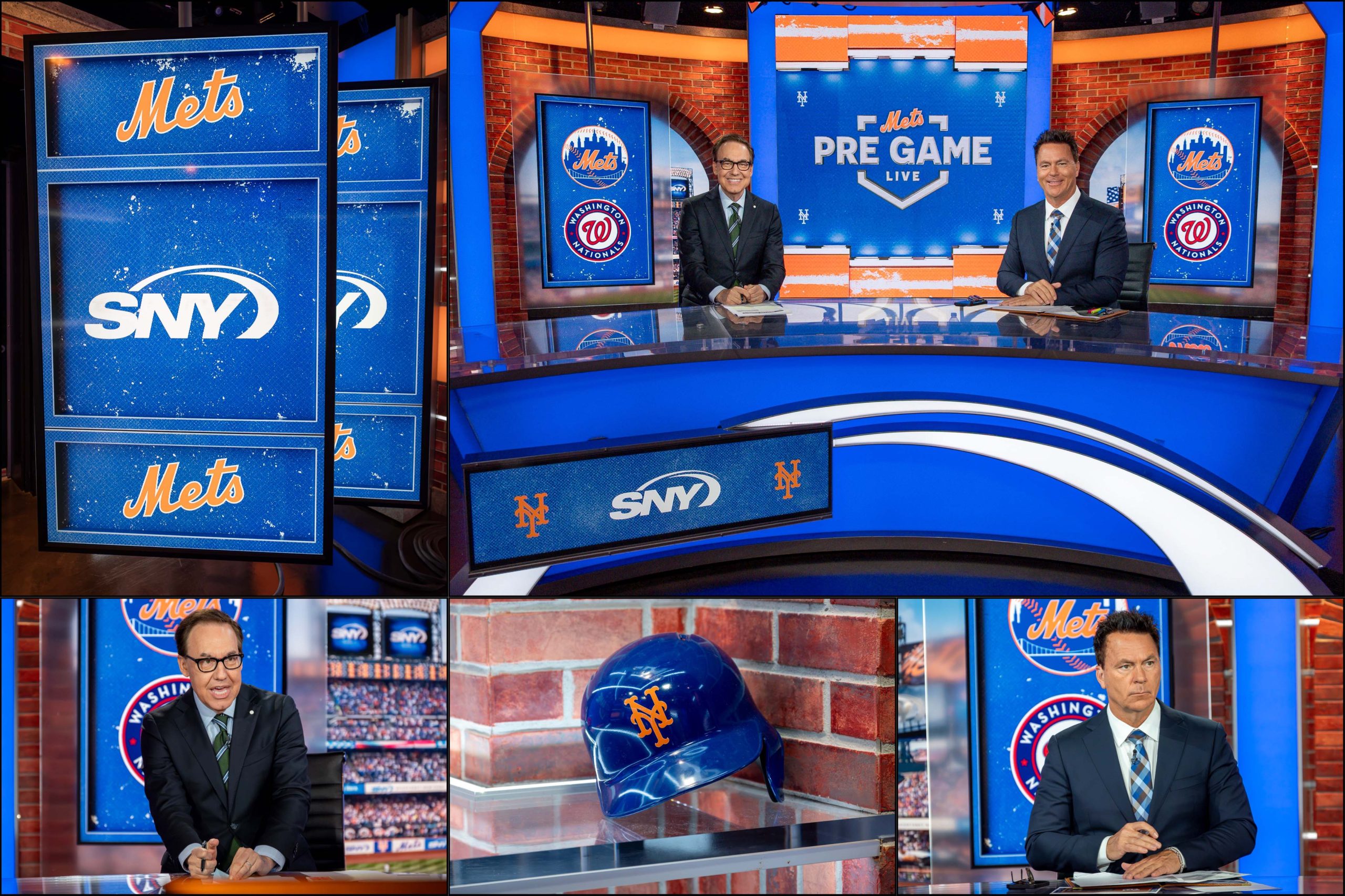
The extensive preparation and subsequent execution extends beyond the broadcast booth to the shoulder programming around the games. Gary Apple, the first person to appear on SNY when the network signed on the air in March 2006, hosts the pregame and postgame show from the network’s studios in downtown Manhattan alongside analyst Todd Zeile, who played three seasons for the team in the early 2000s. Gerard Guilfoyle, the senior director of content creation at SNY, oversees baseball studio programming and challenges Apple to get the most out of his colleagues.
“For me personally, he always says to me from the seat I sit in, ‘Challenge your analyst,'” Apple recalled. “‘Get something out of your analyst that the home viewer doesn’t know or might be thinking,’ and when I’m sitting here, I’m always thinking that way.”
On this particular day, there are only four people in Studio 41 for the program despite the three-camera setup, most of which are stationary outside of a jib to capture sweeping pans. The space itself hosts other programs throughout the season, primarily a weekly baseball talk show hosted by Sal Licata, and is the former home of NFL Network’s “Good Morning Football” when the program broadcast from New York City. There is another studio space next door used for a nightly local sports show titled “SportsNite.”
Leading into the Mets’ matchup with the Nationals, the pregame show offers the standard preview, plus a card game based on the shuffle associated with Mets outfielder Juan Soto.
“If you watch other pregames and postgames — and taking nothing away from the other broadcasts — they’re very generic in my estimation,” Zeile said. “It’s, ‘Here comes the baseball game, here’s what the team looks like, and we’ll talk to you when it’s over.’ I think [SNY gives] us a lot of liberties to do things … We make it more personal, and we try to have a little bit of levity with it, which gives us, I think, a little bit more energy through the course of the season as opposed to if we just had to strictly report on the ins and outs and the Xs and Os of baseball daily.”
Apple and Zeile complete an eighth-inning cut-in to the live game broadcast where they preview the postgame show before handing it back to Cohen for the play-by-play. While there are instances where the game outcome is relatively known by that point, there are other occurrences in which the final score is more ambiguous. Zeile starts preparing potential highlights from the game to discuss afterwards in the fourth or fifth inning, but the direction of the show is based on what occurs on the diamond.
“I think we have great support, not just from the executives here, but I think we have good synergy with the booth with Gary and Keith and Ron and Steve, and I think that makes a big difference rather than two very separate things,” Apple said. “I know those guys are off the charts amongst the best, maybe the best in all of baseball, but I think we have really good synergy between the booth and the studio, and I think the viewers pick up on that.”
Remaining true to the orange and blue
While billionaire hedge fund manager Steve Cohen completed a $2.4 billion purchase of the Mets six years ago, SNY was not included in the sale. The network is instead owned by Sterling Entertainment Enterprises, which is controlled by the Wilpon and Katz families, as well as Charter Communications.
SNY is operating in a turbulent RSN landscape that has imperiled carriage, traditional reach and long-term sustainability, but the network has been able to withstand the industry headwinds thus far. Lauren Thomas of The Wall Street Journal reported last April that SNY was “exploring potential deals including an outright sale,” although no transactions in this regard have been announced.
MLB established a local media department three years ago that now produces and distributes games for almost half of its teams, and commissioner Rob Manfred has been open about trying to centralize local rights in the near future. Earlier in the summer, the league submitted a collective bargaining proposal to the MLBPA that would centralize local television revenue for equal distribution to teams and also tied its proposed salary cap/floor system to ending blackouts.
“Financially, you want to do some things that make all these networks more solvent,” Darling said, “but let’s not lose the creativity in this business because the local creativity with each club is very important, I think, and I would hate to see that go.”
SNY has kept most of its original Mets broadcast team intact over the two decades it has bene on the air, offering viewers a familiar presence throughout the summer. With the noted exception of Darling, who calls select games nationally for TBS, the broadcast team is exclusively regional in scope and rarely misses series.
Cohen is the constant for most of the season, and he will either work with one or both analysts on a given night with occasional guests. The on-air product remains largely the same as when SNY first launched under Curt Gowdy Jr. and Steve Raab. “There’s a great sense of trust among all of us that work together, and so it just works. It’s just like a dance that we do all together,” Picker said.
“We all fell into the right place at the right time, but I think that as players come and go and managers come and go and even ownership comes and goes, if you have announcers who are part of the fabric of the organization and allow fans to get comfortable hearing the same voices and treating them like members of the family, that, I think it feeds on itself,” Cohen added. “The longevity becomes its own reward, and we’ve been fortunate to have that kind of continuity.”