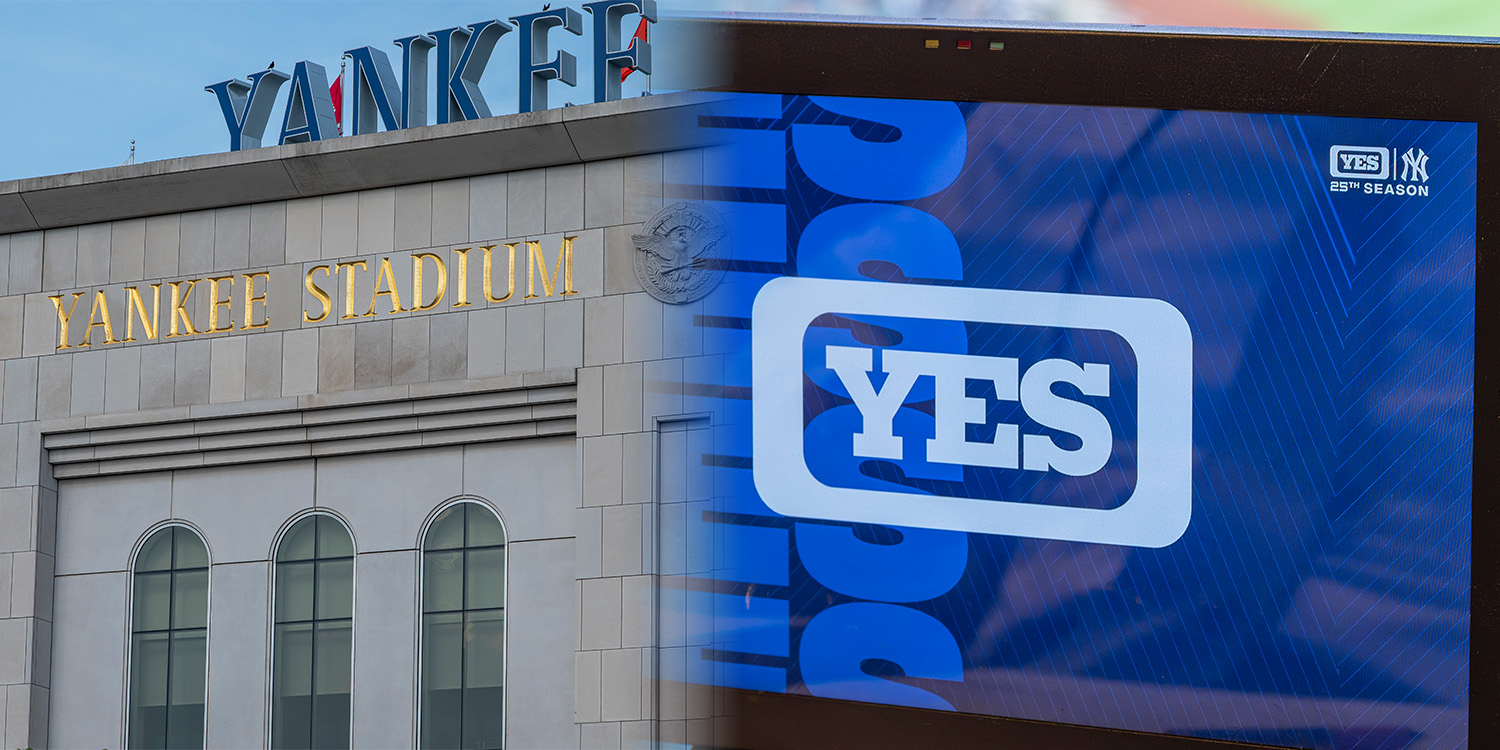
By the time Michael Kay arrives at Yankee Stadium to call Yankees game for YES Network, he already has a sense of what local sports fans are feeling. Kay is both the voice of the Yankees and host of a daily two-hour radio show on ESPN New York, where he regularly takes calls from listeners.
While the program is scaled down from the previous four-hour show he co-hosted for more than two decades, it is still a considerable undertaking and atypical for most commentators. Yet it is no problem for Kay, who finds a way to blend the two full-time roles.
“I hope and pray that everybody consumes me from 1:00 in the afternoon until 11:00 at night, but I have to assume that not everybody is listening to the radio show,” Kay said. “So I might unearth something that one of the guests I had on the radio show said, and I go, ‘Well, that’s something really good that we can address on the game.’ I just think it gives me a deeper appreciation and knowledge than I would have if I didn’t do a radio show.”
Kay has been the television play-by-play voice of Yankees baseball since YES Network launched in 2002, and he previously called games on WABC Radio and covered the team as a beat reporter. The Yankees organization has had a run of sustained excellence during his tenure, fielding a title-contending team year after year.
Although the Yankees have not posted a losing season in more than three decades, Kay remembers a specific advertising campaign from the team’s struggles throughout the 1980s and early 1990s. “At any moment, a great moment.” It is a sentiment he continues to feel in the present moment.
“We have an opportunity every single day to chronicle one of the best baseball players who ever lived in Aaron Judge,” Kay explained. “That gives you a head start, and it’s our responsibility to chronicle it the right way, and we have the means and the ways to do it. We have the experience to do it. We’ve got people that are brilliant to analyze it, so I really think that’s the difference. We’re putting a frame on their picture that they’re painting, and they paint a really interesting picture every single day, sometimes historic, and it’s just up to us to keep up with that. Humbly, I think we do that.”
Preparing for the call
The Yankees entered this particular Tuesday night matchup on a four-game winning streak averaging nearly 10 runs scored per contest in that span. It was the second time in a week the team would face the Texas Rangers and all-star pitcher Jacob deGrom, who allowed just one run over six innings but received a no-decision in a 3-2 loss.
Kay was cognizant of the basic details about the Rangers but made the time to speak with manager Skip Schumaker and other personnel on the field. In addition, he accessed the clubhouse during the latter half of availability, attended the press conference for Yankees manager Aaron Boone and snuck in more research in the booth before the game.
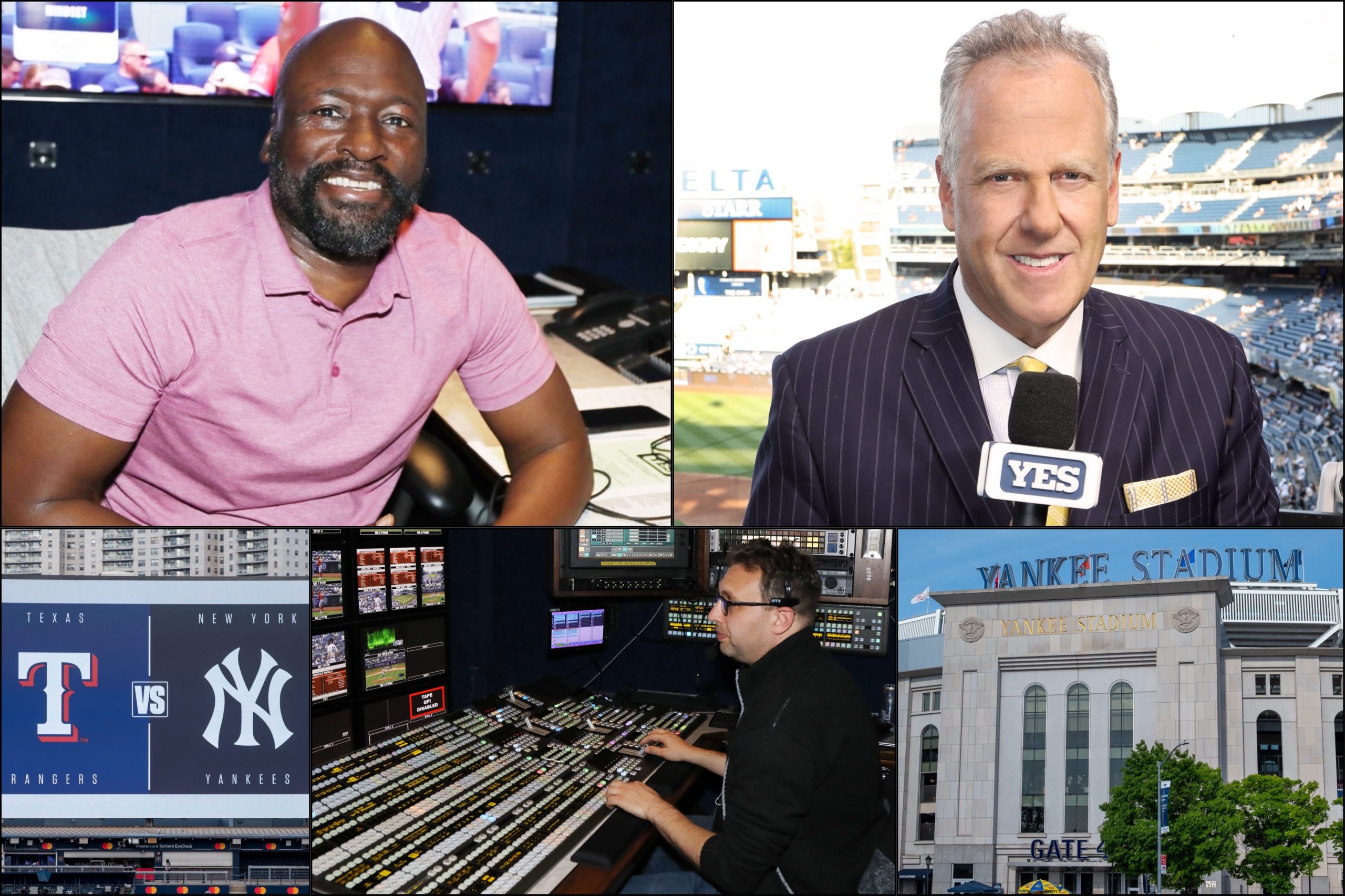
Kay will speak with YES Network producer Troy Benjamin to discuss the broadcast open, which is taped ahead of time, and other elements throughout the presentation. Benjamin has worked at the regional sports network coinciding with when it took the air in 2002, and he has been involved in virtually all of its programming across properties.
Since becoming Yankees producer five seasons ago, the broadcast has added graphics demonstrating arm strength, umpire tendencies and pitcher repertoires, along with new segments and cameras typically reserved for national productions.
“The bigger the show, we’re going to give you a bigger production,” Benjamin said. “The fancy cameras [are] one thing, the drone camera’s another thing that we seem to be emphasizing. I know other regionals are doing that as well, but you’re talking about the quality, the number of cameras that we’ll have. [On] a given day, we could put out almost 10-12 cameras. We’re talking a lot, so that’s the difference you will see – cameras, tape operators. Yeah, we’re definitely bigger than most regionals out there.”
“Troy and I both grew up in this area [as] Yankee fans, and so we can recall things without looking them up that might have happened in ’66 or ’71, and whenever one of us do it, we just hit the talkback button and go, ‘Soul,’ because it’s got to be in your soul,” Kay added. “There are people that go to other cities that didn’t grow up in those cities, and they do a fine job and they do their research. It’s in our soul, and I think that comes out in the YES Network as well.”
Standing out 25 seasons in
Jared Boshnack, the executive producer and VP/production at YES Network, has been overseeing Yankees regional broadcasts since last season. Boshnack has been at YES Network since its launch and took on this lead position when John Filippelli moved to a senior advisor role. Under his leadership, YES Network has continued to invest in production and programming around its Yankees broadcasts, introducing three new studio shows that extends its gameday coverage beyond the standard pregame show.
“We lean into the passion that the fanbase has, and we have some of the best people in the business working at YES, both in front of and behind the camera,” Boshnack said. “So extended coverage for us is a way to build more loyalty, build an audience throughout the early evening and into the night when the game coverage starts that both Michael and Troy do such an excellent job with.”
Yankees clubhouse reporter Meredith Marakovits has known Boshnack from her first day at YES Network in 2012 and commends how he has implemented new ideas into the broadcasts. Marakovits usually hosts the new “Yankees Lineup” show more than an hour before the game begins, but she arrives well ahead of time to attend press conferences, speak with personnel and film interviews.
“I’m in that clubhouse just about every day, with the exception of an off series here or there, but you can’t duplicate that knowledge and those relationships if you’re not on it every day, and I think that is what makes us certainly a viable product, and there are no fans hungrier than the New York Yankees fans wanting to know more about their team,” Marakovits said. “So I think the new offering of shows is kind of against the grain of maybe what some other regionals are doing, and I think that sets us apart.”
Although some regional and national MLB game broadcasts do not regularly implement on-air reporters, Marakovits is grateful that YES Network sees value in the role.
“If I have something more on a player, and we’re one out in the fourth inning and I say, ‘Hey, I can add on this. I spoke to this guy yesterday,’ whatever, they’ll pop my mic open,” Marakovits said. “It doesn’t need to be a formal [thing where] Michael sends it down to me. It’s, ‘Pop in for 30 seconds, pop out,’ and then that could lead to discussion for the guys in the booth.”
In addition to the new programming, YES Network also refined its talent roster by committing to three game analysts throughout the season. David Cone and Paul O’Neill have been broadcasting games with Kay for more than a decade, and Joe Girardi joined the fold two seasons ago. Todd Frazier is contributing to pregame and postgame coverage throughout the year, while John Flaherty and Jeff Nelson are not back with the network.
“When we started YES in 2002, we had so many analysts, so if somebody said, ‘Oh, you have one analyst for the 150 games you’re going to do,’ it would almost seem weird,” Kay said. “I almost would think that it would be stale, so I’m just used to working with different people, [and] I get along with all three of them.”
Kay is aware of the tendencies and areas of expertise for each analyst, and he tries to play to those varying strengths. As the game producer situated in the mobile production unit, Benjamin knows that the broadcast can move in different directions based on the analyst, and he credits Kay for his flexibility.
“A lot of people didn’t give him credit for it before because [of] the fact that he was working with almost like a different analyst in different series, so that takes a lot out of him to manage that situation,” Benjamin said. “So he’s the one doing the heavy lifting, but now it makes life a little bit easier.”

Looking under the hood
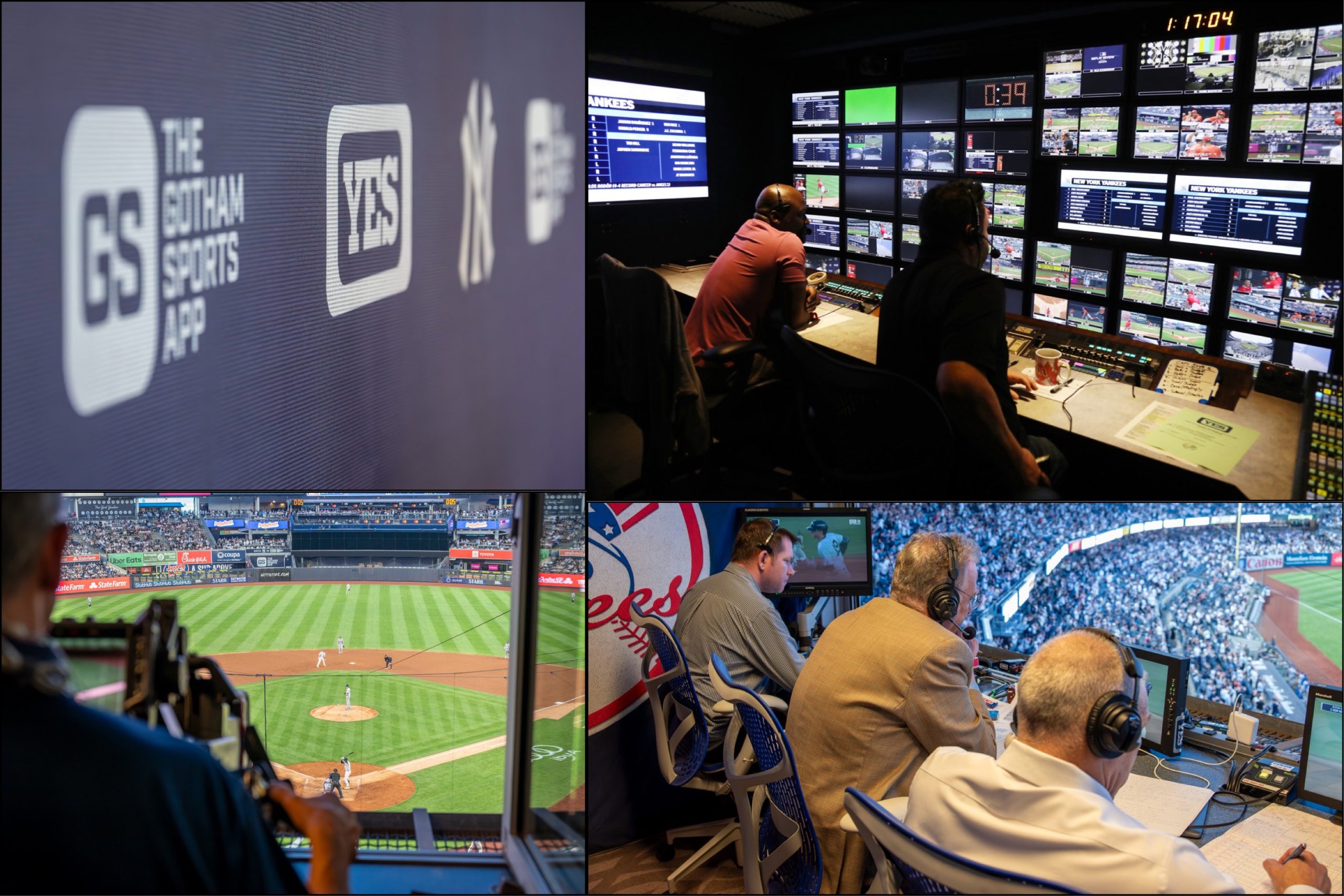
The YES Network broadcast booth is located in the press box behind home plate and outfitted with several cameras and monitors. This space is quite expansive and features a decorative back area with memorabilia and microphone flags where Marakovits used to be situated, but she now reports from the camera well along the field.
Adjacent to the main broadcast table is a bulletin board with broadcast reads organized numerically, which are handed to Kay throughout the game. The booth also has a step-and-repeat with the YES Network and Gotham Sports App logos, along with motorized screens that prevent glare when the announcers appear on camera.
The broadcast truck is able to access the booth camera, scoreboard feed and many other angles of the game viewable on the large monitor wall. Personnel in this space perform designated roles, such as updating graphics, adjusting audio levels and coordinating replays, and they remain in constant communication throughout the broadcast.
YES Network game director Dan Barr composes the look of the broadcast with technical director Seth Zwiebel operating a production switcher to make his vision a reality. Boshnack feels that YES Network is “regional in name only” and trying to present coverage that is commensurate to the high-profile national team it covers.
“We have a quality and a standard that’s been set for our 25th season covering this team, and we look at ourselves as quality that, every day, we know what we expect of ourselves and what our audience expects… and we’re going to lean in on that, and we’re going to do what we do well,” Boshnack said. “I don’t think we ever measure ourselves up against the other regionals. We know the quality that we bring to the table each day, and that’s the standard that we set.”
YES Network is airing 124 Yankees games this season, but in actuality, the regional slate extends to 145 games through a deal with Prime Video, whose parent company Amazon holds partial ownership of the RSN. The streaming service has televised select Yankees games since the 2021 season, but they are still produced by YES Network with the same announcers. Despite the heavy workload, which equates to approximately 90% of regular-season games, the group effectively manages fatigue through a love of the craft.
“That’s just going to bring the energy and the juice when you come to the park every day,” Benjamin said. “It doesn’t feel like work.”
“I think you’re better when you do more games, I really do,” Kay added. “If you take a lot of games off, then you’re parachuting back in, and you’ve missed a lot of the rhythm.”
YES Network entered into a joint venture with MSG Networks in 2024 to create the Gotham Sports App, which offers live streaming of all Yankees games on the RSN. Prior to the season, the app lowered its monthly and annual prices and made subscriptions available through Prime Video. Despite all of the innovations digitally and with specific broadcast elements, such as camera angles, trivia questions and in-game interviews, the game remains the primary focus.
“I think, at your core, you have to stick to why people are watching, and that’s baseball,” Marakovits said. “They want to see the game, they want to hear the calls, but I think within that, there’s certainly room to grow and room to improve that.”
Regional sports networks are operating in a period of uncertainty as Major League Baseball attempts to bring its full suite of local rights to market with national offerings following the 2028 season. The MLB Local Media division is already producing and distributing games for nearly half of the league’s teams, many of which onboarded last offseason after departing Main Street Sports Group as the company faced financial hardships.
The RSN company, then-known as Diamond Sports Group, had previously been in Chapter 11 bankruptcy proceedings, during which it disclosed a 20% minority stake in a joint venture that owns and operates YES Network through an “indirect, wholly-owned subsidiary.”
Although Main Street sold its stake in FanDuel Sports Network West to the Los Angeles Angels, its other 14 regional sports networks are no longer televising MLB games and began winding down operations following the NBA and NHL seasons.
YES Network has been more resilient than other RSNs, but it is nonetheless operating in the same industry replete with challenges. For his part, Kay hopes those in the sport recognize that the strength of baseball is derived regionally.
“I don’t know if Yankee fans have a connection with Joe Davis, as great as he is,” Kay said. “They have a connection with us, and because we’re in their homes every month all summer, so we become part of the family, and baseball should not lose that. They should not mess with that, and I understand there might be more money nationally, but the bottom line is the strength of this whole thing that we call baseball is within. Yankee fans live in New York and Connecticut and New Jersey, they want to be familiar with who’s doing the game.”