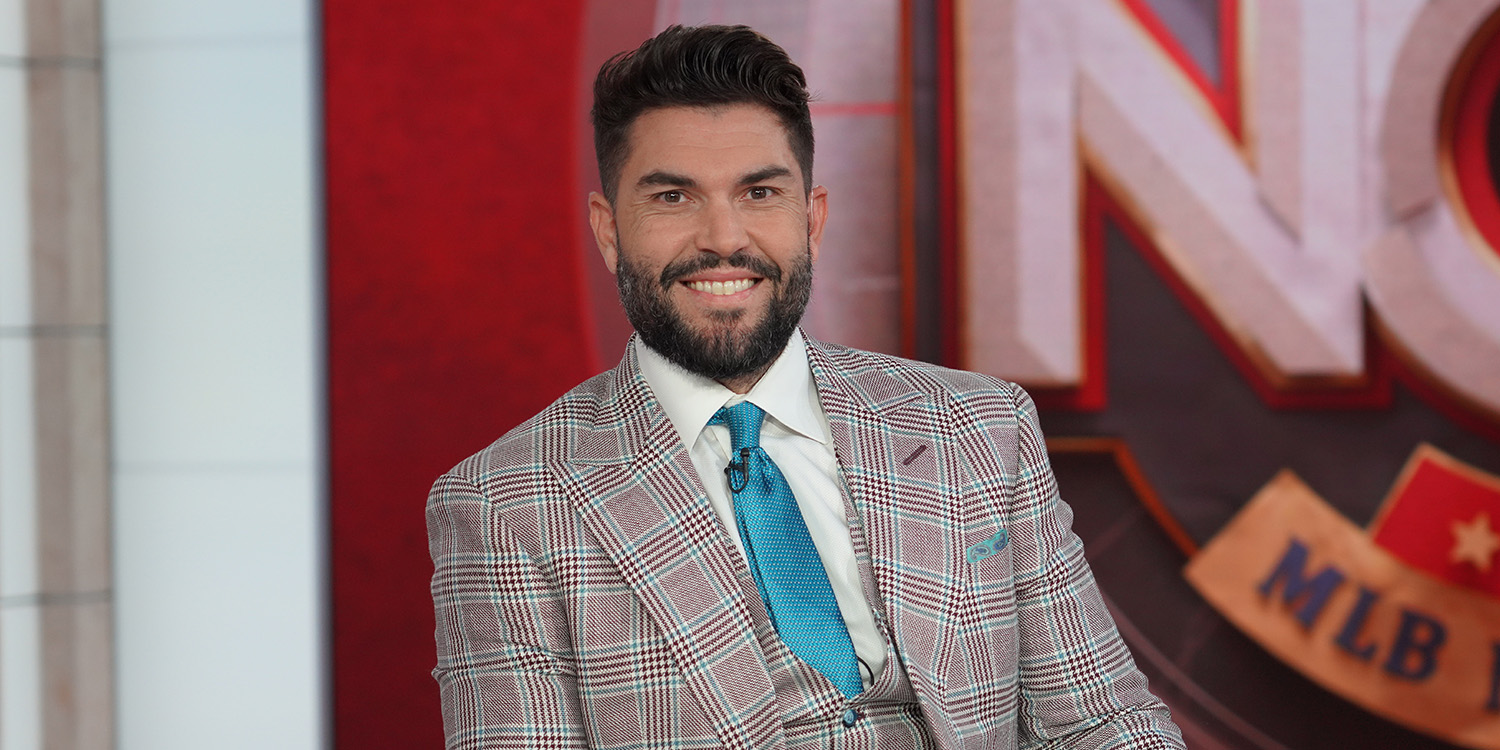
When Eric Hosmer hoisted the Commissioner’s Trophy victorious as a World Series champion with the Kansas City Royals, it was the realization of a life’s dream. Eleven years later, Hosmer is pursuing another goal in the broadcast booth.
“I think every baseball player’s dream when they’re done playing is you have an opportunity to be welcomed back into the game any which way, and you want to take full advantage of that,” Hosmer told Sports Media Watch from MLB All-Star Weekend last month in Philadelphia. “I have three young kids, so you know, selfishly, I want to be at home a good amount of time — but at the same time, if I have an opportunity to be involved in the game and work at the network and do some things like this, then I’m all for it.”
Hosmer is five months into his role as an analyst on MLB Network, joining a growing list of former players who work at the league-owned broadcast entity. Hosmer has been on air for MLB Network Showcase games in addition to studio programs such as MLB Central and MLB Tonight, providing insights derived from recent on-field experience. He recently served as a roving reporter for the network at MLB All-Star Workout Day where he roamed Citizens Bank Park and interacted with counterparts in the outfield.
“It’s been a fun transition so far,” Hosmer said.
Throughout his time in the studio, Hosmer has broken down adjustments at the plate, looked back at his baserunning in the World Series and ranked the best hitters in the sport. During his time as a player, he developed a reputation as a contact hitter with elite bat-to-ball skills and a leader on and off the diamond. He is trying to bring an similar mentality to his new setting.
Hosmer lives within an hour of MLB Network’s Secaucus, N.J., studios, meaning that he is available whenever the network needs him. That might mean appearing on the “National Pregame Show” edition of “MLB Tonight” one day or working alongside Sean Casey and Kevin Millar the next. A self-described baseball nerd, Hosmer said it has been “fun” working with like-minded colleagues: “Everybody from research and the producers are locked in.”
“He’s just coming off the field a few years ago and arguably one of the most popular players in the league amongst his teammates and the other players, so these guys all know him,” added Marc Caiafa, SVP/production for MLB Network. “He’s faced them, and he’s just an all-around good guy, so those are the kind of guys you want in your stable, and at the same time too, he’s also pretty darn good on TV as well.”
Over the last few years, Hosmer has become a consistent presence on media platforms covering baseball as a podcast host and television analyst. At a time where there seems to be a dearth of recently-retired players on traditional baseball coverage, Hosmer may be providing a blueprint for other players to navigate the post-playing media landscape.
Setting the blueprint
Prior to joining MLB Network before Opening Day this past spring, Hosmer launched MoonBall Media with former Royals minor league second baseman Anthony Seratelli. The independent venture was involved producing a variety of content, including docuseries, unscripted programming and podcasts.
The company started with the “Diggin’ Deep” podcast, a show hosted by Hosmer with former MLB relief pitcher Peter Moylan and coach Justin Su’a featuring interviews with players, managers and broadcasters discussing their career journeys and what they have learned through the years. It proceeded to develop a slate of original programming and partnered with companies such as Fanatics, Fox Sports and Showtime.
Even though the scope of player-driven media is more limited in baseball than other sports, Hosmer’s company competed with the likes of Omaha Productions, Shay Shay Media, ThreeFourTwo Productions and others for consumer interest in retention.
“It seems like now, there’s kind of a separate group of ex-players that, when they cover the game, they like to go over the instructional stuff,” Hosmer said. “They like to help out with the youth, and that’s kind of the way I look at it. When I’m doing games, especially in the booth, a lot of times when a replay is happening, I’ll tell all the youngsters to listen up out there and give them a teaching moment, whether it’s instructional, a mental thing or just preparation.”
In addition to MLB Network, Hosmer became part of the Royals.TV team earlier this season, one of the franchises whose games are fully produced and distributed by the league’s local media department, and been an analyst for two Royals games on NBC’s “Sunday Night Baseball.”
As he continues to develop his on-air persona, Hosmer counts one of his colleagues as an influence. Former MLB 1B Yonder Alonso joined MLB Network in 2021 shortly after retiring from baseball, where he contributes across different studio programs and live game broadcasts. Hosmer watched several of Alonso’s game analyst assignments and said he is “definitely learning a lot from him.”
“He’s always had a great baseball mind, he’s a natural leader of men, and someone who makes everyone around him better,” Alonso said of Hosmer. “I have no doubt he’ll become one of the great talents at MLB Network. Looking forward to watching this next chapter — he’s built for it.”
Hosmer also credited MLB Network host Siera Santos, whom he worked with on some MLB Network-produced “Friday Night Baseball” broadcasts on Apple TV, as helping him in adjusting to television. “Hoz hasn’t needed much help, but you can tell he’s got that passion to be really good at this,” Santos said. “He’s come in hot, bringing ideas for segments and breakdowns to our production meetings from the jump. He’s not far removed from the field, so his insights are fresh and of great interest to the fans.”
The next generation of analysts
The recent trend for newly-retired athletes has been to mix traditional television roles with independent media platforms, from as Tom Brady to Carmelo Anthony to Peyton Manning embracing the dichotomy of working both for and with media conglomerates. Active players have started to establish media brands as well, including LeBron James with the SpringHill Company, Patrick Mahomes with 2PM Productions and Stephen Curry with Unanimous Media.
Baseball has taken time to embrace the trend, but it is starting to catch up. For example, the “Foul Territory” network of podcasts features a selection of team-specific programs anchored by former players, such as A.J. Pierzynski, Kevin Pillar and Todd Frazier. Former MLB Network host Scott Braun and coordinating producer Marc Weiner founded the venture under the Make Plays Media banner in 2023.
MLB Network offers digitally-focused programs in addition to its linear shows, including a network-branded podcast with in-depth conversations. The network also has a deep talent roster featuring former players working as analysts, some of whom include Ryan Dempster, Xavier Scruggs, Chris Young and Alex Avila.
The athletes, most of whom are working their first jobs in television, appear on the air with experienced hosts, among them Greg Amsinger, Lauren Shehadi and Brian Kenny, along with veteran analysts such as Mark DeRosa, Harold Reynolds and Dan Plesac. The formula has created a new class of budding television stars.
“I’ve had the good fortune of being with the league for many years even prior to the network, and you really want guys who could relate to today’s game and how it’s played,” Caiafa said. “Several years ago, we brought on Chris Young and Yonder Alonso and Jake Peavy. They just came off the field, and they, again, similar to Hosmer, they know all the guys. They kind of were, as they were winding down their career, the new age and how the game is being played and whatnot. They have good perspective on how it was played 10 years ago to how it’s being played now, so it’s just fresh perspective.”
By the time teams are playing for the Commissioner’s Trophy, Hosmer will be one of a few national analysts recently removed from the game who won the World Series, adding a layer to the value he provides MLB Network and its viewers. As it currently stands, he is the latest product out of a pipeline of new analysts at a time that baseball has prioritized reaching the next generation.
“I think as players transitioning into the media, you think you can kind of just show up and you’re going to know what to say and you’ll be good to go,” Hosmer explained. “So I definitely put in the work, and I want to continue to put in the work. I kind of prepare like I’m playing that day, so it makes life easier when you’re preparing for a guy like Chris Sale and you don’t actually have to get in the box.”