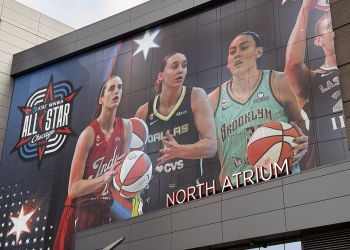
Given how the WNBA is often discussed, one might have expected WNBA All-Star Weekend in Chicago to carry an undercurrent of tension and hostility. But the vibe was actually more positive and relaxed than in Indianapolis a year ago, when looming collective bargaining negotiations were the talk of the weekend. For a league that seems to always be mentioned in the context of one hot-button issue or another, the biggest source of angst was less any specific player or incident, rather than an overarching exhaustion with the all of the controversy surrounding the league.
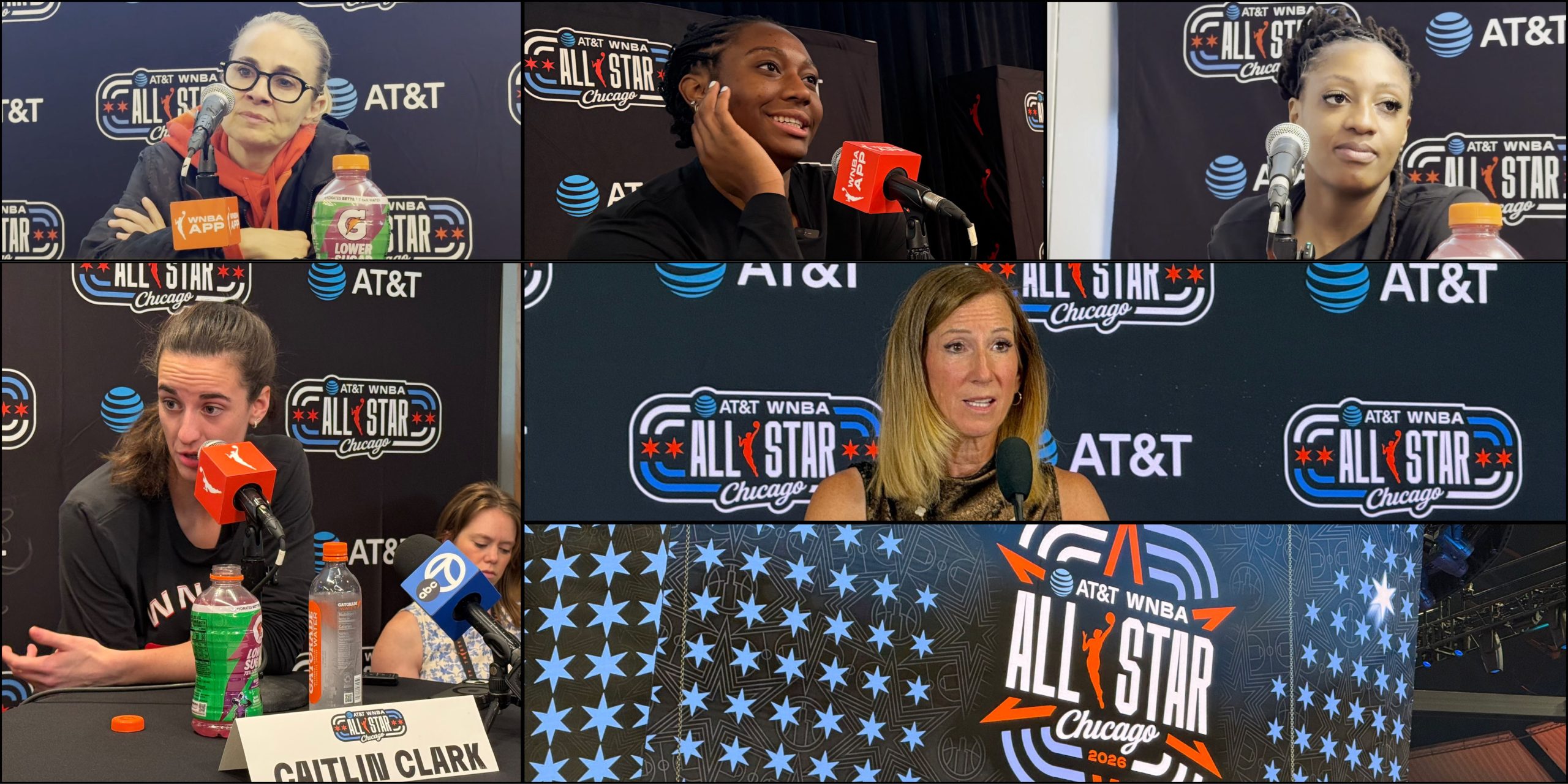
“It’s a little bit exhausting and a little bit tiring to constantly have to deal with things,” Fever G Caitlin Clark said at All-Star Media Day last Friday. “A lot of the times, it’s very distracting from the product and the game.”
“The people that talk the most know the least on some of these topics, don’t have a good pulse on our league at times,” Aces coach Becky Hammon told Sports Media Watch in a media day scrum.
Alyssa Thomas’ fist-to-the-neck foul against Clark, now a month old, has arguably been the defining image of the WNBA season. The argument goes that the play was not merely dirty — a la the foot-to-the-chest, knee-to-the-groin, finger-in-the-eye antics of a Draymond Green, or even Thomas’ own neck-tackle of then-rookie Angel Reese two years ago — but a manifestation of hate centered on Clark’s identity. Stated implicitly and sometimes outright, the suggestion is that WNBA players are targeting Caitlin Clark for being, in Boomer Esiason’s words, “a straight white basketball player.”
That is quite the leap, the sort of thing that might have gotten someone accused of ‘playing the race card’ if the roles were reversed. It is hard to dispute that Clark, inarguably the most popular women’s basketball player ever, has a bigger target on her back than most. The idea that it has to do with her immutable characteristics rather than her outsized popularity, rapid anointment, or even her brash, youthful confidence, is a conveniently-uncharitable explanation for those already inclined to believe the worst about the WNBA and its players. It also makes little sense in a league that welcomed Sabrina Ionescu without any controversy.
Clark, for her part, has given zero oxygen to this argument. She has advocated for herself in a manner typical of basketball stars, by complaining about the officiating, but has reiterated time and time again that all she is looking for is a fair whistle. Clark, the center of the culture war in sports, has given zero indication of wanting to be a culture warrior, and not for lack of opportunity. But in this era, there is the perception that silence is complicity, even violence. As a result, Clark’s general reticence to speak out — which, it should be noted, she has overcome on multiple occasions — is seen by some as a tacit endorsement, or at least enabling, of her worst ‘fans.’
It is that perception which fueled an article by USA Today’s Nancy Armour last week suggesting Clark’s on-court behavior — flopping and complaining about the refs — could cause a dangerous backlash against other players. As part of that argument, Armour invoked the murder of Emmett Till, the 14-year-old black boy kidnapped and murdered in 1955 in one of the most unconscionable crimes of the 20th century. Armour is not the first to suggest that Clark is in some way culpable for the actions of a social media mob, bestowing onto the 24-year-old responsibilities that even whole political parties are not expected to exercise, but she appears to have been the first to invoke one of the worst horrors of Jim Crow in making her argument.
What makes the invocation of Till so perplexing — in addition to breathtakingly poor judgment — is that there is a more relevant example. In 1993, a fan of Steffi Graf stabbed the tennis star’s chief rival Monica Seles in the back during a match, primarily to ensure that Graf would return to #1 in the world. (Seles, at just 19, had won seven of the previous nine majors.) Few if any put the tragedy at the feet of Graf, even as she benefited on the court from the incident, perhaps because no athlete has the power to choose their fans or control the behavior thereof. Frankly, the kind of fan who would commit an act of violence in ‘defense’ of an athlete is obsessed and deranged enough to commit an act of violence against said athlete. (Note that Seles’ attacker was also stalking Graf.) The risk Armour describes is one that could easily be faced by Clark herself.
Esiason and Armour represent extremes, but they are indicative of a broader tendency to ascribe the most negative motivation possible to every controversy in the league. And that is not limited to the media. It was just last week that Tempo coach Sandy Brondello referred to Angel Reese as a “protected species” in an exchange with referees, an ill-advised choice of words that Reese seemed to think was indicative of deeper animus (judging by her all-caps tweet “ARE WE SURPRISED?” afterward).
Thus, the WNBA finds itself in a position where issues that are fairly common in professional sports — physical play that crosses the line, superstars who argue every call, coaches who go too far in the heat of the moment — are seen as proof of far more serious problems. But the hate that so many argue is coursing through the league’s collective veins would seem to be more projection than anything else. If there was one common theme among players last weekend, it was that the outside noise is causing more problems than any internal conflict.
Kelsey Mitchell, who has played for Indiana since before the arrival of Clark or Aliyah Boston, said that when she first arrived in the WNBA, “there was no coverage at all.” That changed, obviously. “I’m like, ‘wow, they found my Instagram? How did they find my Instagram, you know? I didn’t even use it,” she said. But the added attention came at a cost. Mitchell said that after her father’s passing, she started receiving comments after losses about him ‘rolling over in his grave.’
“It was a lot of negative, bad stuff that, for one, you don’t understand. You’re like, how did it get to this point? And then for two, human to human, it’s like, if I’m a human and you’re human, why would you say that to somebody?”
“I feel really bad for these players,” former ESPN commentator Jemele Hill told this writer Friday. “Especially the young players, because they’ve grown up on social media. And the way that fans connect with them, some of them can be great, but some of them can be frightening.” Hill noted the stalking cases that both Clark and her Indiana teammate Sophie Cunningham have faced, as well as the bigoted comments several players have received. “On a day-to-day basis, that’s a lot to deal with. Imagine dealing with that and trying to be the best professional possible.”
Hill can relate. She has long been a lightning-rod for criticism, even before becoming possibly the only sports media figure whose firing was ever called for by the White House. “I’m surprised on the day I’m not called a racial slur. It’s surprising when it doesn’t happen. But trying to compartmentalize that is hard. People assume that because you play a sport or you’re visible in the media, that this just comes with the job. And yeah, that is true. But we shouldn’t normalize that it comes with the territory.”
The players have been particularly concerned about hateful comments on social media, with the league and union putting out a joint statement at the beginning of All-Star week addressing the issue. Contrary to the perception of a league at war with itself, the sense from some of the key players Friday was that they see each other as a support system amidst the outside noise.
Clark in particular expressed gratitude for the support of her teammates. “They always have my back, and they’re the ones that interact with me firsthand every single day, and they see the type of person that I am.”
Indeed, Mitchell did not hesitate to praise Clark when asked. “People create this narrative that she has it all put together at 22 and 23 years old, which is really diabolically crazy. They think that she’s superhuman when it comes to some of the stuff that she goes through,” Mitchell said of the third-year star. “The discourse that she does get, it just comes from people not being decent humans. But CC is obviously a great person with great people behind her.”
For Clark, that internal support may resonate a bit more given the magnitude of her fame and the sheer number of people forming opinions about her. “There’s obviously a lot of people that like to comment on my character, and think that they know me,” Clark continued. “And at the end of the day, they have no idea who I am.”
That may extend to the entire team. “When you actually look at our organization as a whole, and the people that’s in here, we care about each other, we love each other,” Boston told SMW. “I think everyone does everything they can to make sure that we’re all successful. I think people associate the so-called fans, and they’ve used that to define what our program looks like and our franchise looks like, which I think is complete nonsense.”
Despite all the invective about the players, and the myriad ways in which they are being positioned against each other, it would seem fairly evident that the most intense feelings about the controversies in the WNBA are shared by a vocal portion of fans and media. The biggest source of tension among the players would seem to be with the league office — specifically commissioner Cathy Engelbert, who continues to appear almost reflexively out-of-touch with the mounting criticism of her tenure — rather than with each other. Yes, there are hard fouls and dirty plays, there are flops and whines, there are players who do not like each other. But that is typical of pro sports. The only thing strange in the WNBA is how these issues are discussed.
From the players’ perspective, there is one clear way to fix the problem.
“You know, I’m going to treat everybody with respect and kindness and love,” Clark said. “And I think if everybody could do that a little bit better, we’d be in a little bit better of a spot.”
Mitchell echoed those sentiments. “People have to do a better job of just being a better human. Basketball is basketball at the end of the day. … I think that people could be better by being better people.”