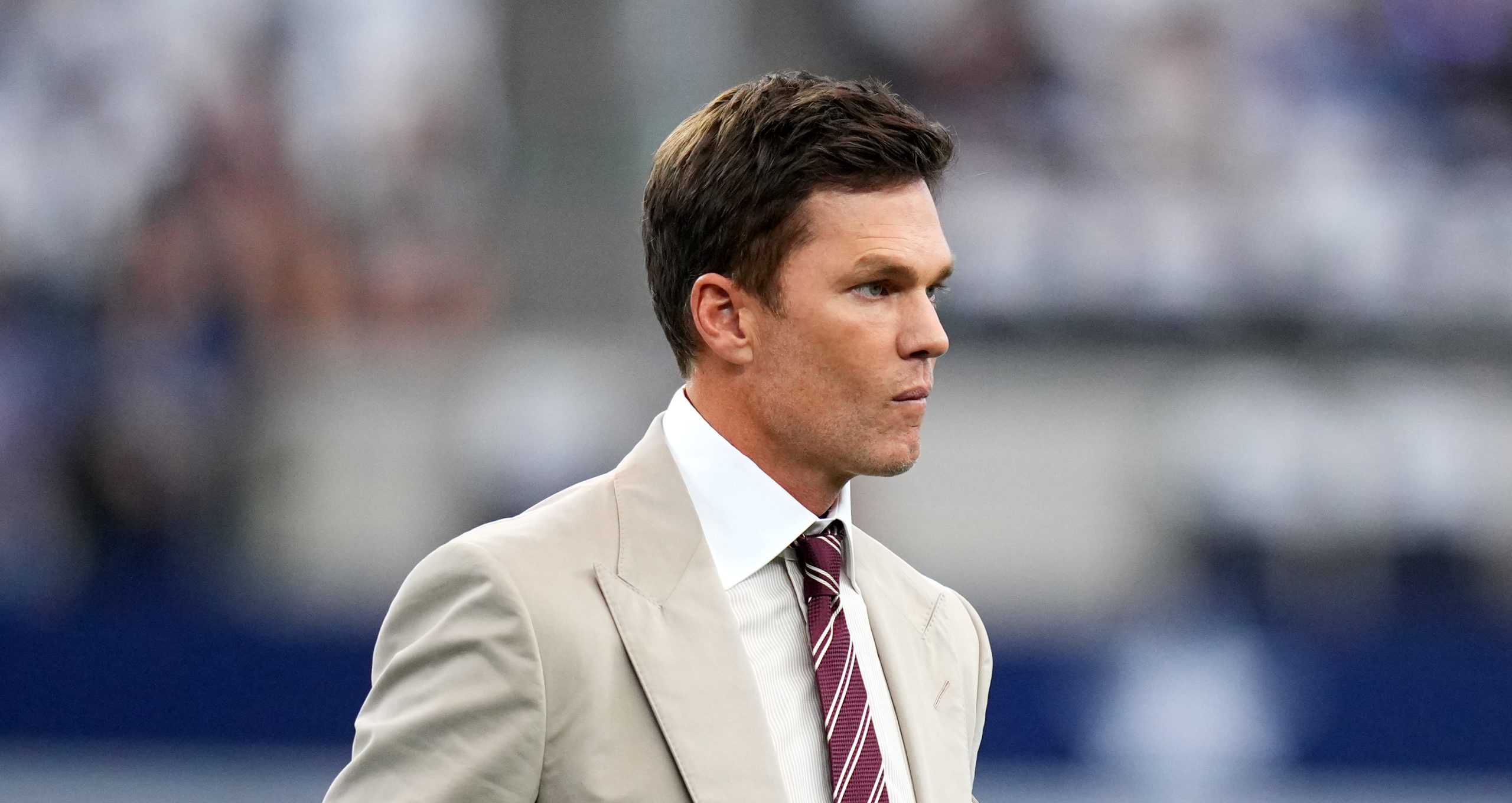
When Tom Brady entered the Fox broadcast booth, the sports media world was eager to find out what kind of analyst he would be. Now in his third year, it seems we’ve found the answer. As he’s settled into the role, Brady has become more willing to speak his mind with refreshing — and, at times, almost brutal — candor.
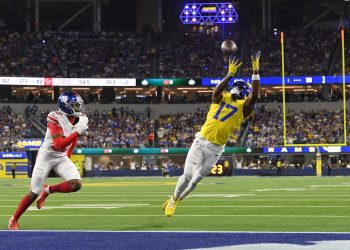
Sunday’s Chargers–Bills broadcast gave Brady no shortage of mistakes to call out. With 13 minutes remaining in the fourth quarter, the Chargers held a 13-10 lead and were driving inside the Bills’ 25-yard line when QB Justin Herbert threw an interception to Bills S C.J. Gardner-Johnson. Brady held nothing back during his assessment of the play.
“Herbert trying to throw down the middle of the field to Valdez-Scantling,” he said. “There’s a safety in the middle of the field and that’s Gardner-Johnson. Poor awareness. Poor decision. Throws him a meatball sub.”
Bills QB Josh Allen was also on the receiving end of pointed criticism from the Fox lead analyst. After Allen’s INT to Chargers S Genesis Smith late in the first quarter, Brady said Allen had made a “poor read” and that Allen didn’t have great anticipation on the throw, calling the pass a “gift interception.”
Often, when analysts scold a player for a mistake, they’ll soften the language by using terms like “he’s going to wish he had that one back” or “not a good decision.” But what makes Brady’s analysis so unique is that viewers can hear the disgust in his voice when a player, especially a QB, commits a costly error. If anyone is allowed to offer a rebuke of a QB, it’s Brady, a seven-time Super Bowl champion widely regarded as the greatest QB to ever play the game. This is the value a former player of Brady’s stature brings to the Fox booth. Brady’s words resonate more deeply because he set a standard of excellence few players will ever be able to match.
His criticisms didn’t end with Allen and Herbert. When he disagreed with the officiating, he let viewers know about it.
Late in the first quarter, Bills LB Greg Rousseau was flagged for a personal foul after driving Herbert to the ground on a pass play.
“I don’t know about that. Oh, my goodness,” Brady said during a replay of the hit. He then turned to rules analyst Dean Blandino, declaring, “I don’t like it.”
During a segment on his “Let’s Go” podcast in 2022, Brady said “there’s probably more Johnny Miller in me, where when I used to watch him on golf telecasts, it was just scathing sometimes. That’s essentially how I end up seeing the game a lot, now.”
While he certainly has his light-hearted moments in the booth, Brady’s pull-no-punches approach may become the defining trait of his broadcasting career.
Plus: Dennis Miller and the failed MNF experiment
Tuesday marks the premiere of “Miller Night Football,” a documentary chronicling former “Saturday Night Live” cast member and satirical comic Dennis Miller’s unlikely two-year stint as an analyst on “Monday Night Football.”
Believing that “MNF” needed a new approach, ABC Sports hired Miller in 2000 to join Al Michaels and Hall of Fame QB Dan Fouts in the booth.
No other football broadcast had ever sounded quite like it. At a moment’s notice, viewers would be hit with references to Ancient Rome, the Pont Neuf or Mesopotamia.
Occasionally, Miller’s quips, some of them undoubtedly scripted, would cause Michaels and Fouts to erupt with laughter. Other times, they were met with awkward silence. Viewers were left confused while Miller unleashed his obscure one-liners.
Looking back, the Miller hire was an obvious roll of the dice, but there was an appealing idea underneath it. “Monday Night Football” in its 1970s heyday succeeded partly because its announcers had distinct personalities. Howard Cosell and Don Meredith could make a game feel like a grand event. The difference between Cosell and Miller, however, is that Cosell — despite his efforts to transcend or even redefine the role — was a sportscaster.
No matter the uniqueness of the talent, personality works in a booth only when it serves the game that is unfolding. Football already asks so much of its audience — tracking formations, substitutions, injuries, replays, the game clock, the play clock, and so on. An analyst’s best contributions often come in short, measured statements. Explain why a protection broke down, notice a matchup, or give a play some room to breathe. Miller’s instinct was to add another layer. His rejoinders could be clever, but a viewer often had to leave the action to make sense of his arcane references.
It brought ABC all kinds of media attention, but the Miller experiment failed because it asked football fans to join the polarizing comedian on a circuitous journey through history, politics, and pop culture. Ultimately, all football fans really wanted was good football.