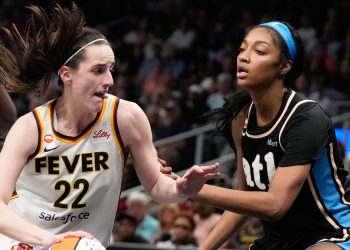
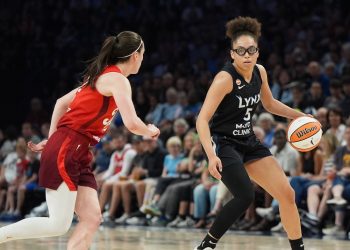
When all is said and done, the Caitlin Clark-era Iowa Hawkeyes will occupy a unique place in the history of sports on television. As has been noted, there have been any number of viewership crazes over the years, from “Coach Prime” and “Linsanity” to Danica Patrick and Mone Davis, but those petered out rather quickly.
The better parallel for what the sport of women’s college basketball has enjoyed in the past two years may be the NBA of the 1980s, which on the backs of Magic and Bird jumped from an also-ran to the “Big Four” status it enjoys to this day. It is not that Clark simply moves the ratings needle, but that she is changing the status quo of her sport.
Raising the bar
Women’s college basketball has never had the difficulties drawing an audience that have afflicted the WNBA. No WNBA game has cracked the million-viewer mark since 2008, while women’s college games have done so with regularity long before Clark ever took the court. Yet the women’s college game has never before been a tier one property.
Assuming one does not consider the NFL a tier to itself, tier one is the domain of the major leagues (NFL, NBA and Major League Baseball), college football and men’s college basketball, and quadrennial events like the Olympics and World Cup. One can also include single events like the final round of the Masters and Kentucky Derby. These are the type of properties that are expected to regularly deliver audiences in excess of ten million viewers. Getting to that mark is not a milestone, but in many cases the bare minimum expectation.
Women’s college basketball has long existed on a secondary tier, generating audiences that are respectable, but nonetheless short of what might be described as a ‘mass audience.’ There were a few years in the CBS era when viewership approached or exceeded the ten million mark, but once ESPN acquired exclusive rights in 1996 and put all of the games on cable, viewership topped out in the five million range — at best. The numbers were respectable for cable and tended to outperform the Major League Baseball games ESPN might otherwise air, but that was about it. [Related: Women’s Final Four Ratings History.]
Just two years ago, an audience of 4.85 million for the South Carolina-UConn national title game was considered excellent. Seven years ago, 3.83 million for South Carolina-Mississippi State was viewed as pretty good, pretty, pretty good.
One can criticize the soft bigotry of low expectations, but those numbers truly were decent. ESPN is not typically generating audiences in the four million range. Nonetheless, they were not the kind of mass audiences that might become the subject of watercooler discussions the next day. One could not bring up a women’s player in a casual setting and expect that anyone would know who they were talking about. ESPN could bump the national semifinals to ESPN2 in favor of regular season NBA or baseball without much complaint.
To say that the situation has now changed is an understatement. The 6.9 million viewers Iowa attracted in the Sweet 16 against Colorado was impressive on its own, but the subsequent two games have delivered easily the two largest women’s college basketball audiences yet: 12.3 million in the Elite Eight against LSU and 14.2 million in the Final Four against UConn.
It is rare in the modern era of sports television for any property to vault from tier two — if even that — to the level of a tier one. To go from being preempted by NBA regular season games to outdrawing NBA Finals games. From such an afterthought that the men’s Final Four was simply called “the Final Four” to potentially outdrawing the men’s national title game. Indeed, Sunday’s South Carolina-Iowa national championship game is poised for any number of viewership milestones that would have been unthinkable just three years ago, when 4.13 million for the Stanford-Arizona title game was cause for celebration.
Why the women’s final will outdraw the men’s
A women’s basketball game outdrawing all of the men’s games in a single year is not going to be soon forgotten. Considering the historical viewership gap between the men’s and women’s games — as little as two years ago, each game of the men’s Final Four and NBA Finals more-than-doubled the women’s title game — it would be as significant a flip as if the Stanley Cup Final suddenly outdrew the NBA Finals or the Monaco Grand Prix topped the Daytona 500.
Entering Saturday, the most-watched game of the NCAA men’s or women’s tournaments was last Sunday’s NC State-Duke men’s regional final with 15.1 million on CBS — an audience that comfortably exceeded the then-record 12.3 million for Iowa-LSU the following day. Yet that comparison obscures important context. The men’s game did not just air in a Sunday afternoon window on broadcast television, but did so on a holiday (Easter) that is associated with family gatherings. In the out-of-home era, that is as good a recipe for high viewership as any. The women’s game aired in a Monday night window exclusively on cable.
Between out-of-home, broadcast vs. cable, and the fact that Sunday afternoon is better for ratings than Monday night (just look at any given week in the NFL), the men’s game had a distinct advantage.
For those same reasons, the women’s national title game should be considered a borderline lock to outdraw the men’s final. The women’s game airs in a Sunday afternoon window, albeit two hours earlier than last week’s dinnertime start for NC State-Duke. It airs on broadcast television (ABC) and the men’s game airs on cable (TBS, TNT and truTV). While this Sunday is not a holiday, Sundays are in general better for out-of-home viewing than Mondays.
Perhaps most of all, the women’s game has a bigger star in Caitlin Clark than the men’s game has had in years.
Is the women’s game benefiting from the men’s decline?
That last note has been the key point of contrast between the men’s and women’s games, mentioned primarily by those who have used the growth of the latter as proof of the former’s decline. There is a long-standing tendency to downplay the success of women’s sports by highlighting perceived inadequacies in the men’s, from one-and-done to poor fundamentals. If not said directly, the argument is that the men’s game has fallen so far that even the low-rated women can overtake it.
Yet there is no indication that the growth in the women’s game is because anyone is fed up with the men’s. Perhaps there has been a superstar vacuum created by the one-and-done rule on the men’s side, but it is also just as possible that Caitlin Clark’s drawing power exists completely independently of the condition of the men’s game. The numbers bear that out, as viewership for the men’s tournament was up four percent through the Elite Eight. There is no grand exodus from the men’s game that is fueling the rise of the women’s.
Barring a blowout, Monday’s UConn-Purdue men’s national championship should have no trouble surpassing last year’s record-low of 14.69 million for UConn-San Diego State — even on cable. Yet 15 or even 16 million viewers is unlikely to be enough to surpass Sunday’s audience. It will not be the case that men’s viewership has fallen so low as to be surpassed by the women, but that the women will have generated a large enough audience to surpass the men.
Sunday’s ceiling and next year’s floor
Outside of football, no domestic sporting event has cracked the 18 million viewer mark since the wave of cancellations and postponements that decimated the industry four years ago. One has to go back five years to 2019 to find the last such instance, Game 7 of the 2019 World Series (23.01M), and the last such instances in pro and college basketball — the Raptors’ NBA Finals clinching victory over the Warriors (18.6M), and Virginia’s win over Texas Tech in the men’s national title game (19.6M). The high-water mark since is 17.08 million for Baylor’s rout of Gonzaga in the 2021 men’s title game.
Given the stakes — Clark, in her final college game, trying to end South Carolina’s undefeated season to win her first national championship — it would not be surprising if Sunday’s national title game is not only the most-watched basketball game of the year, but the most-watched domestic sportscast (again excluding football) in five. It would not be a heavy lift to go from 14.2 million viewers on a Friday night on cable to 17.09 million on a Sunday afternoon on broadcast.
Even a comparably underwhelming number in the 15 million range — unlikely given the size of Friday’s audience — would mark a historic capstone to one of the most unexpected sports media turnarounds of recent times.
Eight years ago, when UConn won its most recent national title — and fourth-straight in the lopsided Breanna Stewart era — fewer than three million tuned in. (That figure would have been higher with out-of-home viewing, but the point remains.) With Clark as a lead-in, this year’s UConn squad averaged more-than-twice as many viewers in their Elite Eight win over USC. On Friday, South Carolina’s rout of low-profile NC State averaged 7.1 million, trailing only its Iowa-UConn lead-out as the highest for the Women’s Final Four since 1992 on CBS.
While it will be borderline impossible to sustain the Clark-fueled heights being reached in this year’s tournament, all indications are that the floor has been raised. There is no reason to believe the bad old days of eight years ago are coming back any time soon.
Ratings prediction
Dating back to last year, Clark and the Hawkeyes have blown past every reasonable expectation of viewership. Coming off of Friday’s 14 million viewer performance on cable, 20 million would seem to be in play.
Previous predictions that seemed optimistic have ended up falling well short of reality. Thus, this prediction may seem overly generous. It may end up that way, but the only way to accurately gauge viewership for a Caitlin Clark game is to go beyond what one thinks is realistic. The Clark-era Hawkeyes have been a true television hit, and heading into Sunday’s series finale, there is no reason to curb one’s expectations.
— NCAA women’s basketball tournament national championship: #1 Iowa vs. #1 South Carolina (3p Sun ABC). Prediction: 24.20 million viewers.
— NCAA men’s basketball tournament national championship: #1 Purdue vs. #1 UConn (9p Mon TBS, TNT and truTV). Prediction: 15.75 million viewers.