This is a trying time for sports on television as the industry fights the headwinds of cord-cutting and media fragmentation. Television networks and leagues have taken measures that just a short time ago would have been considered extreme, desperate, or some combination of the two: an In-Season Tournament in the NBA; MLB in an Iowa cornfield; NASCAR inside the L.A. Coliseum. These efforts have been met with moderate success from a viewership standpoint, but they are not the type of needle-movers that drastically impact viewership in the aggregate. That type of shift requires a unicorn, and the last year has featured two: Caitlin Clark and Deion Sanders.
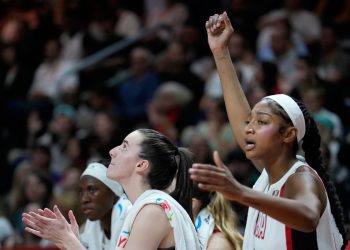
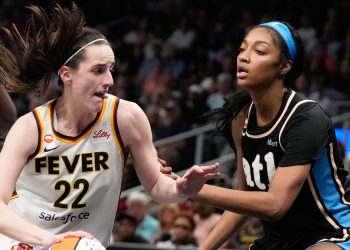
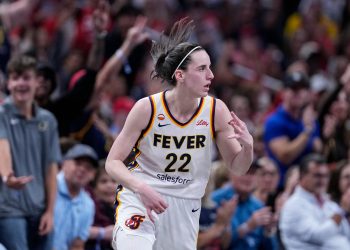
Clark has spent the past season breaking records on and off the court. Her Iowa Hawkeyes played in two of the four most watched college basketball games this season — regardless of gender. Both her record-breaking game against Ohio State and Big Ten Tournament championship win against Nebraska attracted over three million viewers. Only two men’s games, a Thanksgiving NFL lead-out between Michigan State and Arizona on FOX (5.18m), and a Duke-UNC game on ESPN (3.08m) also eclipsed the three million mark. Clark’s Big Ten Tournament semifinal against Michigan was the most watched women’s sporting event ever measured on Big Ten Network (1.08m). The championship game on CBS was the network’s most watched college basketball game of the year, men’s or women’s (pending results from this past weekend).
Of the six most watched women’s college basketball games this year, Clark played in five. Last year’s LSU-Iowa championship game delivered 9.9m viewers, the most ever for a women’s college game in the Nielsen people-meter era (dates back to 1988). The list could go on.
Deion Sanders — aka Coach Prime — transcended the sport of college football for a moment last fall. On his way to becoming Sports Illustrated Sportsperson of the Year, the Prime-fueled Colorado Buffaloes played in five of the fifteen most-watched regular season games of the year, more than any other school. Through the first five weeks of the season, Colorado played in either the first or second most-watched game of the week. Incredibly, that includes a Week 3 game against Colorado State that averaged 9.3 million viewers on ESPN, despite not kicking off until after 10 PM ET. That game drew four million more viewers than the second-most watched game that week, Georgia-South Carolina in the afternoon window on CBS. All of this for a team that won just one game the previous season.
Such viewership anomalies do not happen in a bubble; they are products of larger, media-driven forces. Think of last summer’s “Barbenheimer” craze for instance. Those two blockbuster films almost single-handedly lifted the box office from its pandemic-era depths. As many Hollywood analysts pointed out, the organic social media trend spurred from the strange juxtaposition of both movies being released on the same day led them to sell more tickets. Established media operations then picked up the story and fed into the trend. Social media isn’t always wagging the tail of traditional media, it can go both ways. The key to a true ‘craze’ however, is breaking through everywhere, no matter the media one consumes.
Maybe the most comparable sports craze in recent memory to the Clark-Sanders charged viewership of this past year is Linsanity. For a few weeks in 2012, New York Knicks guard Jeremy Lin broke out in a series of masterful performances that captured the imagination of the basketball world. Lin helped MSG Network improve its ratings by 82% through mid-February compared to the previous season — an absurd jump. However, Linsanity is perhaps also the most illustrative of another key factor in these viewership crazes: by definition, they are fleeting.
A look at Google search trends (below) puts these anomalies into perspective. Linsanity lasted about three weeks. Prime Time at Colorado was able to break through for about a month. Clark’s 2023 spike held for a few weeks in March, though her spike started much earlier this season, beginning to trend up in January. The lesson here, these massive viewership crazes are nice to have, can potentially raise the floor of a sport on the margins, but cannot be relied on for sustained viewership long term.
Caitlin Clark

Deion Sanders

Jeremy Lin

This isn’t to say these anomalies are without value. Networks have realized that facilitating these crazes help maintain healthy viewership in a difficult television environment. Thus, manufacturing these short-lived spikes could prove to be a key component of network’s strategies into the future. Last year for instance, FOX sent its Big Noon Kickoff show to a Colorado game four of the first five weeks of the season to help jump-start the Deion Sanders media blitz. ESPN’s College GameDay also setup shop in Boulder for the Week 3 game against Colorado State, the same week CBS’s 60 Minutes aired a Deion Sanders story.
As for Clark, ESPN recently announced that for the first time, it will embed a reporter (Holly Rowe) with Iowa for the team’s upcoming NCAA Tournament run. FOX gave Clark special treatment as well. When the network aired Caitlin Clark games this season, they would have her stat line permanently fixed on the scorebug. They livestreamed a “Caitlin Clark Cam” on TikTok. FOX even reportedly offered Clark an NIL package to incentivize her to play in college another year.
Of course, these crazes cannot solely be manufactured by the networks. There must be some truly organic interest in the subject for any of this to be possible. Between Clark and Sanders, there’s evidence to suggest that such crazes are becoming more frequent. Two in one year is notable when the last similar instance was Linsanity in 2012. This is partly due to the networks’ willingness to feed into these stories, though the growing desire in public life for shared experiences should not be discounted either.
Record-setting viewership has become commonplace for sporting events that have found ways to break into the monoculture. To be sure, some of that is because of Nielsen’s changes to out-of-home viewing measurements, though arguably the reason a property like the NFL has been so successful lately is because of its ubiquity in American life. Clark and Sanders have been able to simulate similar far-reaching appeal to generate viewership, albeit for shorter periods of time, and orders of magnitude smaller than the NFL.
A level of cultish personality, elite talent, or both seems prerequisite for a viewership craze to start. The level to which television networks will find ways to capitalize on these circumstances in the future remains to be seen. As traditional media fights for survival, with live sports as a main component, replicating Clark or Sanders-esque media booms may well become a substantial part of the formula. The next few years will be telling about how much influence traditional media still has in its agenda-setting role, and how far they’ll be willing to go to facilitate a media-induced frenzy.