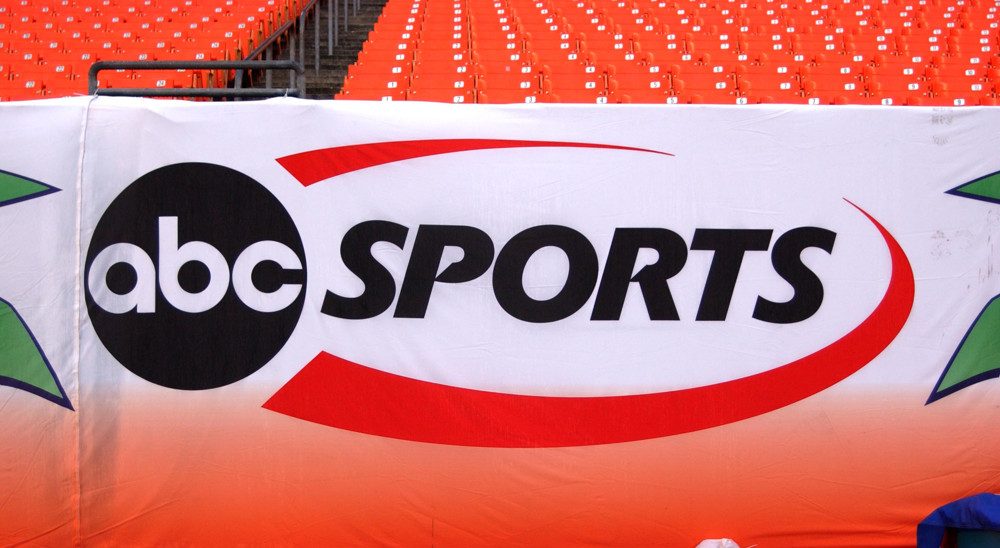
You would be forgiven for not noticing, but this past weekend marked an anniversary of consequence in sports media. It was the final Sunday of August 20 years ago when one of the great legacies in broadcasting drew to a close, as the U.S. Championship of the Little League World Series marked the final broadcast in the history of ABC Sports.
For more than 40 years, “ABC Sports” was as meaningful a name as there was in the industry. It featured some of the biggest names in the history of sports television, chronicling some of the greatest athletes who ever played, stewarded by an executive who is credited for shaping sports television into the form it holds to this day.
ABC Sports was the bombast of Howard Cosell and the eloquence of Jim McKay, the transcendence of Muhammad Ali and the showmanship of Evel Knievel, it was the “thrill of victory” and the “agony of defeat.”
It beamed into viewers homes live coverage of the horrors in Munich, the shock of the Bay Area earthquake, the news of John Lennon’s murder. Through sheer repetition, it cemented iconic shots into memory — the look of determination on Olga Korbut’s face on the balance beam, the disastrous tumble of skier Vinko Bogataj, who would come to represent the ‘agony of defeat.’ (If you are a certain age, or just a sports media aficionado, you know these shots by heart.)
And then, it was over. In mere days, viewers tuning in for the season premiere of ABC’s college football coverage would be greeted by the ESPN logo — specifically “ESPN on ABC.”
It was a perhaps appropriate ending, for by the end ABC Sports had become just a skin for ESPN — a different logo, a different set of graphics and some different music, but ultimately just ESPN. It had really been that way for a few years, save for “Monday Night Football,” and by 2006, creating two sets of graphics packages and two sets of logos for the same product no longer made sense. ESPN, synonymous with sports, was the dominant brand. So much so that people were naming their children after the network (watch a Colorado football game this season and you might see one of them). ABC Sports, on the other hand, was years — even decades — removed from its heyday.
Few can question whether the move made sense. In its prime, ABC was, in the words of its then-president Roone Arledge in his posthumous 2003 autobiography, “the 800-pound gorilla, the outfit that paid the most, moved the quickest, performed the best.” By 2006, that description belonged to ESPN.
But the question of whether it made sense to rebrand “ABC Sports” is entirely different from the question of whether the division’s four decades of indelible moments should have been so thoroughly forgotten.
“[Y]ou certainly must know what a sorry outfit ABC is.” Those words came from Ed Scherick, whose company “Sports Programs, Inc.” had been packaging and producing sports content for the networks and was working primarily with ABC, an also-ran in the early days of television. He was speaking to a young Arledge, then of NBC, about an opportunity to work for him as he prepared for his newest acquisition, NCAA college football.
“I know all about ABC,” Arledge responded, as recounted in his autobiography. ABC, as historian Travis Vogan wrote in his book chronicling the history of the network’s sports division, was “television’s least-distinguished network” and “defined by its comparative misfortune” relative to the dominant CBS and NBC.
Sports provided an opportunity for ABC to differentiate itself, leading to its partnership with Scherick’s SPI. Thanks to an infusion of funds from Gillette, the long-time “Cavalcade of Sports” sponsor who had left NBC, the outfit had enough resources to acquire the necessary rights. And in Arledge, it had unwittingly found someone with the vision to set the venture apart.
Anyone who has ever watched a university-run stream of a non-revenue sport understands the frustration of viewing a sporting event that is recorded with stationary cameras, seemingly placed hundreds of miles away, depicting athletes who are at most mere pixels on the screen. Arledge did not live to see those broadcasts, but if he had, he might have found them familiar. In the earliest days of sports TV, as he described in his autobiography, “we just opened our cameras and waited for something to occur in front of them, ignoring everything else that was going on. It was, I said, like looking out on the Grand Canyon through a peephole in a door.”
“Television treated sports as sacrosanct,” Arledge wrote. “But where was it written that God created a football field 100 yards long and that television cameras had to be riveted around it in fixed locations?”
The Arledge vision was different. It would take viewers inside the game, but more importantly inside the venue — bringing “the color and pageantry” of the event into full view. In a memo entering ABC’s first college football season, he was tasked with putting his philosophy into a memo. As reprinted in his autobiography:
Heretofore, television has done a remarkable job of bringing the game to the viewer — now we are going to take the viewer to the game! We will utilize every production technique that has been learned in producing variety shows, in covering political conventions, in shooting travel and adventure series to heighten the viewer’s feeling of actually sitting in the stands and participating personally in the excitement and color of walking through a college campus to the stadium to watch the big game. All these delightful adornments to the actual contest have been missing from previously televised sports events. … [W]e will have cameras mounted in Jeeps, on mike booms, in risers or helicopters, or anything necessary to get the complete story of the game … all the excitement, wonder, jubilation and despair that make this America’s number one sports spectacle, and a human drama to match bullfights and heavyweight championships in intensity. In short — WE ARE GOING TO ADD SHOW BUSINESS TO SPORTS!
In addition to the natural suspense and excitement of the actual game, we have a supply of human drama that would make the producer of a dramatic show drool. All we have to do its find and insert it in our game coverage at the proper moment. … [The viewer] must know he is in Columbus, Ohio, where the town is football mad; or that he is part of a small but wildly enthusiastic crowd in Corvallis, Oregon. He must know where in the country he is, what town, what the surrounding country and campus look like, how many other people are watching this game with him, how the people dress at football games in a particular part of the country, and what the game means to the two schools involved. … The personal satisfaction in such an undertaking will be great. We will be setting the standards that everyone will be talking about and that others in the industry will spend years trying to equal.
He was undoubtedly proven correct. The Arledge vision revolutionized sports television, and lives on in every crowd shot, every close-up, every beauty shot of a downtown area — in the basic building blocks of sports TV.
But what would eventually become ABC Sports was more than just the basic building blocks. Adding show business to sports meant not just capturing the color, but finding the compelling angles to give the games meaning beyond wins and losses. “We’d started with less than nothing,” Arledge wrote. “In a decade, we’d become the kings of sports programming, numero uno, and we’d done it my way, producing events not by plunking cameras on the fifty-yard lines and droning out the facts that were right before the viewers’ eyes, but the way reporters write stories — good guys and bad guys, drama, color, background, beginning, middle and end.”
It was ABC Sports’ storytelling, as much as anything, that set it apart — from the most famous athletes in the world like Muhammad Ali to the ones it made famous via “Wide World of Sports,” a show Arledge came up with to fill time after football season. “Wide World” would come to define the division, introducing the “thrill of victory … and the agony of defeat” in its second season in 1962. (Today, “Wide World of Sports” means little to entire generations, save perhaps for being the namesake of ESPN’s branded complex at Disney, home of the 2020 NBA bubble and any number of youth and collegiate sporting events.)
It might go without saying that bringing ‘showbiz’ to sports was not solely about high-minded storytelling. ABC’s “Monday Night Football,” the primetime NFL showcase that debuted in 1970, regularly featured celebrity guests in the booth — most famously John Lennon — in a bid to attract crossover viewers, primarily the women execs assumed to be uninterested in the game itself. Long before “MNF” added comedian Dennis Miller in 2000, Arledge wrote that he had contemplated Burt Reynolds and Bill Cosby as potential replacements for analyst Don Meredith (also Joe Namath and O.J. Simpson, both of whom eventually joined “MNF” with subpar results).
The “stylistic excess” and self-promotion of “MNF” — which featured on-air credits for the producers and Arledge (who was regularly credited on ABC Sports productions) — was “unprecedented in sports television,” Vogan observed. “These practices … announced Monday Night as a singularly lavish program driven by the meticulously coordinated vision of its many creators.” Chief among them was Arledge, whose star rose to the point where he was running ABC Sports and ABC News simultaneously.
That excess did not go unnoticed. The competition was keenly aware, and envious, of what was going on at ABC. All CBS Sports’ Neil Pilson had heard during his tenure with the network, Rich Podolsky wrote in his book “Madden and Summerall,” was “how wise, wonderful, and dominant ABC Sports had been. To the news media, Roone Arledge was a god.”
“[T]he larger ABC Sports loomed,” Arledge wrote, “the more determined was the effort to cut it down to size.” Ultimately, it was not the competition, but Capital Cities, who accomplished that goal. Cap Cities was just one fourth the size of ABC when it acquired ownership of the network in 1985, leading to the quip — attributed to Arledge — that “[t]he canary has just eaten the cat.”
Indeed it had. The “lavish” spectacle of ABC Sports made it a target for Cap Cities’ penny-pinching. “Cap Cities management viewed ABC as wasteful, complacent, and undisciplined,” and its sports division as “the principal contributor to the network’s extravagant culture,” Vogan wrote. Arledge was soon out (though he would remain at ABC News), and by the time Disney acquired ABC and ESPN, ABC Sports had fallen back into the pack among sports networks.
When the Disney deal went down in 1996, Michael Eisner was effusive about his acquisition of what “he called a ‘magic name’ comparable as a brand to Coca-Cola and Kodak,” according to Bill Carter and Richard Sandomir of The New York Times. Not ABC, the Times noted, but the 17-year-old ESPN. As Vogan wrote, “Disney gradually shed ABC Sports relics,” including Wide World of Sports, “that did not complement the ESPN-driven image it was building for its sports programming.”
ESPN was known primarily for “SportsCenter,” which in its prime years produced several of the biggest names in and beyond sports broadcasting, but it lacked that extra touch that ABC brought to games. Play-by-play voice Mark Jones, who worked for ESPN and ABC Sports when they were still distinct entities, described the difference in an upcoming edition of the “Sports Media Watch Podcast.”
“There was a different feel at both places,” said Jones. “At ESPN, there was more of a ‘get on the air, get off the air, let’s get on to the next’ for games. At ABC back then, it was ‘hey, let’s go out before the game and get these shots of this player who likes to play chess, and let’s get him playing chess in the park and dress the game up a little bit.’ We would go out before a Saturday afternoon game and shoot some ENG footage of different elements that put bells and whistles on our broadcasts.”
“I felt that ABC was a little bit more customized, we put an extra coat of paint on things,” Jones continued. “We took time to do editorials and humanize, and ESPN had a more statistically, numerically-driven feel to it.”
Ultimately, all stories have to come to an end, and there is no great injustice in the era of ABC Sports having run its course. ABC Sports, after all, was borne out of a desire for new blood, change, a revitalization of a staid form. It is hard to see how “Wide World of Sports” branding would mean much in 2026, much less 2006. But ABC Sports was also, above all, about storytelling, and storytelling is timeless. An understanding of history, of context, and of meaning that gives definition to that which comes after.
The fact that ABC Sports is essentially lost to history is hard to justify. ESPN may trot out the mustard-colored jackets every now and again, almost as a gag, but ABC Sports had a cultural relevance that is as responsible for the creation of sports TV as any other outlet, including ESPN. To be frank, there may not have been an ESPN without ABC Sports. For all of that history to be locked away in some Disney vault — or perhaps somewhere in the abandoned “Baseball Tonight” studio that now doubles as a storage space in ESPN’s Bristol headquarters — leaves a conspicuous hole in the story of sports television.
“Disney, of course, owns and controls ABC Sports’ colossal archive,” Vogan wrote, “But this material seldom surfaces apart from infrequent specials on ESPN Classic” — which in the years since Vogan’s book was published no longer appears to exist — “and scattered documentaries that use it to reflect on sports history.” Vogan described ESPN as “the official keeper of the history” that ABC Sports documented, but ESPN infrequently chronicles its own history, much less that of ABC. “The vast majority of ABC Sports’ material is sequestered within the vaults of a company that insists upon its historical importance while demonstrating little use for this footage, and even less interest in sharing it.”
Indeed, ESPN has not shown much interest in being the keeper of ABC Sports’ legacy. When ABC Sports carried its final broadcast — the aforementioned 2006 Little League World Series — game producer Dick Buffinton “initially wanted [it] to serve as a tribute to the history and tradition of ABC Sports,” longtime ABC Sports producer and director Doug Wilson wrote in a 2013 book. After all, as Wilson noted, the event felt funereal for veteran ABC Sports employees. “ESPN squelched that idea,” and play-by-play voice Brent Musburger was even “told not to talk about Wide World during the telecast,” Wilson wrote. (Though as he noted, Musburger did shout out Wide World at the end of the event.)

The importance of storytelling in sports is as significant in 2026 as it was in 1960, and just as hard won. Particularly in the contemporary social media age, storytelling is slower than a 240-character tweet, less evocative than a thumbnail showing a bug-eyed, slack-jawed facial expression, and less emotionally compelling than a debate. Perhaps a 29-year-old Roone Arledge in 2026 would be producing “First Take.”
But the story of ABC Sports is ultimately what has allowed sports media, including ESPN, to reach the heights it now occupies. And even the contemporary ABC, deemphasized in sports coverage in a way that no other broadcast network even begins to approach, plays a crucial role in ESPN’s success.
ESPN owes a great debt to its broadcast network. What kind of games does ESPN get every NFL season without the ability to simulcast them on ABC? Certainly not the Super Bowl. Does ESPN get the “SEC on CBS” package without a broadcast network? Does it keep the NBA Finals? ESPN gets to put its logo on a great many marquee events, and nearly all of them are airing on ABC.
Realistically, nobody is tuning into a live sporting event to see the network self-indulgently celebrate its past. But there is such thing as continuity, a body of work on which to build. Perhaps that means an unbroken string of broadcasts over the course of decades, like CBS at The Masters. Perhaps it means leaning into the echoes of the past, as with the new NBA on NBC.
When it comes to ABC Sports, there is no one to pass down the history. Even if ESPN was so-inclined, ABC Sports’ history is not ESPN’s story to tell. ESPN’s history begins with Bill Rasmussen, who passed away this month, not Roone Arledge.
There may be no division with a prouder, more complete history than ABC Sports, even in what was a relatively short 45-year lifespan, and that history is appreciated outside of sports. How often is a sports division chronicled in a feature film, as ABC Sports was in the 2024 film about its coverage of the Munich massacre, “September 5″? It is an awfully rich legacy to have no place, no real home.
“I wish that they would, on one of those ESPN channels, throw reruns of ABC’s ‘Wide World of Sports’ on,” Jones said on the upcoming SMW podcast episode, reciting the famous “Wide World” open from memory: The thrill of victory and the agony of defeat, the human drama of athletic competition. “That kind of prose and eloquence, it’s lost. I think today’s generation of broadcasters could learn from the way that they did sports back then. It was a unique brand of storytelling that could still be extremely impactive today. It would still work today. That would be great if they could bring that back.”
As it is, “ESPN on ABC” is branding at the bare minimum. Even something as simple as the opens welcoming viewers to games on ABC are starkly lacking — a plain graphic on a black background, accompanied by a short voiceover and stinger music, that might take about 15 minutes for an enterprising editor to recreate. All other competing sports divisions have more elaborate opens showcasing their various properties. In its final years, ABC Sports still managed to set a decent stage with its “Championship Television” voiceover, ornate theme, and footage of iconic moments of years gone by.
It would suffice to create something as simple as a voiceover combining “The Power of ESPN” (an actual phrase used in an on-air Super Bowl promo in January) with “The Tradition of ABC Sports,” accompanied by glimpses of iconic moments from ESPN’s present (say the O.G. Anunoby tip) and ABC’s past (Ali, or even a broadcaster like McKay).
As of now, ABC Sports lives on in fragments. It was somewhat fortuitous that, following Novak Djokovic’s first round loss at the U.S. Open on Sunday, ESPN host Malika Andrews referenced “the agony of defeat.” Andrews is surely seasoned enough to know exactly what she was referencing, but it is also possible that those distinct elements of ABC Sports are now just part of the lexicon, with no real origins. The legacy of ABC Sports and Roone Arledge may live on, but with no connective tissue, no link to the past or to any tradition.
Arledge did not live long enough to see the transition from “ABC Sports” to “ESPN on ABC,” passing away in late 2002 at 71. But he had lived long enough to discern which way the winds were blowing. Toward the end of his autobiography, which as previously noted was published posthumously in 2003, he struck an accepting tone: “For the devout sports fan, even if the integrity, the dignity — I’m tempted to say the grandeur — that used to characterize the televising of great sporting events has worn thin, there is simply more to watch today than ever.” What he did not say, but is nonetheless often true, is that more is less when it comes to quality.
“The fundamentals haven’t changed and never will,” Wilson wrote toward the end of his 2013 book chronicling his experiences with ABC Sports and “Wide World” in particular. “A good story with conflict and drama and intriguing characters, and told well, will lock in a viewer. That is precisely why Wide World of Sports was able to pull in so many people who weren’t even sports fans. Have today’s producers lost faith in this principle?”
Observing the “undercurrent of frenzy” in sports television, Wilson made an observation that reads truer now than when it was written more than a decade ago. “The priority isn’t storytelling anymore, it’s attention holding. Style overrides content.”
ABC Sports, in its prime, blended style and content in a fashion replicated by Arledge’s protégés, most notably Dick Ebersol at NBC. It was not above hype and glitz, but there was substance beneath it all. As sports television has shifted, even that legacy has eroded as storytelling has fallen by the wayside.
“In the entire history of television,” Arledge wrote in the conclusion of his autobiography, essentially marking his last public statement, “there’d never been a division, not even CBS News at its zenith, that had so dominated its field as ABC Sports. We’d had the best events, the best announcers, the best producers and directors, the best programming by a light year or ten. We’d pioneered all the techniques that were now commonplace throughout our industry.”
Yet for all of those victories, ABC Sports ended not in the agony of defeat, but something arguably worse — quiet erasure.
Plus: Ravech’s exit
20 years after the ABC Sports era ended at the Little League World Series, another broadcasting era came to an end at Williamsport, Pa., this past weekend — that of Karl Ravech at ESPN. The respected broadcaster was laid off earlier this summer, but continued to work on ESPN MLB and Little League games. As a result, he was treated to the kind of tributes and appreciation denied other ESPN employees summarily laid off, from Suzy Kolber to Ron Jaworski.
Those tributes understandably made little mention of why Ravech needed a send-off in the first place. He was not retiring, he had not fallen ill, his network had not lost rights (though its new MLB package is notably slimmed down); he was the victim of cost-cutting. It is unusual for an employee to receive such appreciation from a company after being unceremoniously fired.
Give ESPN credit for allowing Ravech the opportunity to go out on some semblance of his own terms, and for his part, Ravech has been nothing but publicly appreciative. Even so, the entire exercise has been interesting to watch play out. Ravech did not choose to leave, and his departure is not something that just ‘happened’ to him — ESPN chose this outcome, as much as everyone necessarily had to dance around that reality.