Led by some of the biggest names in baseball — such as Shohei Ohtani, Freddie Freeman and now Tarik Skubal — the Los Angeles Dodgers are widely viewed as favorites to win a third consecutive World Series next month. Already a dynasty with three titles this decade, the Dodgers’ success has been fueled, in part, by a reported 25-year, $8.35 billion rights deal with Charter Communications, the owner of Spectrum SportsNet LA.
At a time when the RSN business is collapsing, with all that implies for team payrolls, the Dodgers have the most lucrative deal in all of sports. It has been a boon for the team, particularly as part of the rights fee is said to be exempt from MLB revenue sharing calculations, a holdover from a bankruptcy settlement under previous team ownership. Kurt Badenhausen of Sportico estimated that the savings equate to between $50 million and $55 million this season.
There has been some turbulence. Team owner Mark Walter has reportedly sought to exit the deal amidst his legal issues, and RSN owner Charter Communications “would love to find solutions” to make the relationship more acceptable. Nonetheless, no team may have a better local television situation. That, combined with the on-field success, has caused some to accuse the Dodgers of having an unfair advantage compared to the rest of baseball, and perhaps even being the catalyst for what is expected to be a damaging lockout.
It should be no surprise that the Dodgers have thus become the villains of the sport, less than a decade after being the sympathetic victim of the Houston Astros’ cheating scandal. Rather than shying away from that perception, the Dodgers are leaning into it, opening their games from Uniqlo Field at Dodger Stadium with a hype video set to “Bad Guy” by Billie Eilish.
But once the game starts, all of that background noise takes a backseat. For all the acrimony, controversy and triumphs, the games still need to be played — and broadcast. For the Spectrum SportsNet LA crew, that means figuring out what to give the fanbase that has everything.
Preparing for #ITFDB
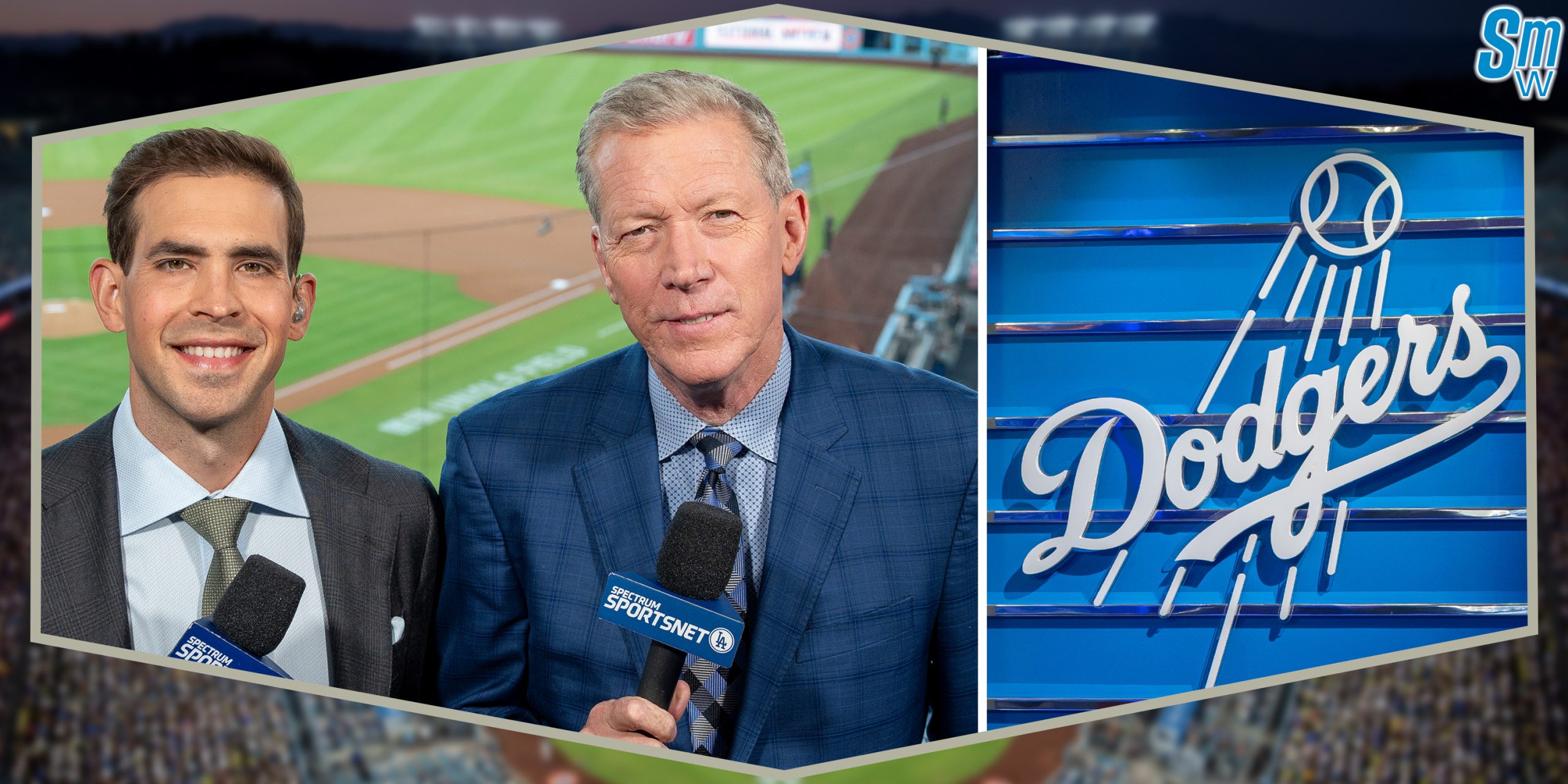
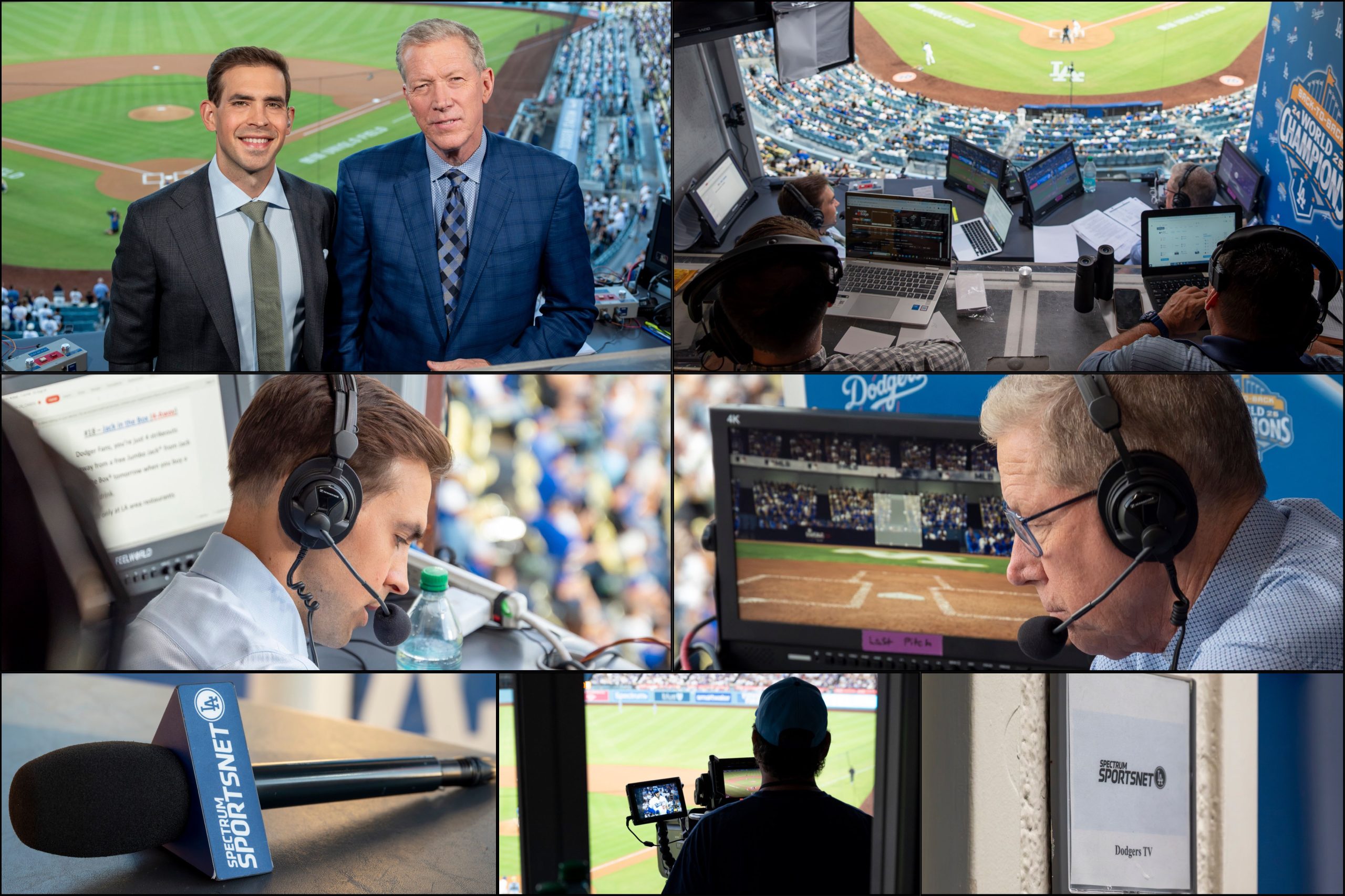
Appropriately, if coincidentally, the national voice of the World Series is also the voice of the Dodgers. Joe Davis, who has called the team’s last two championships on FOX, has been broadcasting for Spectrum SportsNet LA since the 2016 season. On a picturesque August afternoon, in which the Dodgers are set to face the Milwaukee Brewers, he is on the field in his capacity as the Dodgers television play-by-play broadcaster hours before the game, asking questions and watching batting practice.
“If there’s a story, chances are, it’s out there, and I can tell those stories that the writers write and that the people read,” Davis explained. “But the really best stuff is the individual conversations that I have that nobody else has had, and those can keep giving, right? I can go to the field tomorrow with a whole new set of questions and ideas and turn those into threads.”
Davis begins his preparation during the offseason and arrives with detailed notes on individual players from teams across the league. Mike Levy, the executive producer for Dodgers television broadcasts on Spectrum SportsNet LA, said that he has never seen anyone as prepared for the games as Davis, crediting him for taking the production to another level. The challenge for Davis early on was learning the history of the team and being able to apply that in the broadcasts.
“He was learning from the books, from media guides, from the internet,” said Dodgers television analyst Orel Hershiser. “So the warmth of our broadcast has definitely increased through the years because when he talks about a [Max] Muncy home run, he was actually there. When he talks about Justin Turner, he was actually there, and that comes from Mike.”
Looming over all is Vin Scully, whose 67-season tenure as the voice of the Dodgers stands as the pinnacle of the relationship between a team and an announcer. Credentialed media at Dodger Stadium work from the Vin Scully Press Box, and outside of the entrance to the closed area in the mezzanine of the ballpark, there is an exhibit containing artifacts from his career with the team.
“Vin was the most unique person I could ever imagine working with, and the things that were sparked from him were unbelievable,” Levy said. “I think the first main thing was Vin called the game by himself, so that was a very unique way of doing it — no sideline reporter, no color analyst. I used to sort of laugh when there was a close play at second base, and I’d show a replay and Vin would say things like, ‘Man, these umpires have the hardest job in the world.'”
Hershiser, a three-time All-Star pitcher and World Series champion with the Dodgers, can speak to firsthand experiences as a player. Hershiser was part of the launch of Spectrum SportsNet LA, initially beginning in the role for select games that Scully was not working before taking on the role full time starting in 2016.
“With the team, it was great to always be in the playoffs, always be in the World Series, but there was a lot of disappointment at the end of the year,” Hershiser noted, referring to the pre-dynasty years when the Dodgers seemed to come up short every October. “There’s always a chance in broadcasting when the fans are disappointed in the team or the finish, they start to take it out in other places. But we were fortunate that the level of the broadcast and what we were doing was holding its own.”

Blue skies and walk-off drives
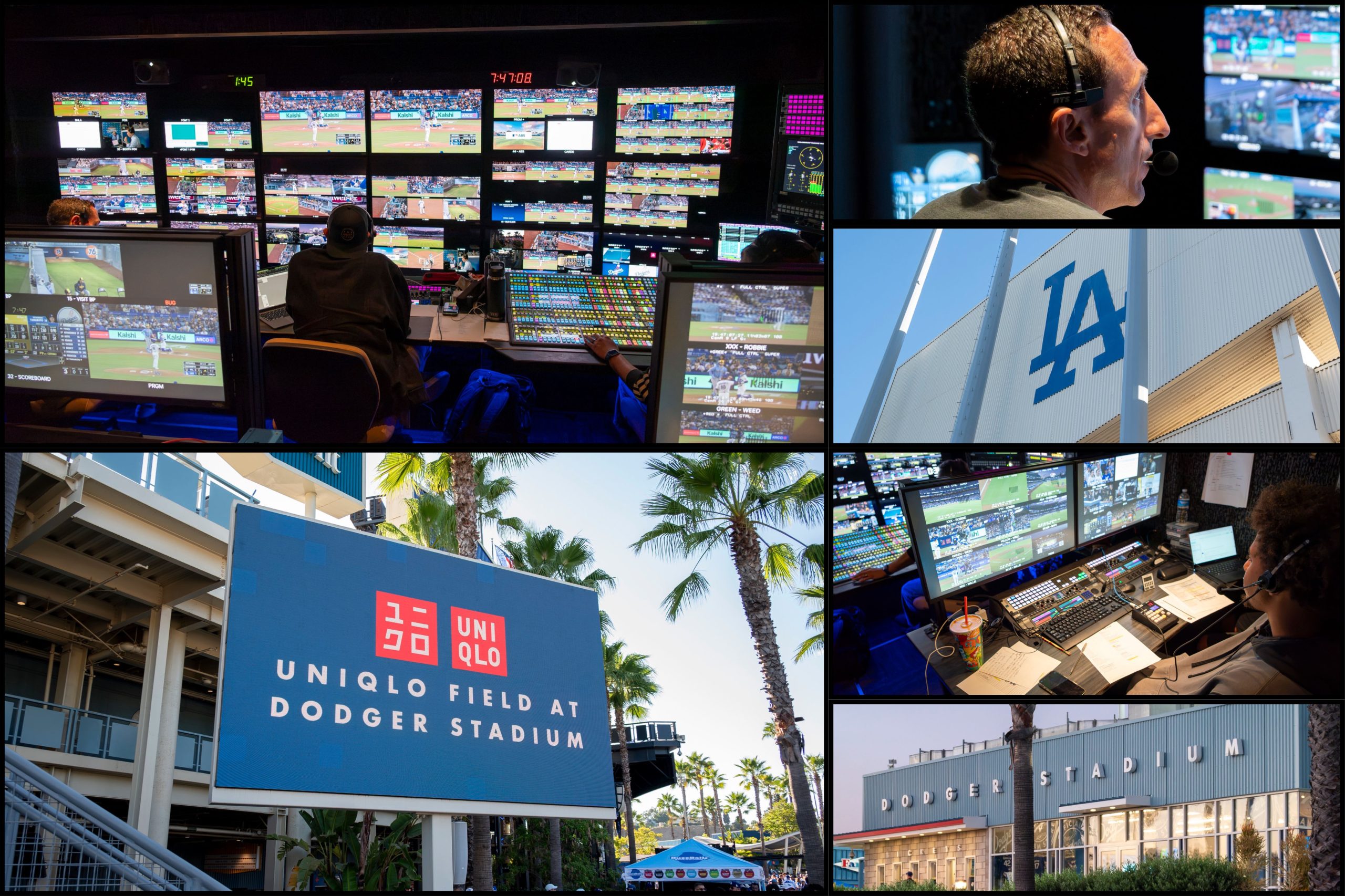
Whether the Dodgers hit a walk-off home run or complete a stellar defensive play, there is no shortage of resources to accurately and rapidly convey the sequences to viewers. Dodgers broadcasts, akin to some other teams, are equipped with slow-motion cameras, a cable cam and drone technology, along with a scorebug that displays ABS challenges remaining and the pitch clock timer in addition to other essential information.
“We tell our camera operators, our replay people, our audio technicians, everybody — the game has to be the thing that drives everything,” Levy explained. “So if we don’t see if he’s safe or out, or if we don’t see if that ball is fair or foul, then the rest of it is not really worth it.”
During the game itself, Levy is situated in the broadcast truck alongside production personnel and shaping what is ultimately shown on the screen. The advanced technology and production capabilities are all used in moderation under the discretion of their operators aligned with the common goal of creating the best broadcast possible.
“There’s times where it’s like, ‘Man, we have a thousand unbelievably great replay angles, and we’re not going to show any of them right now,’ because nothing’s better than the guys high-fiving in the dugout or Joe laying out and letting the crowd cheer or Orel letting Joe make the call,” Levy said. “I think things like that have taken the broadcast to the next level.”
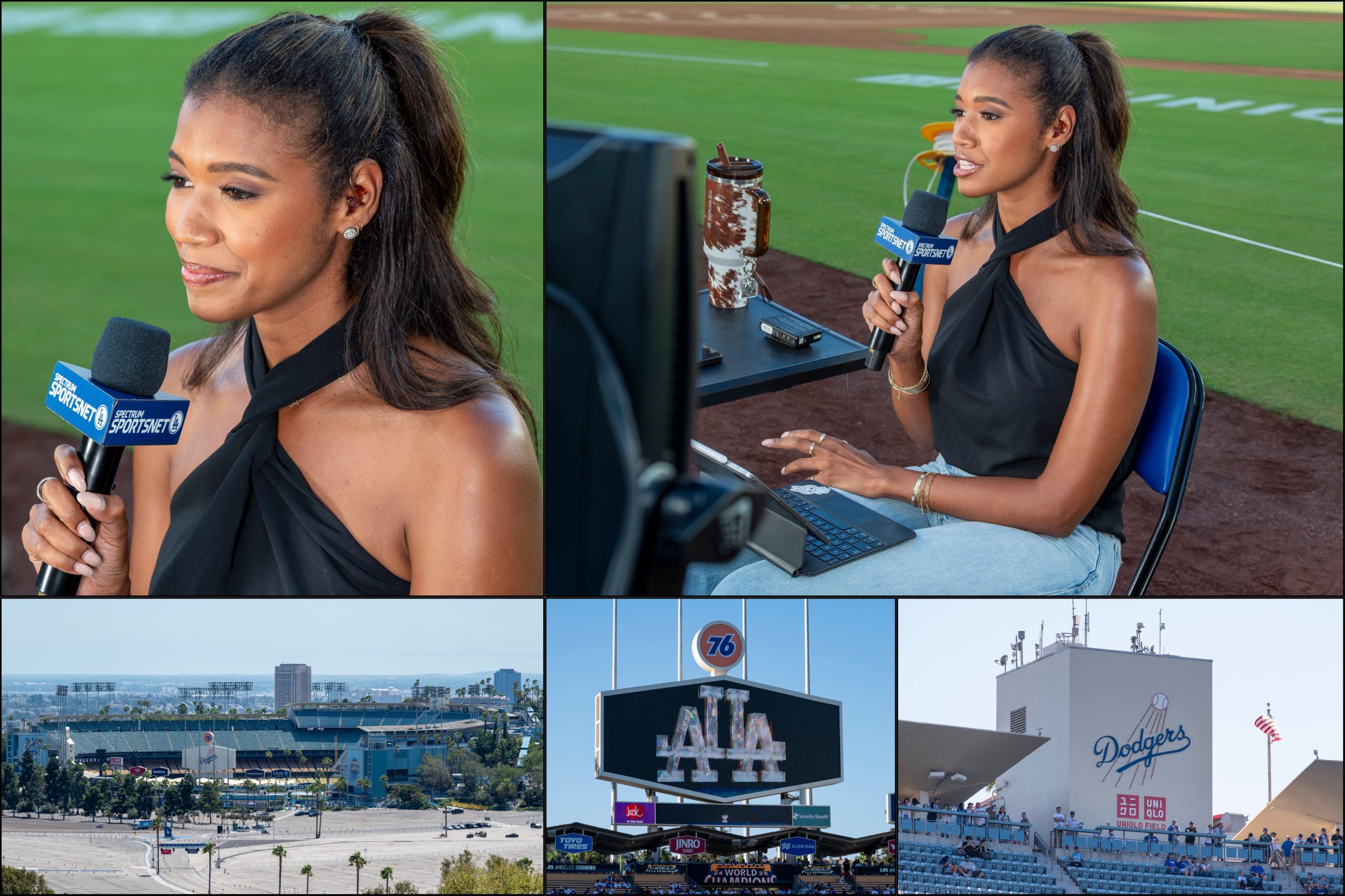
In an era where some MLB broadcasts have moved away sideline reporting, Spectrum SportsNet LA has leaned into the position. Kirsten Watson, who has been in the role since the 2021 season, is situated along the field throughout the game and provides insights and perspectives not as easily discernible from the confines of the broadcast booth. During a recent contest, for example, Watson noticed that Dodgers manager Dave Roberts signaled that Mookie Betts was going to be entering the game on defense despite having a scheduled night off.
“I’m literally right there, so I can see all this information, and that’s not giving anything away,” Watson said. “It’s just preparing us for what’s to come. So then, when Joe brought up, ‘Tommy Edman’s playing at short for the first time in two years,’ I can be like, ‘He is; however, this is going to be happening soon, so keep an eye out for this.'”
Aside from her in-game responsibilities, Watson contributes to the pregame show whether through one-on-one interviews with Dodgers players or live hits from the field. The broadcast also welcomes a guest via headset 20 minutes before every home game, a level of access Spectrum SportsNet LA coordinating producer Stuart Mitchell says is unmatched.
“I think the access that we have is as good as any team in baseball,” Mitchell said. “I don’t watch a lot of other networks, but I know people that work at a lot of them, and they’re like, ‘Boy, we get a player once a week,’ or whatever. We get two players for every single home game. That’s pretty incredible.”
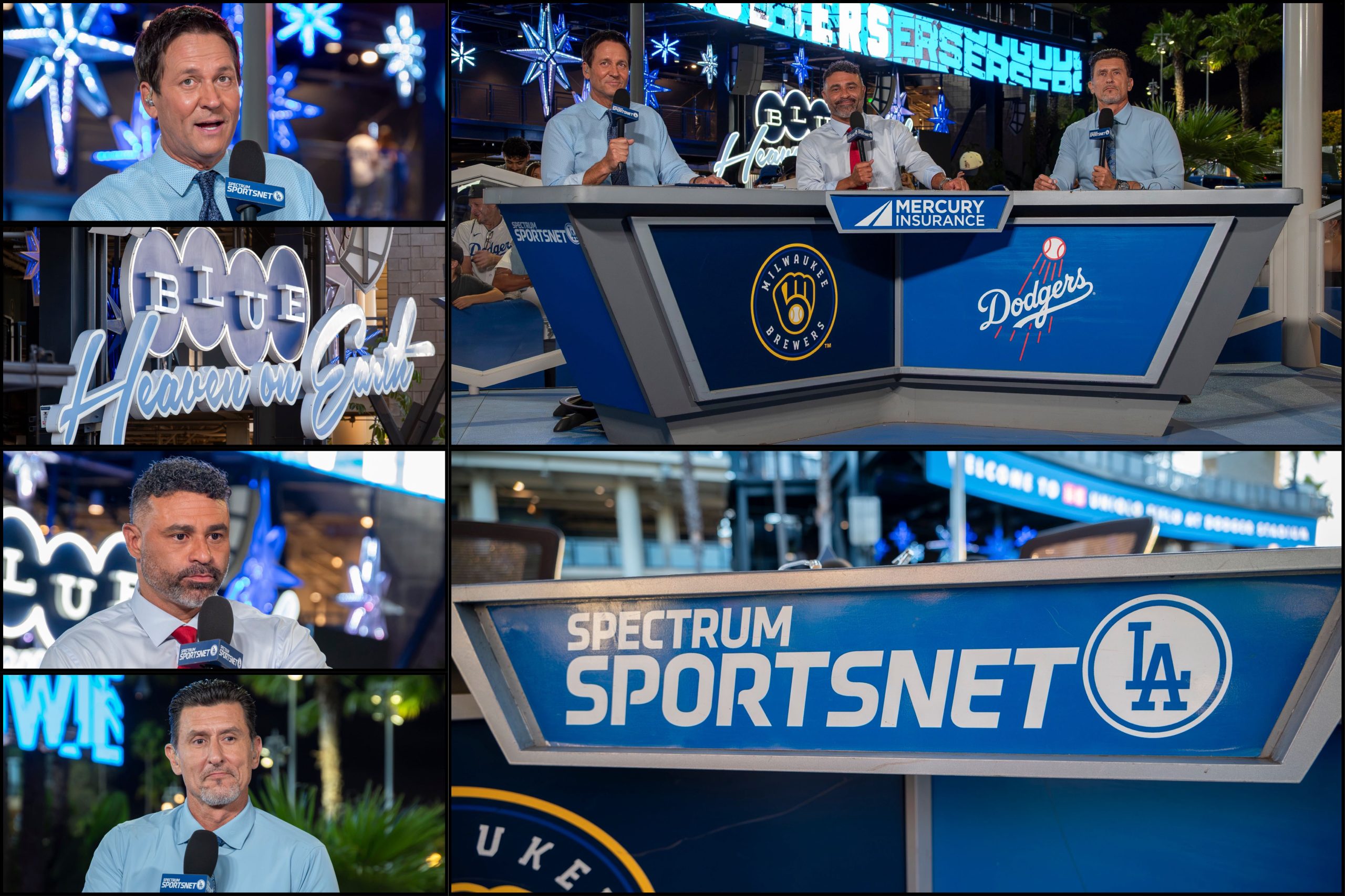
The pregame and postgame show for Dodgers home games, with the exception of early afternoon contests, takes place on site from the ballpark rather than the network’s El Segundo studios.
John Hartung, who also hosts Lakers coverage on sister network Spectrum SportsNet, primarily anchors the program alongside analysts Jerry Hairston Jr. and Nomar Garciaparra. The difference between broadcasting from El Segundo as opposed to Dodger Stadium is the presence of fans, and they frequently flood the dedicated ballpark set before and after games. Hairston has dubbed the space “Club Ravine,” referring to the lively setting around the center field plaza.
“Being here on site at a historic venue like Dodger Stadium, you get a chance to feel the culture, the vibe, especially in the postgame when you have Club Ravine rocking after a win, and in the postseason, there’s nothing really like it,” Hairston said. “It’s truly something special.”
“It was incredible when they first built this, and we started doing shows out here in 2021,” Hartung said. “For me, it changed everything because it allowed us to have more of a connection with the fans [and] also have more of a connection with the team.”
Despite the El Segundo set implementing elements of Dodger Stadium, it does not provide the same feeling as being present at the ballpark. Garciaparra, who grew up in the Los Angeles area and played three seasons with the Dodgers towards the end of his career, likens it to ESPN’s “College GameDay” atmosphere.
“Anytime you can come to the stadium and be a part of it and feel the energy, it is special,” Garciaparra said. “When you actually have the fans around you, this set that they built for us to have this show, it is pretty special, and we’re pretty lucky to be able to do this.”
Spectrum SportsNet LA, much like the Dodgers, have built a deep bench containing quality talent to fill in when necessary. Stephen Nelson or Tim Neverett will usually call select weekend games when Davis is on assignment for Fox Sports, and Eric Karros, Jessica Mendoza and Dontrelle Willis work as analysts when Hershiser is not behind the microphone. While Garciaparra and Hairston are most often the studio analysts, other voices such as Adrian González and James Loney are part of the rotation as well.
“Just the people that we’ve added over the years have all just done a lot to make us a more diverse, broader, a different set of voices,” Mitchell said. “We use Nomar and Jerry a lot, and they’re great [with] their expertise and on-TV presentation, but just the other voices are also a chance to do something different.”

Staying focused on the present with an uncertain future ahead
While various MLB teams have decided to forgo their traditional regional models and work with the league on production and distribution, the Dodgers are among a shrinking list of franchises continuing to broadcast on independent and/or team-owned RSNs that are susceptible to industry headwinds.
“I think from our standpoint, it’s always going to be, ‘Let’s focus on what we are and what we can do,’ and that’s present the best team in baseball to the best fans in baseball, and from our point, we always say, ‘Let’s be the best network in baseball,'” Mitchell outlined. “YES, SNY and Marquee are both in the same situation of [being] in huge cities and marquee teams, and we’re going to do what we can to be a great part of a great organization.”
No matter if the Dodgers make a run to the World Series or are eliminated early in the playoffs, live game broadcasts of Spectrum SportsNet LA conclude for this season on Sunday. While the network continues to cover the team throughout its postseason quest through studio programming and on-site reporting, the end of its 13th season with the Dodgers offers a moment for reflection.
“I think to do you part on the team is all you really can control, and so for me, it’s, ‘Did I get a little bit better each game? Did I have a feeling of freedom to be myself?,’ and, ‘Did I let that come out at the appropriate times?,'” Davis said. “If I’ve done that — not that it’s going to be a perfect climb — but if I’m better than I was at the end of the year than I was at the start, I think that’s a pretty good direction.”