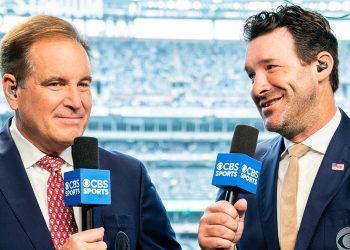
The Tony Romo-CBS divorce has been finalized. CBS announced Friday an agreement to “mutually part ways” with its lead NFL analyst, ending a nine-year tenure.
Looking back, there were obvious signs that a breakup was imminent. The first was the promotion last season of JJ Watt to the network’s secondary NFL broadcast team. After Romo went on leave following his OWI arrest in July, CBS quickly named Watt as his temporary replacement on the lead crew.
For years, Romo had drawn fire for a perceived regression, and it seemed CBS was eagerly looking to turn the page. His arrest provided the escape route the network had been seeking. The question now is if Watt is merely keeping the seat warm or making it his own.
One could make the argument that naming Watt the full-time analyst makes sense for CBS. He possesses many of the traits network executives look for in a football commentator. He’s young, telegenic, easygoing, and sure to be a first-ballot Hall of Famer. Unlike Romo, whose devil-may-care approach eventually wore thin, Watt appears to relish the preparation that goes into a broadcast.
He is also quick to offer an opinion or a criticism when the situation calls for it. Late in the fourth quarter of last week’s Ravens-Cowboys game, Watt immediately pointed out Cowboys WR CeeDee Lamb had hooked the arm of Ravens CB Nate Wiggins after Wiggins was penalized for defensive pass interference.
Watt does many things well, but does he feel like a #1 analyst? There’s a sharp distinction between doing a serviceable job and elevating a broadcast. Last week’s Ravens-Cowboys telecast featured his strongest performance in the lead chair, but there were blemishes. With seven seconds left in a 31-31 game, Watt and play-by-play announcer Jim Nantz began an ill-timed conversation about soccer. This is not to suggest the connection shouldn’t have been made at all. Last week’s game was played in the same stadium that will host the Women’s World Cup Final next year. But a prolonged discussion about soccer should be had under different circumstances — certainly not with seven seconds left in a thrilling contest. The duo missed the opportunity to talk strategy, which would’ve given Watt a chance to bring needed analysis and illumination at a critical juncture.
There are other factors to consider. According to reports, Greg Olsen’s contract with Fox is up after this season. The status of ESPN NFL analyst Troy Aikman also appears to be up in the air. On a recent edition of the “Sports Media Podcast with Richard Deitsch,” Aikman, whose contract expires after the Super Bowl, stated he had expected to reach a new deal before the start of the NFL season and that he is unsure when the two sides might reach an agreement.
Watt is likable, steady, and clearly dedicated to the craft, but he lacks the cachet of Olsen and Aikman. He may be the future of NFL broadcasting, but Olsen and Aikman are at the top of the industry, now.
In February, Aikman will call his seventh Super Bowl with longtime broadcast partner Joe Buck. More than 25 years into his broadcasting career, Aikman still delivers sharp, cogent, candid analysis.
Olsen, meanwhile, has become the face of a sort of new generation of NFL analysts — the bookworms who eat, breathe, and sleep football. With an urgent and convincing delivery, Olsen commands the audience’s attention with every phrase he utters. No analyst communicates the intricate details of the game better.
Olsen and Aikman are proven analysts whom CBS would be wise to at least consider for the lead role. That position becomes more valuable as the network prepares for its Super Bowl broadcast at the end of next season.
But that’s next year. This year, Watt will have a full slate of games, including an AFC Championship Game, to prove he deserves the job. Each game presents an opportunity to improve his chemistry with Nantz, and to set himself apart from potential competitors. As the NFL season continues, viewers and critics will be able to track Watt’s growth and evolution. How crisp are his explanations? How authoritative is he during a game’s most consequential moments? Does he possess the unique ability to give a game a sense of occasion?
Fair or not, Watt has been and will be compared to Romo. It is important to remember Tony Romo’s tenure at CBS in full. At his worst, Romo was a liability — an unpredictable free spirit who relied too heavily on schtick and vibes to get through a broadcast. But at his peak, he was one of the most insightful and entertaining analysts of recent sports media history. The standard Romo set at his best still hovers, even as Watt surges ahead in the interim.
He has the inside track and months to make his case. By season’s end, Watt needs to give CBS more than a reason to keep evaluating him. He needs to give the network a reason to stop looking.
Plus: Eduardo Perez blasts Austin Wells’ base-running blunder
In the playoffs, decisions are scrutinized more intensely. When players make egregious errors in the sport’s biggest games, the best commentators respond accordingly. After Yankees catcher Austin Wells’ inexplicable base-running blunder in game 1 of the ALDS Saturday, ESPN Radio analyst Eduardo Perez offered an unvarnished rebuke.
The game was in the eighth inning. The Rays were leading the Yankees 1-0 and right-hander Drew Rasmussen had not allowed a hit. With two outs and on a 1-0 pitch, Wells drilled a line drive into the right field corner. Instead of stopping at second, Wells threw caution to the wind and trotted for third, where he was thrown out by a mile.
“That can’t happen,” Perez said emphatically. “This is the playoffs. That cannot happen. Thrown out by more than four steps before you even go headfirst into third base. I am sorry, but you do not make the first or third out at third base, especially when a pitcher like Drew Rasmussen is absolutely dealing.”
When a play of such consequence happens, announcers must be laser focused. And when such an obvious mistake is made, analysts must be fair yet firm. Perez gave the miscue the scrutiny it deserved, matching the urgency of the moment with the force of his criticism.