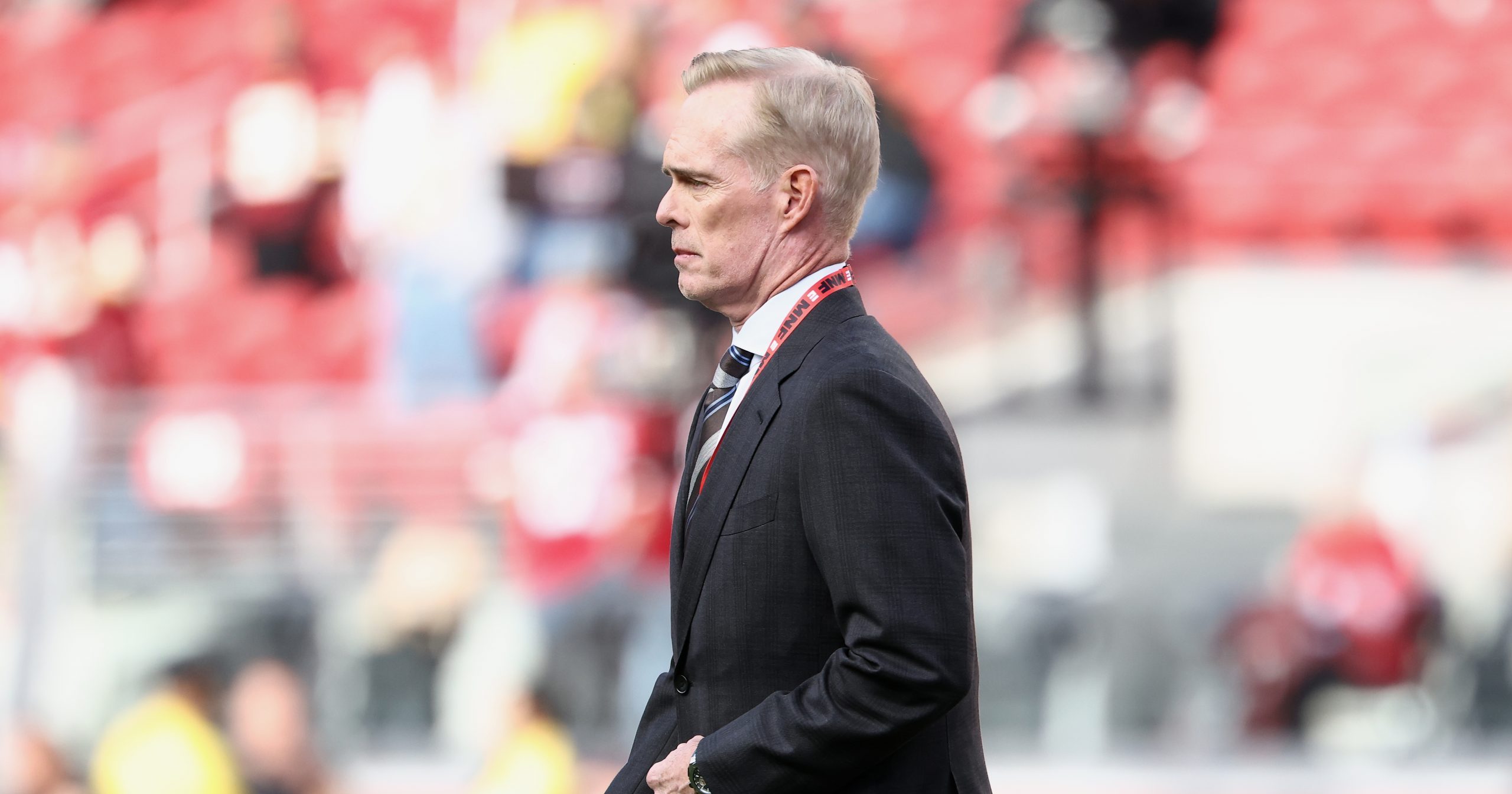
Joe Buck knows what it’s like to have a target on his back. For two decades, he served as lead voice of the NFL on Fox and the MLB on Fox, and for much of that time, he faced more scrutiny than any other network sports broadcaster. Critics claimed he favored opponents and that he announced games with a smug indifference that insinuated he was more important than the games he called.
Now, he faces a more personal accusation. After nearly 25 years together, Buck and longtime football boothmate Troy Aikman appear headed for a rancorous breakup, with recent reports suggesting Aikman feels betrayed by the man with whom he has shared the booth for a quarter-century.
Buck and Aikman signed five-year deals when they left Fox to join ESPN in 2022. While Aikman continues to work with new no deal in place, Andrew Marchand of The Athletic reported in September that Buck had agreed to a new six-year contract extension worth about $18 million annually. That underlying tension reportedly came to a head last month when, according to Ryan Glasspiegel of Front Office Sports, the two had an argument prior to ESPN’s broadcast of Bills-Rams. In a lengthy report published Friday, Marchand presented the position of both sides, citing sources aware of the pregame argument.
Buck to Aikman: “I’m not the reason you don’t have a contract.”
Aikman to Buck: “I just never thought you’d do it to me.”
Comments like these give the controversy its emotional weight. Marchand’s report frames Buck’s position as a sensible business move, while Aikman’s response conveys a sense of deep personal betrayal.
This apparent drawn-out divorce is playing out in public, with Marchand’s detailed account adding more context. Aikman is characterized by sources — seemingly in Buck’s corner — as a demanding bully who is more replaceable than Buck due to a perceived depth in the NFL game analyst market. To those familiar with Aikman’s perspective, Buck is a self-serving opportunist. That dubious distinction could inflame criticisms Buck has faced over his lengthy career.
From the beginning, Buck drew heat from those who believed that his being the son of a famous broadcaster, legendary play-by-play voice Jack Buck, had given him an unfair head start in the business. It’s a reputation Buck acknowledged in his 2016 memoir “Lucky Bastard: My Life, My Dad, and the Things I’m Not Allowed to Say on TV.” Recalling an early baseball broadcast in his book, Buck offered a candid assessment of his inexperience — and the advantage of his last name: “I was sweating so much that my earpiece fell out of my ear and fell onto the floor. I should’ve just said, ‘I don’t know what I’m doing. If you think I only got this job because my father’s a beloved broadcaster, you’re right.'”
As his career advanced, the vitriol intensified. Some was the usual accusation of bias that follows any national announcer; detractors felt he was a Yankees homer, others claimed he hated the team. After he condemned Randy Moss’ TD celebration in the 2004 NFC Wild Card game (“a disgusting act”), viewers blasted him for his sanctimony. For a different sect, he was too smooth, too polished, too perfect, too buttoned-up. Though he possessed obvious skill and consistently nailed the biggest moments of his career, Buck couldn’t shake the scorn. Sure, public perception began to turn around 2011 after his vocal cord scare, but to suggest Buck is a widely beloved figure would still be a stretch. Now, an audience already inclined to dislike Buck may readily accept an unfavorable interpretation of his conduct, especially if it means the dissolution of NFL TV’s longest-tenured broadcast team.
ESPN its undoubtedly at fault for its woeful mishandling of their most important property. Aikman’s decision to air his grievances publicly has done him no favors. But Buck also has much to lose, particularly if others agree with Aikman, who apparently views his colleague as a Benedict Arnold. One could argue that, given the length of their partnership and their longstanding friendship, Buck owed it to Aikman to inform him of his plans to re-sign with ESPN. Instead, according to Marchand’s reporting, ESPN and Buck “quietly and quickly reached an agreement” in the spring of this year and neither side informed Aikman. Even if your position is that Buck did not owe his partner anything beyond fulfilling his own contract, one could understand why Aikman would’ve expected more communication.
At the same time, signing an extension does not necessarily establish that Buck is responsible for Aikman’s predicament. According to Marchand’s report, the two had always negotiated their deals separately. If ESPN wanted to ensure Aikman had a new contract before this season began, it could’ve done more to re-sign its star analyst — or, at minimum, avoid the kind of circus this messy situation has created. It should be noted that Marchand’s column places considerable blame at the feet of Burke Magnus, ESPN’s president of content, who “failed to manage the contentious tandem and seemingly did not see that striking a deal with one and not the other could play out acrimoniously — and publicly.”
It is the public aspect that could affect how Buck is perceived going forward. In many ways, that scrutiny has already begun. Each week, viewers with knowledge of the controversy check the broadcast for even the slightest trace of dissension. To this point, the quality of the broadcasts has not diminished, but the duo has another three months before it calls ESPN’s first Super Bowl (assuming Aikman finishes the season).
Viewers should expect Buck to continue doing excellent work, but it doesn’t mean fans and sports media observers won’t raise questions about his character or that public goodwill hasn’t been lost.
Joe Buck has spent decades as a pinata in sports broadcasting, but this controversy carries a different sting. It’s one thing for fans to think you’re rooting against their team; it’s another for your longtime partner to believe you’ve helped dismantle your own.
Plus: Brady and Olsen’s next-level analysis
If your position is Greg Olsen and Tom Brady are the two best analysts in the NFL, Sunday’s performances would provide strong evidence for your case.
Early in the 2nd quarter of Cardinals-Cowboys, Olsen gave viewers a useful tip for spotting when a quarterback sneak might be coming in a short-yardage situation.
“If you ever want to know if it’s a quarterback sneak, the deeper the quarterback’s foot — the deeper that goes, the higher the likelihood a QB sneak — kind of dropping that thing back and using it to push,” Olsen said. The analysis was useful, as viewers watched Cardinals QB Jacoby Brissett’s left foot rest a full yard behind his right foot before the snap.
Meanwhile, after a Jared Goff interception, Brady explained how poor technique by Lions WR Jameson Williams led to the turnover.
“Jameson Williams is trying to cut off his left foot when he breaks to the left,” Brady said during the replay. “You have to cut off the inside of your right foot. When that foot comes underneath you and that plastic on the left side of your cleat hits the plastic of the turf, you just slip right out from underneath your leverage point.”
Not every moment of a broadcast calls for analysts to share those kinds of enlightening observations, but the best analysts recognize opportunities to help viewers better understand the game. Brady and Olsen succeeded during Sunday’s broadcasts.