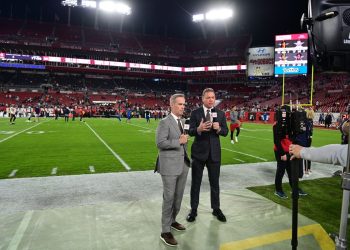
NBC’s Christmas evening broadcast of the Philadelphia Eagles and Dallas Cowboys game registered 23.2 million viewers, higher than any game of the NBA Finals since 1998 and any game of the World Series since 2004.
I haven’t found the numbers for the Lakers/Heat game on ABC yet, but Cowboys/Eagles likely more than doubled them (last year’s Lakers/Heat game got 8 million viewers). The NFL is having one of its best seasons, ratings wise, with growth on every single network. The Cowboys and New York Giants have been the main catalysts for this growth.
- ESPN scored the largest audience in cable history with its Monday Night Football presentation of Cowboys/Giants on November 12.
- FOX drew the largest ratings for any NFL regular season game in nearly a decade with its presentation of Cowboys/Giants on November 3.
- NBC’s top two broadcasts this season: Cowboys/Eagles on December 25, and Colts/Giants on September 10.
- Nine of the thirteen times FOX went on the road for its NFL pregame show, the game featured involved Dallas or New York.
If by some miracle New York (the largest TV market) and Dallas (7th largest TV market) both make the playoffs, look for this year to have the highest playoff ratings in well over a decade. It should be pointed out that the Chicago Bears (3rd largest TV market) have helped drive ratings up as well; having dominant teams in large markets like New York, Chicago and Dallas is helping the NFL create more separation between itself and the rest of the sports world.
How can the NBA, MLB and NHL catch up? It’ll be easier for baseball; the New York teams, the Yankees and Mets, are both doing well. The Boston Red Sox contend each year, the Los Angeles Dodgers should have an easy time making the playoffs in a weak NL West, and the Chicago White Sox are one year removed from winning the World Series. The problem is, if the St. Louis Cardinals and Detroit Tigers play each other, ratings plummet.
Things are harder for the NBA. The Los Angeles Lakers and Chicago Bulls are decent, but aren’t championship contenders. The New York Knicks, Philadelphia 76ers, Boston Celtics and Los Angeles Clippers are all having miserable seasons. If Chicago and the Lakers somehow break through and make the Finals (an unlikely scenario), ratings could rise back into the double digits, as they did for the Lakers/Pistons Final in 2004.
For the NHL, catching up is impossible. Doing well is also a far off goal; the L.A. Kings haven’t been noteworthy since Gretzky left, and the New York Rangers’ only playoff appearance this decade happened last season — and they were swept. The Chicago Blackhawks are toiling in anonymity, as are the New York Islanders. The Sabres have a very dedicated television audience in Buffalo, but Buffalo is a very small market.
Baseball, the NBA and NHL are all in trouble if their large-market teams don’t start playing well. Having stars alone won’t help if they play in small markets. Look at Dwayne Wade with the Miami Heat (17th largest TV market) and Albert Pujols with the St. Louis Cardinals (21st largest TV market). Wade only helped the NBA Finals to an 8.5 rating, and Pujols played in the lowest rated World Series of all time (10.1).
Kobe Bryant and Derek Jeter are more likely to drive the numbers up. The reason baseball and the NBA did so well in recent years was because of the success of teams like the Chicago Bulls, Los Angeles Lakers, Boston Red Sox and New York Yankees, large market teams that dominated and made the championship series nearly every season.
The Miami Heat and St. Louis Cardinals will get mediocre ratings. The Dallas Cowboys and New York Giants will get phenomenal ratings. And when ratings help determine the status of your league, parity and the ability of small market teams to succeed might actually hurt business.